
summon worlds ai art
  • Home
    • About Summon Worlds
    • AI Image Generator | Summon Worlds
    • Fantasy AI Worldbuilding
    • AI Chat Roleplay | Summon Worlds
    Epic fantasy party lineup featuring a muscular armored bear warrior, a wise old wizard in a pointed hat, a radiant winged female elf with glowing armor, and a noble white dragon humanoid – set against a surreal alien twilight landscape with jagged mountains and multiple moons, perfect for immersive AI-powered roleplay and worldbuilding.
    About Us
    Expansive floating city with futuristic towers and a colossal suspended orb, surrounded by clouds and cascading waterfalls at sunrise – AI-generated fantasy world perfect for collaborative storytelling and immersive worldbuilding.
    Fantasy AI Worldbuilding
    Mystical fairy with luminous wings and a jeweled headpiece, gazing through the twilight with a glowing green serpent coiled across her shoulder—an ethereal guide to realms where magic and danger intertwine in Summon Worlds.
    AI Art
    Futuristic biker racing across a dusty alien landscape with towering rock formations, scattered meteors, and a massive ringed planet looming overhead, an adrenaline-charged moment in an AI-generated world perfect for sci-fi storytelling and off-world adventure campaigns.
    AI Chat Roleplay
  • Worlds
    • Create a World with AI | Summon Worlds
    • Summon Worlds For Dungeon Masters
    • Summon Worlds For Writers
    create an ai art world

    Create a World

    Design stunning worlds with the help of AI

    dnd masters

    For Dungeon Masters

    Transform your D&D campaign preparation

    ai art storytelling

    For Writers

    Create immersive fantasy worlds through interactive roleplay

  • Resources
    • Blog
    • Summon Worlds Community Updates
  • Plans
    • Pricing Plans for Worldbuilders and Storytellers
  • Guidebook
    • Guidebook
Join Us!
summon worlds ai art
  • Home
    • About Summon Worlds
    • AI Image Generator | Summon Worlds
    • Fantasy AI Worldbuilding
    • AI Chat Roleplay | Summon Worlds
    Epic fantasy party lineup featuring a muscular armored bear warrior, a wise old wizard in a pointed hat, a radiant winged female elf with glowing armor, and a noble white dragon humanoid – set against a surreal alien twilight landscape with jagged mountains and multiple moons, perfect for immersive AI-powered roleplay and worldbuilding.
    About Us
    Expansive floating city with futuristic towers and a colossal suspended orb, surrounded by clouds and cascading waterfalls at sunrise – AI-generated fantasy world perfect for collaborative storytelling and immersive worldbuilding.
    Fantasy AI Worldbuilding
    Mystical fairy with luminous wings and a jeweled headpiece, gazing through the twilight with a glowing green serpent coiled across her shoulder—an ethereal guide to realms where magic and danger intertwine in Summon Worlds.
    AI Art
    Futuristic biker racing across a dusty alien landscape with towering rock formations, scattered meteors, and a massive ringed planet looming overhead, an adrenaline-charged moment in an AI-generated world perfect for sci-fi storytelling and off-world adventure campaigns.
    AI Chat Roleplay
  • Worlds
    • Create a World with AI | Summon Worlds
    • Summon Worlds For Dungeon Masters
    • Summon Worlds For Writers
    create an ai art world

    Create a World

    Design stunning worlds with the help of AI

    dnd masters

    For Dungeon Masters

    Transform your D&D campaign preparation

    ai art storytelling

    For Writers

    Create immersive fantasy worlds through interactive roleplay

  • Resources
    • Blog
    • Summon Worlds Community Updates
  • Plans
    • Pricing Plans for Worldbuilders and Storytellers
  • Guidebook
    • Guidebook
Join Us!
  • Home
    • About Summon Worlds
    • AI Image Generator | Summon Worlds
    • Fantasy AI Worldbuilding
    • AI Chat Roleplay | Summon Worlds
    Epic fantasy party lineup featuring a muscular armored bear warrior, a wise old wizard in a pointed hat, a radiant winged female elf with glowing armor, and a noble white dragon humanoid – set against a surreal alien twilight landscape with jagged mountains and multiple moons, perfect for immersive AI-powered roleplay and worldbuilding.
    About Us
    Expansive floating city with futuristic towers and a colossal suspended orb, surrounded by clouds and cascading waterfalls at sunrise – AI-generated fantasy world perfect for collaborative storytelling and immersive worldbuilding.
    Fantasy AI Worldbuilding
    Mystical fairy with luminous wings and a jeweled headpiece, gazing through the twilight with a glowing green serpent coiled across her shoulder—an ethereal guide to realms where magic and danger intertwine in Summon Worlds.
    AI Art
    Futuristic biker racing across a dusty alien landscape with towering rock formations, scattered meteors, and a massive ringed planet looming overhead, an adrenaline-charged moment in an AI-generated world perfect for sci-fi storytelling and off-world adventure campaigns.
    AI Chat Roleplay
  • Worlds
    • Create a World with AI | Summon Worlds
    • Summon Worlds For Dungeon Masters
    • Summon Worlds For Writers
    create an ai art world

    Create a World

    Design stunning worlds with the help of AI

    dnd masters

    For Dungeon Masters

    Transform your D&D campaign preparation

    ai art storytelling

    For Writers

    Create immersive fantasy worlds through interactive roleplay

  • Resources
    • Blog
    • Summon Worlds Community Updates
  • Plans
    • Pricing Plans for Worldbuilders and Storytellers
  • Guidebook
    • Guidebook
ai art generator
ai art generator
  • Home
    • About Summon Worlds
    • AI Image Generator | Summon Worlds
    • Fantasy AI Worldbuilding
    • AI Chat Roleplay | Summon Worlds
    Epic fantasy party lineup featuring a muscular armored bear warrior, a wise old wizard in a pointed hat, a radiant winged female elf with glowing armor, and a noble white dragon humanoid – set against a surreal alien twilight landscape with jagged mountains and multiple moons, perfect for immersive AI-powered roleplay and worldbuilding.
    About Us
    Expansive floating city with futuristic towers and a colossal suspended orb, surrounded by clouds and cascading waterfalls at sunrise – AI-generated fantasy world perfect for collaborative storytelling and immersive worldbuilding.
    Fantasy AI Worldbuilding
    Mystical fairy with luminous wings and a jeweled headpiece, gazing through the twilight with a glowing green serpent coiled across her shoulder—an ethereal guide to realms where magic and danger intertwine in Summon Worlds.
    AI Art
    Futuristic biker racing across a dusty alien landscape with towering rock formations, scattered meteors, and a massive ringed planet looming overhead, an adrenaline-charged moment in an AI-generated world perfect for sci-fi storytelling and off-world adventure campaigns.
    AI Chat Roleplay
  • Worlds
    • Create a World with AI | Summon Worlds
    • Summon Worlds For Dungeon Masters
    • Summon Worlds For Writers
    create an ai art world

    Create a World

    Design stunning worlds with the help of AI

    dnd masters

    For Dungeon Masters

    Transform your D&D campaign preparation

    ai art storytelling

    For Writers

    Create immersive fantasy worlds through interactive roleplay

  • Resources
    • Blog
    • Summon Worlds Community Updates
  • Plans
    • Pricing Plans for Worldbuilders and Storytellers
  • Guidebook
    • Guidebook

Tag: dnd

Featured Image
December 22, 2025
by Andrea ChavezBlog

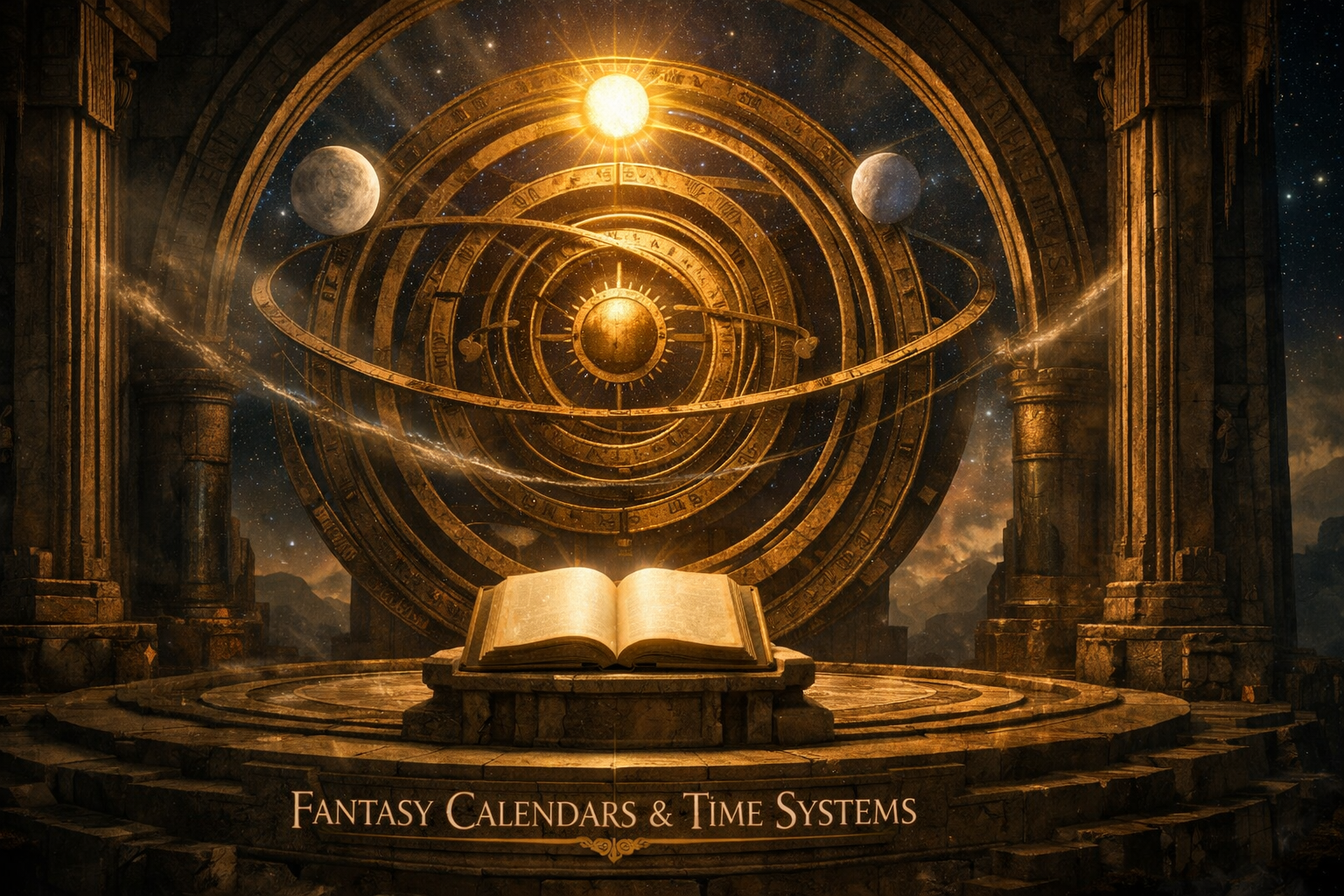
How to Design Fantasy Calendars and Time Systems for Your Storyworlds

How to Design Fantasy Calendars and Time Systems for Your Storyworlds

👉 Learn how writers create fantasy calendars and time systems that shape culture, history, and narrative flow, and how timekeeping strengthens immersion and consistency.

  • December 22, 2025
  • Andrea Chavez

It is time, one of the most significant and neglected aspects of fantasy worldbuilding. With space being defined by maps and identity by cultures, the calendar defines rhythm. The time system is well structured that influences rituals, seasons, conflicts, traveling, politics, and even magic. The world becomes alive when time is meant, or intended.

This article discusses how authors and worldbuilders may create realistic fantasy calendars and time systems that facilitate storytelling, instead of making it more complex. Be it a fresh setting or a tabletop campaign, the time is structured so that it puts your world into perspective and internal coherence.

Table of Contents

Why Time Systems Matter in Fantasy Worlds

In actual life, time dictates action. Planting of crops is done at a certain time of the year. Religious holidays take place on predetermined dates. Wars pause for winter. Trade depends on cycles. Similar limitations should be reflected in fantasy worlds.

An effective time system assists writers in responding to respond to real life questions. How long does a journey take? How old is a character? What is the rate at which magic regenerates? At what times do the heavenly happenings take place? These questions have no clear calendar and therefore tend to give inconsistencies.

Narrative pressure is also produced by time systems. Counting days makes deadlines real. When weighed, long winters are oppressive. Divine dates are heavier when the reader realizes they are divinely rare.

Try Summon Worlds for free.

"Download on the App Store"


"GET IT ON Google Play"

Start With the Natural Cycles of Your World

Any calendar starts with astronomy. Study the physical make-up of your world, then name days or months.

Ask whether there is one sun in your world or many. Think about the number of moons and how they are affecting the tides, magic, or rituals. Choose the duration of a day and seasons in a regular or erratic way.

In case your world is tilted to the extreme, either winter or summer may last forever. In case eclipses are repeated, they may influence religion or prophecy. Time systems are perceived to be rooted when they occur naturally due to planetary occurrences.

Define the Length of a Year

Create Months With Cultural Meaning

Months give time to make history. Rather than calling months by numbers, which will be meaningless, assign some meaning.

A month can be named after a harvest, a god, a historical event, or a heavenly appearance. A war that had been over in a month may be renamed permanently. A month can be spared for weddings or coronations that are cursed.

Such names make the reader perceive the time lapse as he/she hears of the world, its past. They also construct natural hooks of stories without expository additions.

Design Weeks and Days With Purpose

Weeks do not have to be seven days. Certain cultures can be lunar cycles. The rest patterns and work patterns may be divided by others.

Make decisions concerning the organization of days. Are there formal rest days? Are the markets cyclical in nature? Are there only some days when courts meet? This information is a part of everyday life and gives societies a sense of order.

Day naming after deities, virtues, or the stars strengthens culture. Justice is another word with a different color compared to conquest.

Account for Festivals, Holy Days, and Irregular Events

Calendars are easy to remember when a disruption is added. Festivals, solstices, eclipses, and intercalary days are disruptions of the normal, and they form history.

Other cultures correct their calendar and add additional days. These days could be dreaded, feasted, or magic days. Others could be robbed of days in heavenly circumstances or godly intervention.

The irregular time events are particularly helpful in telling stories. The prophecy that is triggered every half century is even more tension-filled when the calendar brings out the rarity.

Consider How Different Cultures Track Time

All cultures in your world do not need to use the same calendar. Empires can use formal systems, whereas the countryside can use seasonal time. Religious groups will keep time in a different way than Mercury or scholars.

Indispensable calendars may lead to political tension, business wrangles or misinterpretations. What is a celebration day in one society will be mourning in another.

In a case of several systems, select one dominant reference to the reader but mention the rest in the discussion or legend.

Link Time to Magic and Technology

Fantasy worlds tend to have time being a direct influence on magic. The regeneration of spells, ley line cycles, portals, and rituals can be based on certain dates or astronomical alignments.

Timekeeping can also be constructed by technology. Mechanical clocks will emerge only in developed societies. Others may have to use sundials, star charts, or sacred chants.

These relations strengthen inner logic. When power is in time, it no longer remains in the background of the world but is a part of its rules.

Keep the System Understandable for the Audience

Lore may be complicated with complex calendars, but it should be understandable. The reader is not supposed to follow the story with the help of a chart.

Use familiar anchors. It is better to use seasons, festivals, or lengths than exact dates. Present calendar information slowly but not elaborately.

When your behind-the-scenes system is a complex one, make what is on the page look simpler. Invisible detail is more important than visible detail.

Use Time to Shape History and Memory

Calendars preserve memory. They document wars, reigns, disasters, and miracles. The history of a society tells us what a society cherishes.

There are cultures that count the years since the establishment of a city. Others measure time with an event of god or a calamity. These decisions are disclosures of belief and worldview.

Culture-wise and knowledge of history, when characters mention dates, we know that these characters have the same perspective. Time is made a trifle narration instrument.

Authors with a need to arrange timelines, historic periods, and systems of the world that could interact would frequently resort to such websites as Summon Worlds to ensure time, folklore, and narrative structure are consistent.

Conclusion

The creation of a fantasy calendar does not entail the creation of names or numbers. It is about creating rhythm. Behavior, belief, conflict, and consequence are all products of time. A good time system is developed as a result of the natural regulations of the world, and it is a mirror of the culture of its people. When in good taste, it enhances immersion without making itself noticeable.

When writers treat time as a structural component but not a decoration, it gives their storyworlds the beat that the reader can feel, although they may never be told about it directly.

If you want to know more about the way a time system operates within a living environment, you can find a well-developed storyworld page as a helpful context and source of inspiration. Explore more!

Readers interested in honing the structure of aspects of their worlds, such as calendars, naming systems, and continuity, can also find the reading of How to Build Fictional Worlds That Drive Your Plot

Institutions are indicative of what a culture values. Ideology is likely to be maintained in their names. A society in which or

Start building your World!

"Download on the App Store"

"GET IT ON Google Play"

Disclaimer: Summon Worlds and the content on summonworlds.com are not affiliated with, endorsed by, or sponsored by Wizards of the Coast LLC. Dungeons & Dragons, D&D, and related terms are registered trademarks of Wizards of the Coast. Any references to D&D game mechanics, settings, or terminology are made for educational, commentary, and fan content purposes only. This blog does not reproduce or distribute official D&D content. All original ideas, characters, and creative content in this post are the intellectual property of OpenForge LLC, the parent company of Summon Worlds.
Previous
Share the Post:

Recent Posts

How to Design Fantasy Calendars and Time Systems for Your Storyworlds

Read More
December 22, 2025

Fantasy Names That Tell a Story: How to Use Naming to Build Cultures

Read More
December 17, 2025

FAQ

1. Do fantasy worlds need Earth-like years and months?

No, fantasy calendars can use different year lengths, seasons, or divisions, as long as the system remains consistent throughout the story.

2. How can months and seasons add storytelling depth?

Naming months after gods, harvests, or historic events embeds culture and history directly into the passage of time without exposition.

3. Should different cultures in a fantasy world use different calendars?

Yes, multiple timekeeping systems can reflect political, religious, or cultural differences and naturally create tension or misunderstanding.

4. How can time systems be connected to magic or technology?

Magic cycles, spell regeneration, rituals, and even timekeeping tools can be tied to astronomical or seasonal events to strengthen internal logic.

5. How do you keep complex fantasy calendars understandable for readers?

Use familiar anchors like seasons and festivals on the page while keeping detailed calculations mostly behind the scenes.

6. How can calendars shape history and cultural memory in fantasy worlds?

Calendars preserve what societies value by marking wars, reigns, disasters, or divine events as reference points for measuring time.
Read More
Featured Image
December 17, 2025
by Andrea ChavezBlog

Fantasy Names That Tell a Story: How to Use Naming to Build Cultures

Fantasy Names That Tell a Story: How to Use Naming to Build Cultures

👉 Learn how fantasy writers use naming systems to reflect culture, history, and social structure, and how meaningful names strengthen worldbuilding and narrative cohesion.

  • December 17, 2025
  • Andrea Chavez

One of the very first signals that comes to a reader when entering the world of fantasy is the names. There is already a name that implies belonging, belief, power, and memory before history is told or landscapes are uncovered. Names in popular fantasy worlds are never found alone. They are cultural records that are written in language.

This article covers the use of naming systems to develop authentic cultures by writers. Instead of writing names off as superficial ornamentation, it demonstrates how they can convey social structure, history, and worldview through a coherent linguistic design.

Table of Contents

Why Names Carry Cultural Meaning

In the actual society, names ensure continuity of identity between generations. They depict ancestry, geography, occupation, religion, and significant events in history. The same applies to fantasy cultures. Whenever names are produced through collective rules, they are an indication of unity and genuineness.

The name of a character can relate back to a place or can denote a family position. A geographical name may give a clue to climate, resources, or war. The structure of power may be exposed through a ceremonial title. These cues are silent, and this enables the readers to internalize the cultural context without being told about it.

When the patterns of names are repeated in a given setting, the readers start perceiving the cultural boundaries subconsciously. This appreciation creates confidence in the world.

Try Summon Worlds for free.

"Download on the App Store"


"GET IT ON Google Play"

Sound as Cultural Identity

Each culture contains its sound. Other languages are fluid and melodic and are influenced by open vowels and long syllables. Others are heavy and abrupt and propelled by consonant clusters and compressed rhythm. Such sound decisions have effects on the emotional state of a culture.

Provide the phonetic character of each culture before coming up with names. Choose which sounds are predominant in speech and which ones are evaded. Identify a preference for short and practical names or formal and complicated ones.

Consistency is important once these sound rules are put in place. Whenever people read a name, they need to feel the place of the name in the world. Sound is a cultural signifier way before meaning is disclosed.

Meaning Hidden Inside Language

Names are given a sense when they have a meaning that is not seen on the surface. This connotation does not have to be spelled out in a straightforward way. And the weight and coherence is added as well through its presence.

The meaning can be fabricated through the invention of linguistic roots, which are linked to cultural values. A culture formed by rock, metal, or hardship can reiterate hard or down-to-earth sounds. The culture associated with water or wind can prefer building softer and flowing structures. An intellectual civilization can be based on more formal and extended structures, implying tradition and hierarchy.

Such roots may be personal names, names of places, and institutional names. It is through repetition that language transforms into a history and a faith over a period of time.

Personal Names and Social Structure

The naming systems of the people are usually a mirror of the identity in a society. There are those cultures that focus on family heritage, where the old names become central to one person. Some of them appreciate personal success, and they can change their names after significant life occurrences.

Consider how names are given. Do they come by birth or are they acquired in later years? Are names changeable according to age, rank, or achievement? Are there prophetic and professional names?

And titles and honorifics indicate order. Formal address culture strengthens organization and power. Minimalist culture can esteem equality or rebellion. These differences influence the dialogue and interaction between characters.

The informal names and nicknames also count. They disclose intimacy, power, and emotional intimacy. A narration-free depiction of social layers is done through one personality treated differently by family, peers, and rulers.

Place Names as Cultural Memory

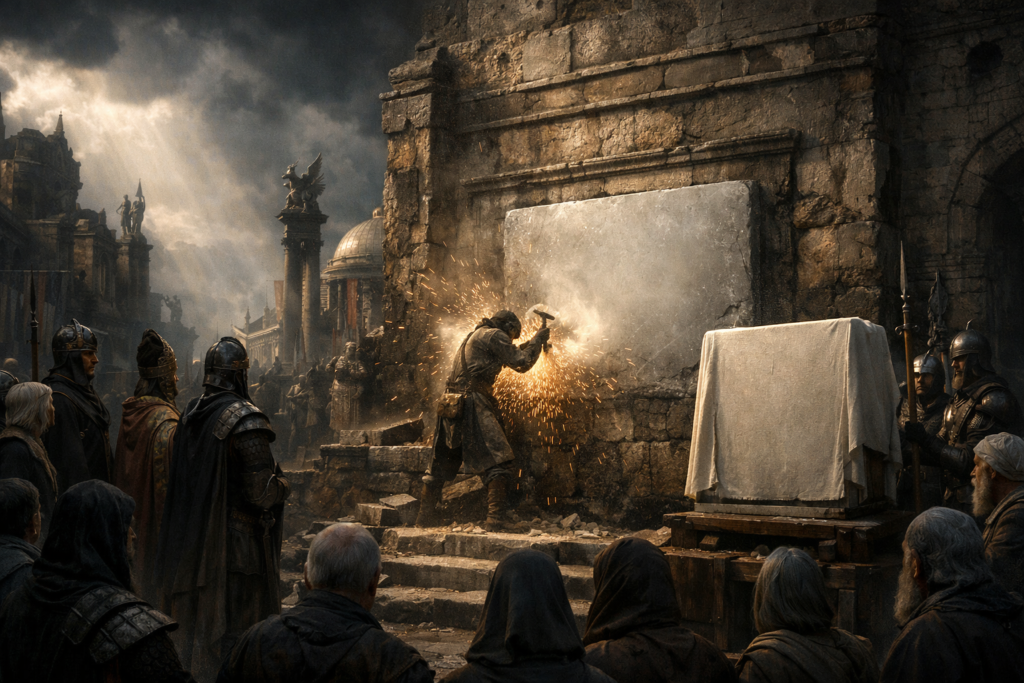
Environmental and historical memory is often maintained in place names. The name of a city based on a river implies survival and trade. There is a settlement whose name is a reminder of a dead chief. A fortress that was coined by the conquerors embodies superiority and not geography.

In naming places, the question is who named it. Linguistic fingerprints are left behind by settlers, priests, merchants, and invaders. With time, names can change with the changing culture or simplification of languages.

When the same place has several names, then it is a sign of a stratified history. An old ritual name can have a contemporary abbreviation. They both make sense culturally.

Institutions, Titles, and Collective Values

Institutions are indicative of what a culture values. Ideology is likely to be maintained in their names. A society in which order is cherished may give councils the official title. One of them, who formed in a conflict, might prefer symbolic or violent language.

Titles express the way power works. A high rank culture attributes importance to hierarchy. One who holds few titles might have to depend on reputation or agreement. Many of the titles are based on political philosophy.

Meaningful naming is also good in artifacts and traditions. Mythical, ritual, or functional associations of names make objects feel part of the culture, rather than created to be easy and convenient.

Language Change and Cultural Evolution

Cultures evolve, and the naming systems must reflect the same. Language changes by way of dispersion, commerce, conquest, and time. Older names can be more cumbersome or more complicated. Newer names can be simplified, or foreign languages can have an impact on them.

Contacts with history may be indicated by borrowed words. Distorted pronunciations may indicate a local dialect. These developments are realistically added without being explained.

It is the possibility of names changing generations that gives an impression of a lived history.

Avoiding Common Naming Mistakes

Naming undermines culture where it is not internally logical. Unstructured random combinations of sounds are not natural. Lack of uniformity in naming in the same culture interferes with immersion.

Connection can also be inhibited by names that are too complicated. What happens if the readers find it hard to recall the names or pronounce them? They are not emotionally engaged. Clarity should not be limited by distinctiveness.

Strong naming is creative and restraining.

Consistency Through Documentation

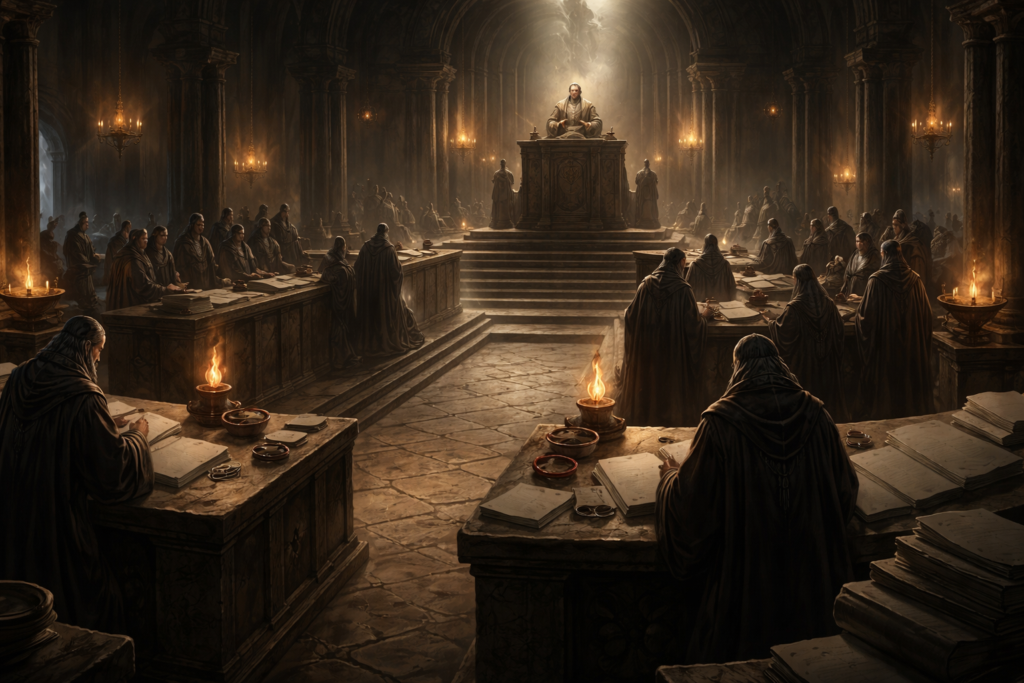
Documentation makes it easier to have consistent naming systems. Authors tend to catalogue the naming rules and sound rules, and lists of examples. This makes sure that new names are in line with existing logic.

Collaboration also has documentation. There is a possibility of drift when sharing rules between creators of the same world.

Uniformity is not consistency. Rules that are varied bring variety.

Naming as Narrative Signal

The names can be the silent prefigurations of change, conflict, or fate. A name related to fire or loss can be a repeat of what is going to happen in the future. A prematurely granted title can be seen as an indication of instability.

When applied in an unobtrusive manner, naming turns into narrative texture and not symbolism. The reader feels that he/she is important without being told.

Conclusion

Fantasy names accomplish much more than naming characters and places. They maintain culture, history, belief, and power within the language itself. In the case of naming according to cultural logic, worlds become inhabited, unlike built worlds.

Writers who want to organize naming systems alongside cultures, timelines, and lore often rely on platforms like Summon Worlds to keep language and world structure aligned.

For those interested in seeing how naming operates inside a complete fictional setting, examining a detailed storyworld page for writers can provide a valuable perspective. Explore more!

Writers seeking deeper insight into continuity, language systems, and cultural cohesion may also benefit from readingour blog on  How to Generate Fictional Languages with AI  that focuses on maintaining consistency across expansive fantasy worlds.

When names tell stories, cultures come alive before the plot even begins.

Start building your World!

"Download on the App Store"

"GET IT ON Google Play"

Disclaimer: Summon Worlds and the content on summonworlds.com are not affiliated with, endorsed by, or sponsored by Wizards of the Coast LLC. Dungeons & Dragons, D&D, and related terms are registered trademarks of Wizards of the Coast. Any references to D&D game mechanics, settings, or terminology are made for educational, commentary, and fan content purposes only. This blog does not reproduce or distribute official D&D content. All original ideas, characters, and creative content in this post are the intellectual property of OpenForge LLC, the parent company of Summon Worlds.
Previous
Next
Share the Post:

Recent Posts

How to Design Fantasy Calendars and Time Systems for Your Storyworlds

Read More
December 22, 2025

Fantasy Names That Tell a Story: How to Use Naming to Build Cultures

Read More
December 17, 2025

FAQ

1. How do naming conventions help build believable fantasy cultures?

Consistent rules for sound, structure, and meaning allow readers to subconsciously recognize cultural boundaries and shared identity.

2. Should fantasy names have meanings, even if readers never learn them?

Yes, hidden meanings create internal coherence, making languages and cultures feel lived-in even without explicit explanation.

3. What do personal naming systems reveal about social structure?

Whether names are inherited, earned, or changeable reflects how a society values lineage, achievement, hierarchy, or equality.

4. How can place names convey history and conflict in fantasy worlds?

Place names preserve memory of geography, conquest, rulers, and cultural shifts, often revealing layered or contested histories.

5. What are the most common mistakes writers make when creating fantasy names?

Inconsistent rules, overly complex spellings, and random sound combinations break immersion and weaken cultural authenticity.
Read More
Featured Image
December 14, 2025
by Andrea ChavezBlog

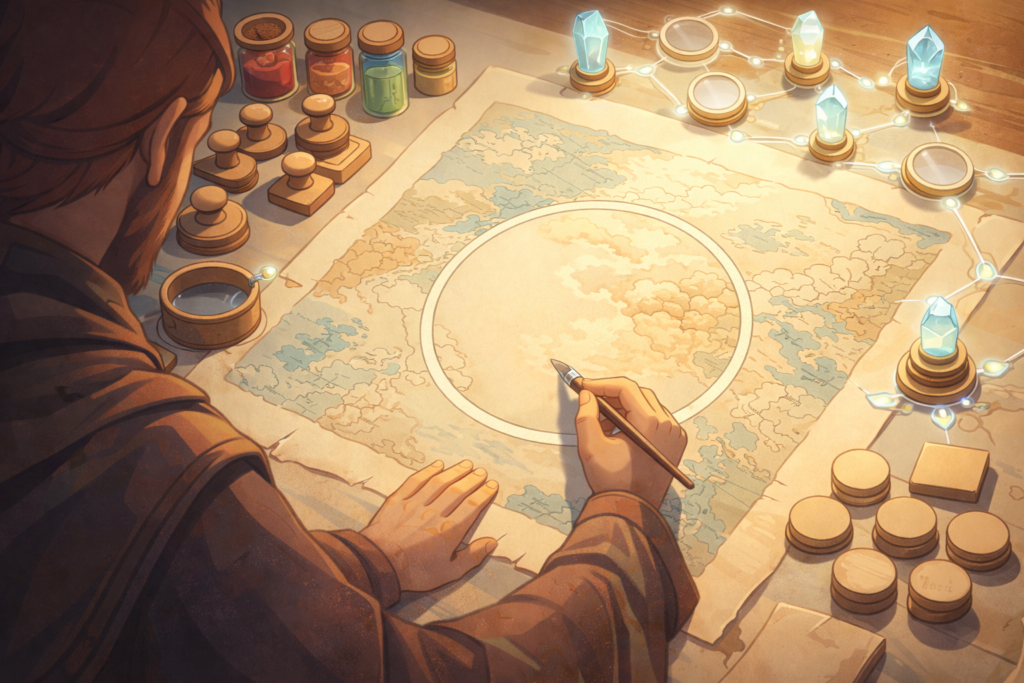
The Cartographer’s Secret Weapon: AI Tools for Fantasy Map Design in 2026

The Cartographer’s Secret Weapon: AI Tools for Fantasy Map Design in 2026

👉 Learn how AI is transforming fantasy cartography in 2026. Explore tools that help writers, gamers, and creators build realistic, dynamic, and story-driven maps.

  • December 14, 2025
  • Andrea Chavez

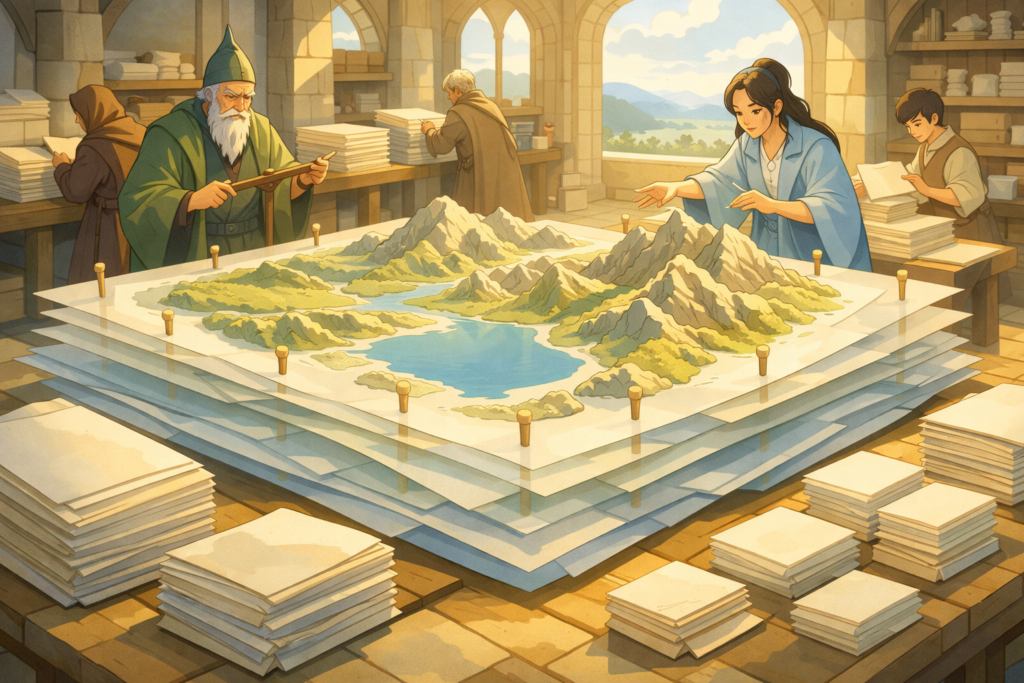
Maps have been a key feature of fantasy narratives. They mark boundaries, carve out paths, affect politics, and ground imagination in something real. For centuries, fantasy cartography used to be based on drawings made by hand and painful revisions. In 2026, that process has changed. Artificial intelligence has emerged as one of the most effective instruments that can be used by the current fantasy cartographers.

AI tools have ceased being fads. They are now creative collaborators who assist writers, game designers, and worldbuilders with visualizing complex worlds more quickly and keeping internal logic. This article examines the use of AI tools to design fantasy maps in 2026 and how writers can use them in a responsible manner to create a more detailed storyworld.

Table of Contents

Why Maps Still Matter in Fantasy Worldbuilding

A map does not just indicate where to be. It defines the functioning of the world. Climate is determined by geography. Climate influences culture. Trade, war, religion and migration are influenced by culture. In the absence of a map, such relationships tend to be loose or incoherent.

Spatial logic is anticipated by fantasy readers and players. Travel time must make sense. Boundaries ought to be in accordance with topography. Politics should be affected by natural obstacles. A good map silently provides credibility in a narrative even where it is not on the page.

AI tools allow creators to preserve this logic without creativity or control loss.

Try Summon Worlds for free.

"Download on the App Store"


"GET IT ON Google Play"

How AI Changed Fantasy Cartography

Non-practical digital map tools were concerned with aesthetics. They gave pleasing results to the eyes, but had to be checked manually. AI technologies in 2026 are different. They understand patterns.

The contemporary systems examine the flow of the terrain, the behavior of rivers, the gradients of the elevation, and the climate distribution. River paths react to the appearance of a mountain range. Natural harbors are naturally created when coastlines are formed. This helps to avoid the general mapping errors that disrupt immersion.

AI is no longer used to replace the cartographer but to aid decision-making. It opens up possibilities and leaves narrative intent in the hands of humans.

From Blank Page to Living Geography

The problem of starting is one of the biggest problems of map design. AI will eliminate that barrier by creating foundational geography out of high-level input.

Artists can determine the world size, climate bias, tectonic activity, or magic. The system then forms the landmasses, seas, and topographical formations, respectively, which follow the above parameters. 

The process does not hold the creator down to an outcome. It does not give a final copy; it gives a working draft that can be improved, redefined, or discarded. The value lies in momentum. Space is becoming the world between idea and image in a very brief time, which enables the writers to think spatially at an earlier stage of development.

AI Assisted Terrain Logic

By 2026, AI map tools would perceive geography as a system and not as an image. Water flow is influenced by the height. There is an influence of temperature on vegetation. Settlement density is influenced by distance.

It implies that designers do not need to be hand-compiled to work out all the river origins and mountain passes. AI takes care of the physics, and the creator takes care of the story.

In settings of fantasy that are influenced by magic, AI tools provide the possibility of purposeful breaking of rules. Natural logic can be defied in controlled ways by floating continents, corrupted zones, or enchanted forests. The system is flexible and does not oppose creative intervention.

Cultural Mapping and Political Boundaries

Contemporary AI systems do not just make terrain. They assist in picturing human and non-human presence.

The placement of settlements is now based on the availability of water, defensibility, trade routes, and climate. Natural barriers are addressed by political boundaries. The road networks are developed naturally along the population centers.

This is useful in enabling creators to create realistic civilizations. A capital that is located on a river delta or crossroad will feel justified. In case there are mountains or deserts as the boundaries, war is logical.

Authors wishing to bring together geography with culture, history, and ties between factions frequently resort to websites such as Summon Worlds as a way of maintaining maps tied to narrative systems and not kept as disconnected images.

Iterative Design Without Starting Over

The old map design was prohibitive to revising. Even one change would involve the redrawing of whole regions. In 2026, AI tools consider maps as life forms.

Designers are also able to tweak variables without having to re-write it. Climate change has an impact on vegetation. The rise of the sea level reinvents shorelines. The changing political authority parallels the drawing of boundaries but does not change the landscape.

This flexibility promotes experimentation. The worlds are naturally developing rather than frozen in the early stages of the struggle because of the lack of energy.

Style Control and Aesthetic Consistency

Visual sameness has always been taken as one of the issues with AI-generated maps. By 2026, it have become far better in terms of style control.

Artists can establish the tone of art. Parchment of the old, parchment of the new, hand-inked fantasy, schematic with bare minimum, or painterly. AI is used to make changes to the outputs to fit the selected style without changing structural logic.

This enables maps to fit book covers, game interfaces, or game tone. Congruency enhances immersion through media. 

Maps as Narrative Tools

AI maps are no longer reference images. They are storytelling tools.

Dynamic layers can enable creators to trace back in history, land expansion, magically corrupted, or destroyed by the environment. It is possible to present various timelines on the same world map and not confuse them.

This will be of particular use in long storytelling. Maps also change as empires come and go. The spatial memory is experienced by the readers and players, which makes the world seem persistent.

To the user who is curious about geography operating within a completely developed environment, seeing a descriptive storyworld page may be informative regarding the way maps engage with narrative systems.

Ethical Use and Creative Responsibility

The AI tools present significant creative questions. They may give generic results when applied unintentionally. When applied sensibly, they enhance novelty.

The key is authorship. Artificial intelligence must not substitute vision. The narrative themes, cultural bias, and emotional tone are present in the most interesting fantasy maps, which are characterized by their creator.

Producers who do not use AI as a shortcut but as a partner end up making worlds that are personal as opposed to procedural.

Learning Curve and Accessibility

The accessibility of AI map tools has increased in 2026. Interfaces are intuitive. There is no longer a barrier in terms of technical knowledge.

This has made cartography democratic. Maps that were initially only produced by professional artists are now made by independent writers, small studios, and hobbyist game masters.

It is not knowing how to use the tools, but knowing how to restrain oneself. Comprehension of timing between creation and formulation is what differentiates between functional and meaningful maps.

The Future of Fantasy Cartography

There will be further development of AI tools. It will be integrated further with narrative engines, character systems, and simulation tools. In the near future, maps may react to the story events or decisions made by players.

Nevertheless, in spite of this development, there is one fact. Imagination cannot be substituted for technology. It can only give it form.

Authors who want to preserve long-term coherence between maps and lore and the changing story lines usually will find the reading of a related blog article on sustaining coherence over large fantasy worlds valuable.

List of AI Tools for Fantasy Map Generation:

The following AI tools can be used by creators and fantasy worldbuilders to generate maps and build new worlds:

  • World Machine
  • Gaea
  • Summon Worlds
  • Inkarnate
  • Wonderdraft
  • Azgaar’s Fantasy Map Generator
  • World Creator
  • Midjourney 
  • DALL·E
  • Stable Diffusion
  • Dungeon Alchemist

Conclusion

In 2026, AI has become the cartographer’s secret weapon. It accelerates creation, reinforces realism, and supports complexity without overwhelming the creator.

Fantasy map design is no longer about drawing coastlines alone. It is about building systems that support story, culture, and memory. When AI tools are used with intention, they turn maps into living frameworks rather than static illustrations.

Want to know more about utilizing world geography and power structure? Read more!


Want to create your own world? Explore more!

Start building your World!

"Download on the App Store"

"GET IT ON Google Play"

Disclaimer: Summon Worlds and the content on summonworlds.com are not affiliated with, endorsed by, or sponsored by Wizards of the Coast LLC. Dungeons & Dragons, D&D, and related terms are registered trademarks of Wizards of the Coast. Any references to D&D game mechanics, settings, or terminology are made for educational, commentary, and fan content purposes only. This blog does not reproduce or distribute official D&D content. All original ideas, characters, and creative content in this post are the intellectual property of OpenForge LLC, the parent company of Summon Worlds.
Previous
Next
Share the Post:

Recent Posts

How to Design Fantasy Calendars and Time Systems for Your Storyworlds

Read More
December 22, 2025

Fantasy Names That Tell a Story: How to Use Naming to Build Cultures

Read More
December 17, 2025

FAQ

1. Why are maps still important in fantasy worldbuilding?

Maps establish spatial logic, ensuring travel, politics, climate, and conflict feel consistent and grounded within the storyworld.

2. Can AI-generated fantasy maps still feel unique and original?

Yes, when guided by human intent, AI acts as a collaborator that supports creativity rather than replacing the creator’s vision.

3. How does AI improve geographic realism in fantasy maps?

Modern AI understands terrain systems, producing natural river paths, realistic coastlines, and believable climate distribution automatically.

4. What role do AI tools play in cultural and political mapping?

AI assists in placing settlements, borders, and trade routes based on geography, reinforcing realistic power structures and conflicts.

5. How do AI tools support iterative worldbuilding and map revisions?

Creators can adjust variables like climate, sea level, or political control without rebuilding maps from scratch, encouraging experimentation.
Read More
Featured Image
December 11, 2025
by Andrea ChavezBlog

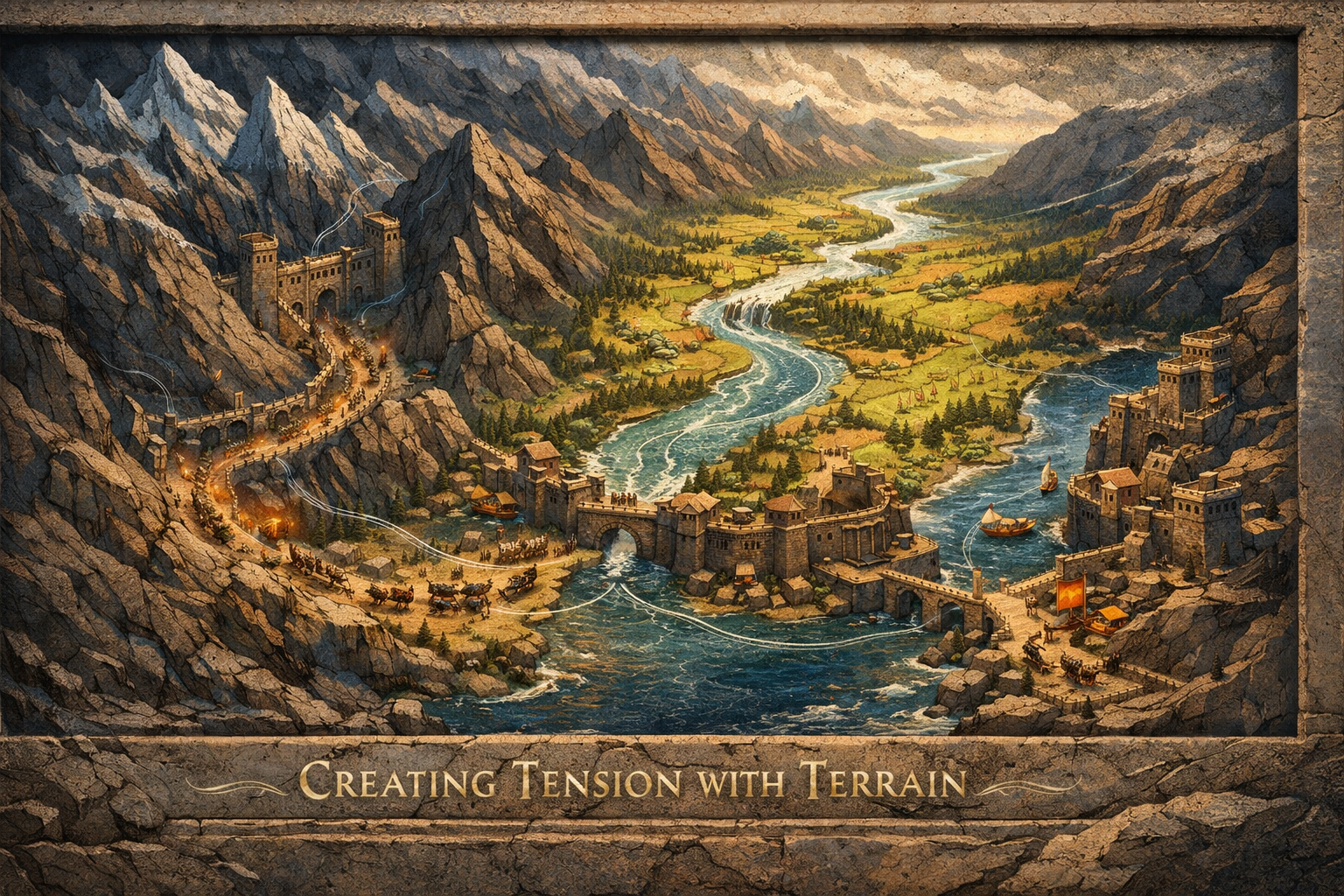
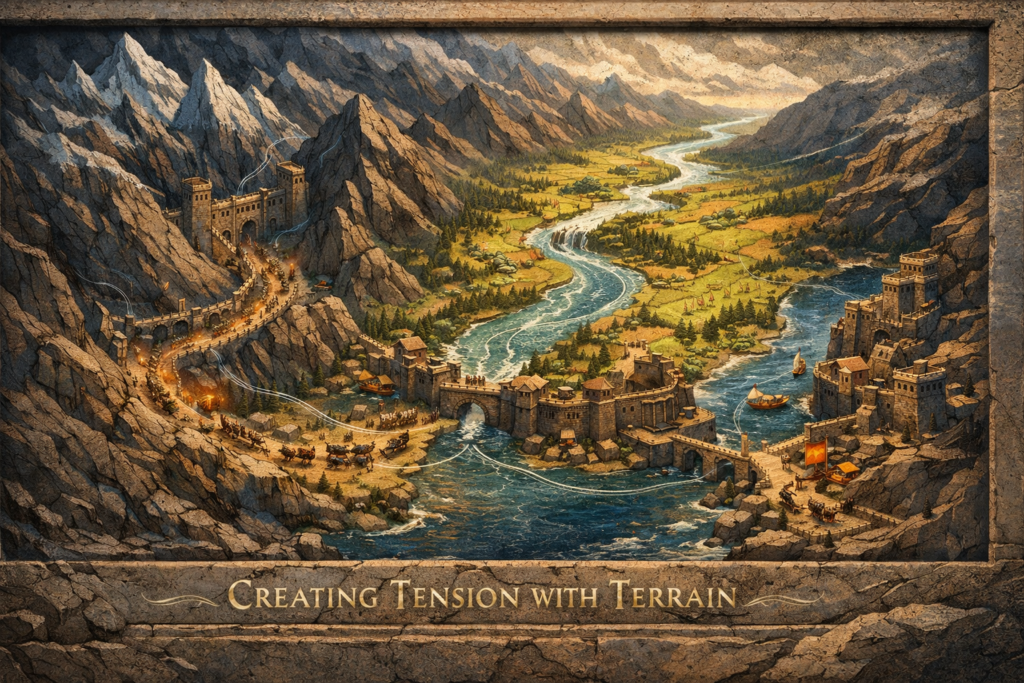
Creating Tension with Terrain: How Geography Drives Conflict in Fantasy Worlds

Creating Tension with Terrain: How Geography Drives Conflict in Fantasy Worlds

👉 Discover how story world maps of continents control power, tension, and theme. Learn smart map design that strengthens your plot. Build better worlds today.

  • December 11, 2025
  • Andrea Chavez

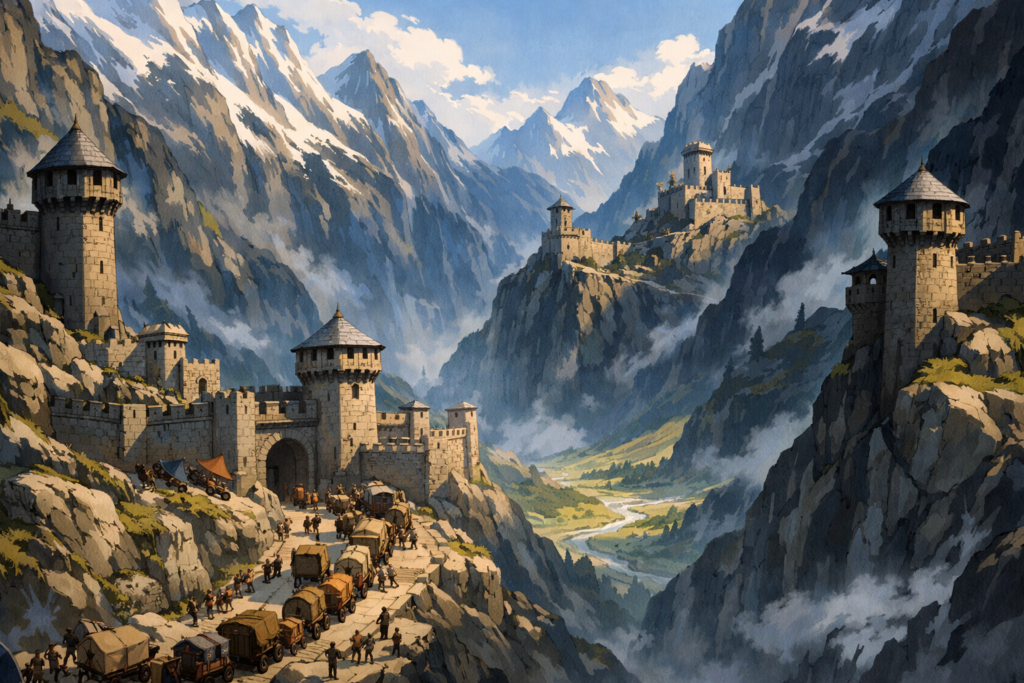
Fantasy conflict is commonly defined in terms of character, politics, or systems of magic, but one of the most perennial sources of conflict is found beneath them all. Geography defines the boundaries of power, speed of war, and the sustainability of cultures. Mountains postpone armies, rivers separate allegiance, deserts make ambition starve, and coastlines beckon invasion. Terrain is not a backdrop. It is an active power that pushes conflict ahead.

This article discusses the tension created by physical landscapes in fantasy worlds and how geography can be utilized by authors to produce realistic and satisfying conflict without the need to always have action or exposition.

Table of Contents

Why Geography Creates Natural Conflict

In any world, access is dictated by physical space. Who regulates water governs existence. Who controls the trade is the commander of the mountain passes. Those living on the other side of the natural boundaries are safe at a price.

These pressures are instinctively known to fantasy readers since they are real historical reflections. Conflicts over fertile valleys, trade routes, and defensible terrain seem to cross cultures and centuries. Whenever this logic is reflected in a fantasy world, its conflicts do not seem arbitrary.

Geography imposes restrictions. Restraints are like wearing a thorn. Friction becomes story.

Try Summon Worlds for free.

"Download on the App Store"


"GET IT ON Google Play"

Mountains as Barriers and Power Filters

Mountain ranges maximize movement, disintegrate cultures, and provide unequal access. One blow can spell out the progress or stalemate of armies. Isolated areas have different identities, dialects, and loyalties in the long run.

With a mountain-based conflict, the stress usually revolves around the possession of small areas. Fortresses, watchtowers, and pass points are exposed as strategic points of pressure. The collapse of the defense may reveal whole areas. An effective counteroffensive can change the state of affairs in a single fight.

Psychology is also a product of mountains. Those cultures that grow up in isolation embrace self-reliance. People who live along mountain borders tend to become suspicious of strangers. Political decisions are made by these traits even before the weapons are drawn.

Rivers as Lines of Division and Connection

Rivers not only separate land but also bring together faraway places. They facilitate commerce, farming, and transport, but they establish landscapes of nature that become even more concrete political identities.

River wars may be characterized by opposing interests. One state can depend on the river to irrigate its production, and another one can dominate the origin. Population displacement and strained alliances can be caused by seasonal flooding. Bridges are unifying or sabotaged.

The rivers are unpredictable since they change with time. Water boundaries seldom remain in place. This insecurity leads to tension in the long run, even during times of peace.

Deserts and Scarcity-Driven Conflict

The lack of something makes each choice more dramatic. In dry areas, domination of oases, wells, and trade routes is what survival thrives on. Travel becomes dangerous. Supply lines stretch thin. Minor benefits have tremendous weight.

Conflict in the desert tends to be based on survival and not on victory. Nomadic societies embrace the art of movement, whereas established authorities have problems holding armature power. The reason why invasions are unsuccessful is not due to the strength of the enemy but due to the consumption of resources at a higher rate than they can be supplied.

This kind of tension is noiseless. Long before the fighting takes place, hunger, thirst, and distance destroy morale.

Forests and the Threat of the Unknown

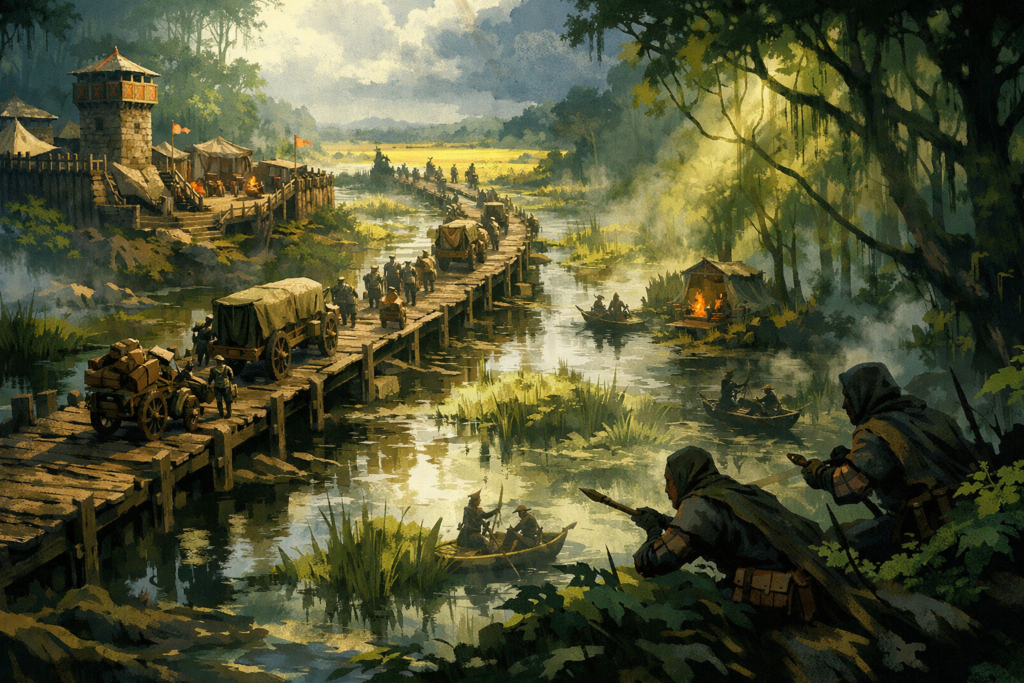
Immense forests print out the sight, stifle the creation, and those who are familiar with the earth. They protect ambush, retaliation movements, and concealed settlements.

Forest wars are usually based on asymmetry. Large armies lose advantage. Smaller groups are hit and disappear. Power falls and fades away far beyond swept roads and barricaded cities.

Even forests have a symbolic value. They are areas that are out of control, where the law dies out, and there are more ancient forces about. This doubt breeds fear and gossip, building up the tension without talking face-to-face.

Coastlines and Constant Exposure

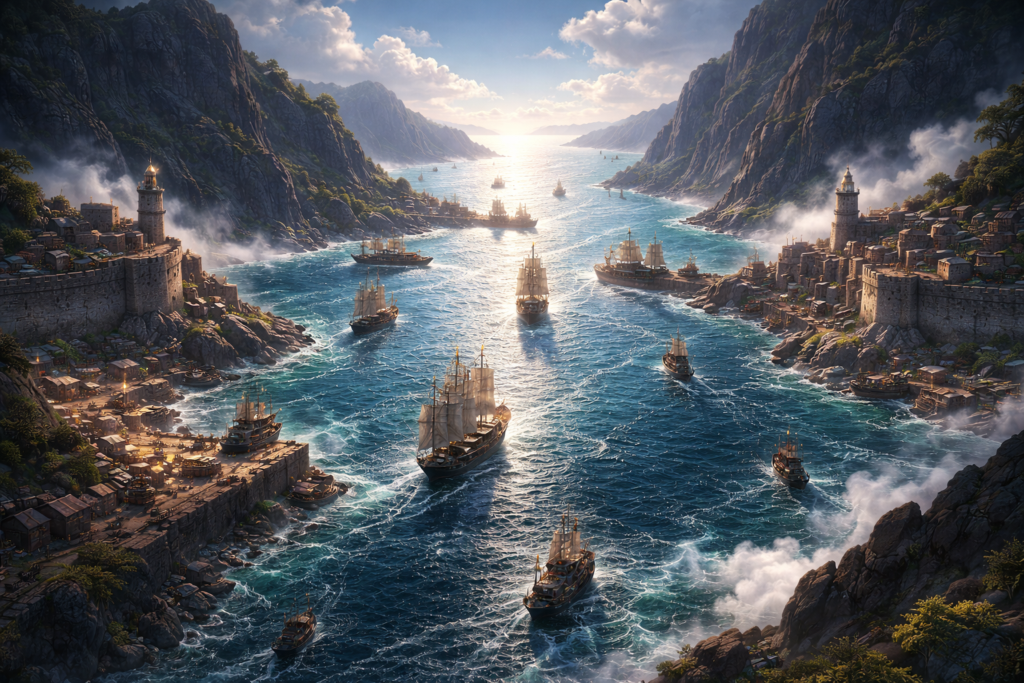
There are opportunities and threats that exist along the coastal regions. The free movement of trade exists, but there is always a threat of an invasion. Ports are equal sources of wealth and war.

Politics is transformed by the naval power. Kingdoms that have powerful fleets exert their influence much further. Individuals who lack access to the sea are reliant on trade with others.

The unpredictabilities are the storms, tides, and seasonal winds. A stalled fleet or missing convoy may destroy alliances or start a war. Even as the diplomacy attempts to decelerate the coastal conflict, geography puts it into motion.

Terrain Shaping Culture and Motivation

Geography is not just a way of tactics. It shapes the worldview. Cultures of the mountain treasure defense. The river cultures appreciate exchange. The desert cultures appreciate endurance. Adaptability is appreciated in forest cultures.

Such characteristics affect the reaction of groups to pressure. A self-defensive society is opposed to change. A society that is trade-oriented sacrifices to maintain flow. In situations where geographically opposite cultures clash, conflict is aggravated by a lack of understanding.

Authors who make cultural behavior correspond with the landscape generate tension that is perceived as natural instead of imposed.

Strategic Geography and Political Stakes

Where there are constrained choices due to geography, political choices become meaningful. A despot might be desirous of peace and be unable to relinquish a boundary gate. An alliance might appear prudent until geographical conditions render co-operation impossible.

Geography forces choice. To have one place naked is to have the other place naked. The protection of fertile soil exposes high ground. These tradeoffs create narrative tension whose effect is not necessitating villains and unexpected twists.

To authors who have to work with dense political environments, it can be convenient to store terrain alongside groups, boundaries, and resources in a systematic worldbuilding tool such as Summon Worlds, where geography exists in the plot of a narrative and not as a map on its own.

Using Terrain to Control Pacing

Terrain is a determinant of the speed at which a conflict is fought. Great distances retard growth. Thin islets increase the speed of the face-off. Time and decision-making are squeezed at natural chokepoints.

A mountain valley siege is not a naval standoff. A pursuit over open country is urgent. An expedition through the forest creates a week-long tension.

Another way that writers manipulate pacing is by using terrain without the need to change the plot.

Conflict Without Constant Violence

Part of the most powerful tension is achieved when violence has not taken place and is only potential. This pressure is maintained by geography.

A river can be the boundary of generations, but with each flood, there is the danger of war. A succession crisis in one of the mountain passes is controlled by treaties. The existence of a route of deserts that is a monopoly of one group makes it resentful even before the time of rebellion.

These slow-burning fights enhance the realism of the world and provide weight to the future events through emotions.

Geography Across Time

Landscapes change. Rivers shift. Forests retreat. Seas rise. Such rearrangements interfere with the balance of power and rekindle ancient antagonisms.

A once defensible city can be exposed. A lost pass can open up trade. Climatic changes drive migration, which generates tension between the outsiders and the natives.

Geography should be left to evolve so that conflict can be dynamic and not stagnant.

Conclusion

Terrain is one of the most reliable engines of tension in fantasy worlds. It limits ambition, shapes culture, and forces conflict to emerge naturally rather than through coincidence.

Writers who treat geography as an active force gain access to layered tension that supports character, politics, and history simultaneously.

Creators who want to align geography with long-term narrative structure often benefit from reviewing a detailed storyworld page of Summon Worlds, where terrain, borders, and cultural tension intersect within a single setting. Explore more!

Those interested in maintaining consistency between landscape-driven conflict and broader world logic may also find value in reading a related blog article focused on sustaining coherence across large fantasy settings. Read more!

When terrain drives conflict, the world itself becomes part of the story, pressing against every decision made upon it.

Start building your World!

"Download on the App Store"

"GET IT ON Google Play"

Disclaimer: Summon Worlds and the content on summonworlds.com are not affiliated with, endorsed by, or sponsored by Wizards of the Coast LLC. Dungeons & Dragons, D&D, and related terms are registered trademarks of Wizards of the Coast. Any references to D&D game mechanics, settings, or terminology are made for educational, commentary, and fan content purposes only. This blog does not reproduce or distribute official D&D content. All original ideas, characters, and creative content in this post are the intellectual property of OpenForge LLC, the parent company of Summon Worlds.
Previous
Next
Share the Post:

Recent Posts

How to Design Fantasy Calendars and Time Systems for Your Storyworlds

Read More
December 22, 2025

Fantasy Names That Tell a Story: How to Use Naming to Build Cultures

Read More
December 17, 2025
Read More
Featured Image
December 8, 2025
by Andrea ChavezBlog

Worldbuilding Winter: How to Use Seasons, Weather, and Climate in Your Story

Worldbuilding Winter: How to Use Seasons, Weather, and Climate in Your Story

👉 Learn how seasons, weather patterns, and climate influence culture, conflict, pacing, & survival in fantasy storytelling, creating consistent and believable storyworlds.

  • December 8, 2025
  • Andrea Chavez

The aspects of fantasy worlds that take up a lot of time and effort are usually magic, political intrigue, and convoluted histories, but the power of influence that is the most persistent in shaping the story and culture is often ignored. Climate governs survival, and seasons regulate behavior. Weather alters plans and changes beliefs. These elements, as active systems and not as decorative elements, shape conflict, pacing, and character development in a manner that feels natural and unavoidable.

This article considers the role of seasons, weather, and climate in storytelling in fantasy and how authors can use them to provide consistency and intentionality in the design of narratives.

Table of Contents

Climate as the Foundation of World Logic

Climate defines the ground-level parameters of existence of a society. It determines agricultural patterns, patterns of settlement, viability of trade, and population density. An arid temperate zone favors excess and growth. What it requires is a frozen territory, storage, discipline, and collective dependence. Unpredictable weather creates flexibility and extreme care.

The readers subconsciously believe these are relationships since they are representative of reality. Credibility suffers when society is seen to flourish in a harsh environment with no explanation. The world becomes coherent when the cultural behavior is congruent with environmental pressure.

There are also constraints caused by the climate. It inhibits ambition and adds consequence. There is no way characters just travel, fight, or even construct without taking into consideration the environment. These limitations bring about some realism without clarification.

Try Summon Worlds for free.

"Download on the App Store"


"GET IT ON Google Play"

Seasons as Narrative Rhythm

Natural structure to storytelling is offered by seasons. They are the creators of expectations and time-based punishment. Change is realized instead of being abstract.

Winter limits mobility, isolates people, and risks. The springtime calls to reconstruction and political restructuring. Summer allows travelling, fighting, and increasing. Autumn is about being ready, harvest, and thinking.

By placing the events in a seasonal context, the readers are able to keep count with natural time. A delayed message in winter has a different weight than one lost in summer. A late campaign is an indication of failure even before the initial battle.

The repetition of seasons also enhances memory. Patterns are identified by the readers, leaving some anticipation and tension without direct narration.

Winter as Sustained Pressure

Winter is one of the best devices of long term tension. It consumes resources, retards communication, and increases consequences. There is no certainty of survival without outside enemies.

In winter-driven narratives, conflict is usually turned inward. There is a lack of characters, dread, and moral decline. Alliances strain. Authority is undermined when protection is lost. Decisions made when under winter pressure show values better than victory could ever show.

Power dynamics also shift. Those who have resources in store are leveraged. The ones who had no face dislocation, submission, or insurrection. The issue of control becomes contingent and does not assume a priori control.

A lengthy winter does not mandate an action-packed one. It is present and has a way of altering each decision.

Weather as Immediate Narrative Force

Weather is on a smaller scale than climate or season, but its influence is immediate and personal. Storms disrupt travel. Fog conceals truth. Heat exhausts armies. The rain washes away any traces or shows the vulnerability.

Since the weather is not predictable, it brings in an element of uncertainty that does not look artificial. A lost battle because of flooding is one that was deserved. A journey postponed by contrary winds brings about reality.

Weather can only be effective by changing the result and not the mood by itself. When the characters are called upon to act instead of suffer, the weather wins narrative power.

Environmental Influence on Culture and Belief

Generations change the culture to suit the environment in adaptation. Preparation in colds turns out to be a moral virtue. In the flood-prone areas, the impermanence defines architecture and ritual. In dry areas, transport and bargaining are more important than owning.

Religion is usually developed out of environmental exposure. Gods represent extremes of seasons. Myths are descriptions of the rituals of the loss and the beginning. Festivals are in line with survival milestones as opposed to abstract tradition.

When faith portrays climate, then societies tend to feel molded by their world and not superimposed on it.

Political Stress Created by Environment

The issue of climate change puts a strain on the government. An acute winter reveals poor leadership. Unsuccessful crop production disrupts relationships. Frequent storms are a burden on infrastructure and loyalty.

The environment restricts choice, and this increases the weighting of political decisions. A leader can delay war because of insurmountable geography. When resources do not work, a treaty can fail. Things become risky when the weather is uncontrollable.

These strains are naturally created in the environment.

Seasonal Change as Pacing Control

Seasons control the motion of stories. The winter brings the slowness of the plot and character focus. Summer accelerates action. In between seasons, assist in the accumulation and follow-up.

Writers regulate pacing without unnaturally delaying through the structure of arcs around environmental cycles. Time passes visibly. Stakes rise gradually. Things do not occur without a consequence.

Even when the events halt, readers get the feeling of motion.

Travel and Environmental Cost

Travels become meaningful when climatic conditions influence them. Snowbound passes create geographical isolations. Delays in caravans are caused by seasonal flooding. Heat consumes stamina and spirit.

Realism is supported by environmental cost. Travel is not an option but a luxury. The distance becomes significant again. Maps matter again.

This strategy boosts political geography and cultures’ seclusion.

Changing Climate Within a Storyworld

Planets do not require climatic stability. The changing patterns cause long-term tension. An area increasing in temperature poses a threat to the authority. The presence of a cooling land interferes with trade and farming.

Change in the environment is particularly effective between generations. Older characters have a recollection of stability. Uncertainty is inherited by the younger ones. War is brought on by recollection just as much as need.

Such changes do not necessarily have to be radical. Slow disruption is more usually disturbing.

Avoiding Environmental Overuse

When it is a matter of the atmosphere, weather loses its effects. Random storms that solve conflicts dilute tension. The effects of extremity are numbed.

Pattern and consequence are the flourishing ingredients of environmental storytelling. Repetition builds trust. Change signals disruption. Restraint preserves power.

Maintaining Environmental Consistency

Focusing on seasons, climatic conditions, and climate impacts becomes complicated in large worlds. A number of writers find it useful to systematize environmental systems as well as time lines, geography, and culture in systematic resources such as Summon Worlds, where the seasonal logic has not been dispersed through notations.

Consistency enables the environment to influence the story as opposed to responding to it.

Environment as Silent Antagonist

Climate does not usually serve a purpose, but its power is like that of any villain. It cannot be reasoned with. It cannot be defeated. Characters either have to change, or they perish.

This builds tension that spans across arcs. Winning is a momentary feeling when the surrounding is the same.

When exploited, the environment turns out to be a constant stressor that is pushing ambition.

Conclusion

The atmosphere is influenced more by seasons, weather and climate. They control existence, culture, politics, and rhythm. They are treated as active systems and add tension and strengthen realism without any explanation.

Writers seeking to observe how environmental systems function inside a developed setting may find assistance while understanding how climate, culture, and conflict intersect organically. Explore more!

Those interested in maintaining coherence between seasonal change and long-term narrative structure may also benefit from reading our blog on How to Build a Fictional World with AI: A Step-by-Step Guide. Read more! 

When the environment shapes the story, tension grows steadily, quietly, and with lasting impact.

Start building your World!

"Download on the App Store"

"GET IT ON Google Play"

Disclaimer: Summon Worlds and the content on summonworlds.com are not affiliated with, endorsed by, or sponsored by Wizards of the Coast LLC. Dungeons & Dragons, D&D, and related terms are registered trademarks of Wizards of the Coast. Any references to D&D game mechanics, settings, or terminology are made for educational, commentary, and fan content purposes only. This blog does not reproduce or distribute official D&D content. All original ideas, characters, and creative content in this post are the intellectual property of OpenForge LLC, the parent company of Summon Worlds.

Previous
Next
Share the Post:

Recent Posts

How to Design Fantasy Calendars and Time Systems for Your Storyworlds

Read More
December 22, 2025

Fantasy Names That Tell a Story: How to Use Naming to Build Cultures

Read More
December 17, 2025

FAQ

1. How do seasons like winter influence plot structure in fantasy stories?

Seasons can act as narrative rhythm, controlling pacing, tension, and reader expectations by naturally marking the passage of time.

2. How can weather events be used as narrative tools instead of backdrops?

Weather becomes impactful when it changes outcomes, like a storm delaying a journey or fog hiding danger, making it a force that actively shapes the plot.

3. In what ways do climate and environment influence fantasy cultures and belief systems?

Long-term exposure to environmental extremes helps shape religion, rituals, architecture, and moral values rooted in survival and adaptation.

4. How does the environment create political stress and conflict in fantasy worlds?

Environmental constraints like crop failures, harsh seasons, and unpredictable weather can weaken leadership, undermine alliances, and force difficult decisions.

5. What is the difference between climate, weather, and seasons in worldbuilding?

Climate describes long-term environmental conditions, seasons provide recurring narrative rhythm, and weather drives immediate story tension and uncertainty.
Read More
Featured Image
December 5, 2025
by Iqra QaiserBlog

From Script to Setting: Worldbuilding for Fantasy Screenwriters

From Script to Setting: Worldbuilding for Fantasy Screenwriters

👉 Learn how fantasy screenwriters build believable worlds that translate clearly from script to screen, balancing narrative logic and visual storytelling.

  • December 5, 2025
  • Andrea Chavez

Screenwriting fantasy originates with character and conflict, but what makes people stay believing on screen is the environment that surrounds them. The world may be too thin, too uneven, or too visually disjointed, and a well-written script will be ineffective. Screenwriting, as opposed to prose writing, requires worldbuilding to operate within stringent time, budget, pacing, and visual clarity requirements. Each place should have a story, each rule should be on the screen, and each option of the choice must have its reasons.

This article discusses how fantasy screenplay writers can create worlds that are easily script to setting translation, narrative, production, and long-term story development.

Table of Contents

Worldbuilding Under Screenwriting Constraints

Screenwriters lack the freedom of inner monologue or overexposition. Action, dialogue, environment, and implication are the aspects of worldbuilding that must be externalized. The setting will last as long as the camera can legitimize it.

This limitation is a stimulus to efficiency. Each detail in the world has to serve several purposes. A place must display culture, power relations, as well as conflict. A prop ought to convey history, status, or belief without clarification.

Even the best screen worlds are not full of details but discerning in meaning.

Try Summon Worlds for free.

"Download on the App Store"


"GET IT ON Google Play"

Starting with Function, Not Lore

In fantasy worlds, a lot of precedent is usually created through a long history, but screenwritings require the reverse. Begin with what the world has to do with the story.

Inquire about the stresses that the environment puts on the characters. Ask about the hindrance of movement by geography. Ask what cultural rules cause tension and not texture.

The lore that is not shown on screen cannot be narrated. In the case when a rule has no impact on action or choice, it should not be part of the script.

This does not imply that there is no depth. It refers to the fact that depth is suggested by implication as opposed to description.

Designing Locations That Carry Story

Any place setting in a screenplay ought to respond to a dramatic need. A city is an expression of a power system. A borderland is indicative of instability. A ruin is a representation of lost or lost power.

Places ought to change as the story does. A location presented as secure can turn into dangerous due to the change in alliances. A battlefield can then be seen to be empty, which presents expenditure without communication.

The use of screen settings is most effective when they alter their meaning with time.

Visual Rules and Internal Logic

When it comes to fantasy screen worlds, there must be rules that can be recognized by audiences in a short period. The magic systems, the level of technology, and social classes should be the same.

Graphical continuity is important in addition to narrative continuity. Identity and allegiance can be indicated in costumes, architecture, and color palettes. Immersion is interrupted when these cues change without any explanation.

Consistency is not repetition. It means clarity. Even when the boundaries of the world are crossed, the viewers need to know them.

Worldbuilding Through Action

Action discloses the structure of the world more quickly than explication. Who is the keeper of a gate tells who the controller is. Who eats first displays order. Power is expressed through who speaks freely.

The screenwriters are encouraged to seek the places where the characters are exposed to the surrounding. Fighting the ground, or getting acclimatized to the climate, or coping with new manners of doing things, is a natural expression of world logic.

The world is real in the sense that characters have to react to it.

Cultural Detail Without Exposition

Culture is manifested not in words, but in deeds. Rituals that one only peeps through a window are more real than ceremonies that are completely described. Social norms can be seen through the accent, greetings, and gestures.

There should be no dialogue that leads to an explanation of the world to the audience. Rather, allow characters to share knowledge. Meaning is made by the viewers based on the context. Subtlety builds trust.

Time, History, and Visual Memory

Screen worlds are advantageous in visible history. Scars, ruins, and piled-up architecture imply conflict in the past, but no flashbacks.

Even in an unseen way, time should be present. Change of season, fading of costumes, and changing places suggest time.

This continuity facilitates long-form narratives, particularly in episodic formats.

Adapting World Scale to Production Reality

Fantasy screenwriting is within pragmatic boundaries. The world should be large enough so as to be expansive and contained enough so as to be producible.

The screenwriters devising malleable locations are reusable and transformable. One set can be used to depict several areas in terms of lighting, framing, and story context.

Production reality worldbuilding enhances the chances of adaptation.

Collaboration and Shared World Logic

Screenwriters do not normally work alone as novelists do. The world is interpreted not only by the directors but also by the designers or even producers.

The fragmentation is avoided by clear world rules. Departmental alignment of vision is achieved through shared reference documents.

The ability to arrange world elements, timelines, and location logic using structured platforms, such as Summon Worlds, has helped many screenwriters keep the narrative systems in the story intact instead of being dispersed across drafts and notes. Collaboration is enhanced by consistency.

Worldbuilding Across Episodes and Films

In long running fantasy series, the world must support expansion without contradiction. In a fantasy series that lasts long, the world must be able to promote expansion without contradiction. New destinations are to be more of an extension than an invention.

Decisions of the world are reverberating. There is a border drawn in one episode that defines the conflict season in later episodes. A cultural taboo presented in a casual way can form a plot.

Screenwriters are not supposed to think in a lengthy scope but in layers.

Audience Orientation and Trust

The lack of consistency is easily noticed by fantasy audiences. Trust is lost when there is a change of rules to suit. With erratic settings, tension is reduced.

Orientation matters. Within seconds of being in a scene, the viewers must know where they are, why it is important, and what is at stake. Transparency favors emotional capital.

The World as Narrative Pressure

A good fantasy setting is not one that essentially has conflict. It creates it. Terrain blocks escape. Culture restricts choice. History limits forgiveness.

When the environment works against the desire of the character, the story comes as it is.

This strategy eliminates the use of artificial barriers and abrupt turns.

Conclusion

Fantasy screenwriters do not need to do worldbuilding in terms of volume or spectacle. It is of purpose, articulateness, and outcome. An effective screen world is a visual, structural, and emotional reinforcement of the story, which does not need a lot of exposition.

Screenwriters interested in exploring the interaction between setting, culture, and narrative within a richer environment, explore more! 

The individuals who might be interested in being consistent throughout scripts, episodes, or adaptations can also take help from our blog ⁠on How Writers Built Entire Universes and What Tools They Use.

A world that transitions well between script and setting is more than merely that. It actually gets included in the flow of the story, the meaning that is felt even after the scene is over.

Start building your World!

"Download on the App Store"

"GET IT ON Google Play"

Disclaimer: Summon Worlds and the content on summonworlds.com are not affiliated with, endorsed by, or sponsored by Wizards of the Coast LLC. Dungeons & Dragons, D&D, and related terms are registered trademarks of Wizards of the Coast. Any references to D&D game mechanics, settings, or terminology are made for educational, commentary, and fan content purposes only. This blog does not reproduce or distribute official D&D content. All original ideas, characters, and creative content in this post are the intellectual property of OpenForge LLC, the parent company of Summon Worlds.
Previous
Next
Share the Post:

Recent Posts

How to Design Fantasy Calendars and Time Systems for Your Storyworlds

Read More
December 22, 2025

Fantasy Names That Tell a Story: How to Use Naming to Build Cultures

Read More
December 17, 2025

FAQ

1. How is worldbuilding for screenwriting different from novel writing?

Screenwriting relies on visual and behavioral cues rather than internal narration. Every aspect of the world must appear through action, dialogue, setting, or design, making efficiency and clarity far more important.

2. How much worldbuilding detail should appear in a fantasy script?

Only details that affect character choices, conflict, or visual storytelling should be included. Background lore that never influences action or setting does not belong in the script itself.

3. Can fantasy worldbuilding be shown without exposition?

Yes. Cultural norms, power structures, and history can be conveyed through environment, costume, behavior, and conflict rather than direct explanation.

4. How do screenwriters maintain consistency across a fantasy series?

Consistency comes from clear rules, recurring visual language, and documented world logic that guides future scripts, locations, and character decisions.

5. Should screenwriters consider production limits during worldbuilding?

Yes. Worlds designed with flexible locations and scalable scope are more likely to be produced and adapted without losing narrative coherence.
Read More
{"type":"elementor","siteurl":"https://www.summonworlds.com/wp-json/","elements":[{"id":"f93d843","elType":"widget","isInner":false,"isLocked":false,"settings":{"editor":"Try Summon Worlds for free. ","ha_advanced_tooltip_content":"I am a tooltip","ha_cmc_text":"Happy Addons","align":"center","typography_typography":"custom","typography_font_size":{"unit":"px","size":23,"sizes":[]},"link_color":"#D94FF9","drop_cap":"","text_columns":"","text_columns_tablet":"","text_columns_mobile":"","column_gap":{"unit":"px","size":"","sizes":[]},"column_gap_tablet":{"unit":"px","size":"","sizes":[]},"column_gap_mobile":{"unit":"px","size":"","sizes":[]},"align_tablet":"","align_mobile":"","typography_font_family":"","typography_font_size_tablet":{"unit":"px","size":"","sizes":[]},"typography_font_size_mobile":{"unit":"px","size":"","sizes":[]},"typography_font_weight":"","typography_text_transform":"","typography_font_style":"","typography_text_decoration":"","typography_line_height":{"unit":"px","size":"","sizes":[]},"typography_line_height_tablet":{"unit":"em","size":"","sizes":[]},"typography_line_height_mobile":{"unit":"em","size":"","sizes":[]},"typography_letter_spacing":{"unit":"px","size":"","sizes":[]},"typography_letter_spacing_tablet":{"unit":"px","size":"","sizes":[]},"typography_letter_spacing_mobile":{"unit":"px","size":"","sizes":[]},"typography_word_spacing":{"unit":"px","size":"","sizes":[]},"typography_word_spacing_tablet":{"unit":"em","size":"","sizes":[]},"typography_word_spacing_mobile":{"unit":"em","size":"","sizes":[]},"text_shadow_text_shadow_type":"","text_shadow_text_shadow":{"horizontal":0,"vertical":0,"blur":10,"color":"rgba(0,0,0,0.3)"},"paragraph_spacing":{"unit":"px","size":"","sizes":[]},"paragraph_spacing_tablet":{"unit":"px","size":"","sizes":[]},"paragraph_spacing_mobile":{"unit":"px","size":"","sizes":[]},"text_color":"","link_hover_color":"","link_hover_color_transition_duration":{"unit":"s","size":"","sizes":[]},"drop_cap_view":"default","drop_cap_primary_color":"","drop_cap_secondary_color":"","drop_cap_shadow_text_shadow_type":"","drop_cap_shadow_text_shadow":{"horizontal":0,"vertical":0,"blur":10,"color":"rgba(0,0,0,0.3)"},"drop_cap_size":{"unit":"px","size":5,"sizes":[]},"drop_cap_space":{"unit":"px","size":10,"sizes":[]},"drop_cap_border_radius":{"unit":"%","size":"","sizes":[]},"drop_cap_border_width":{"unit":"px","top":"","right":"","bottom":"","left":"","isLinked":true},"drop_cap_typography_typography":"","drop_cap_typography_font_family":"","drop_cap_typography_font_size":{"unit":"px","size":"","sizes":[]},"drop_cap_typography_font_size_tablet":{"unit":"px","size":"","sizes":[]},"drop_cap_typography_font_size_mobile":{"unit":"px","size":"","sizes":[]},"drop_cap_typography_font_weight":"","drop_cap_typography_text_transform":"","drop_cap_typography_font_style":"","drop_cap_typography_text_decoration":"","drop_cap_typography_line_height":{"unit":"px","size":"","sizes":[]},"drop_cap_typography_line_height_tablet":{"unit":"em","size":"","sizes":[]},"drop_cap_typography_line_height_mobile":{"unit":"em","size":"","sizes":[]},"drop_cap_typography_word_spacing":{"unit":"px","size":"","sizes":[]},"drop_cap_typography_word_spacing_tablet":{"unit":"em","size":"","sizes":[]},"drop_cap_typography_word_spacing_mobile":{"unit":"em","size":"","sizes":[]},"_title":"","_margin":{"unit":"px","top":"","right":"","bottom":"","left":"","isLinked":true},"_margin_tablet":{"unit":"px","top":"","right":"","bottom":"","left":"","isLinked":true},"_margin_mobile":{"unit":"px","top":"","right":"","bottom":"","left":"","isLinked":true},"_padding":{"unit":"px","top":"","right":"","bottom":"","left":"","isLinked":true},"_padding_tablet":{"unit":"px","top":"","right":"","bottom":"","left":"","isLinked":true},"_padding_mobile":{"unit":"px","top":"","right":"","bottom":"","left":"","isLinked":true},"_element_width":"","_element_width_tablet":"","_element_width_mobile":"","_element_custom_width":{"unit":"%","size":"","sizes":[]},"_element_custom_width_tablet":{"unit":"px","size":"","sizes":[]},"_element_custom_width_mobile":{"unit":"px","size":"","sizes":[]},"_grid_column":"","_grid_column_tablet":"","_grid_column_mobile":"","_grid_column_custom":"","_grid_column_custom_tablet":"","_grid_column_custom_mobile":"","_grid_row":"","_grid_row_tablet":"","_grid_row_mobile":"","_grid_row_custom":"","_grid_row_custom_tablet":"","_grid_row_custom_mobile":"","_flex_align_self":"","_flex_align_self_tablet":"","_flex_align_self_mobile":"","_flex_order":"","_flex_order_tablet":"","_flex_order_mobile":"","_flex_order_custom":"","_flex_order_custom_tablet":"","_flex_order_custom_mobile":"","_flex_size":"","_flex_size_tablet":"","_flex_size_mobile":"","_flex_grow":1,"_flex_grow_tablet":"","_flex_grow_mobile":"","_flex_shrink":1,"_flex_shrink_tablet":"","_flex_shrink_mobile":"","_element_vertical_align":"","_element_vertical_align_tablet":"","_element_vertical_align_mobile":"","_position_description":"","_position":"","_offset_orientation_h":"start","_offset_x":{"unit":"px","size":0,"sizes":[]},"_offset_x_tablet":{"unit":"px","size":"","sizes":[]},"_offset_x_mobile":{"unit":"px","size":"","sizes":[]},"_offset_x_end":{"unit":"px","size":0,"sizes":[]},"_offset_x_end_tablet":{"unit":"px","size":"","sizes":[]},"_offset_x_end_mobile":{"unit":"px","size":"","sizes":[]},"_offset_orientation_v":"start","_offset_y":{"unit":"px","size":0,"sizes":[]},"_offset_y_tablet":{"unit":"px","size":"","sizes":[]},"_offset_y_mobile":{"unit":"px","size":"","sizes":[]},"_offset_y_end":{"unit":"px","size":0,"sizes":[]},"_offset_y_end_tablet":{"unit":"px","size":"","sizes":[]},"_offset_y_end_mobile":{"unit":"px","size":"","sizes":[]},"_z_index":"","_z_index_tablet":"","_z_index_mobile":"","_element_id":"","_css_classes":"","e_display_conditions":"","_element_cache":"","wgl_pointer_events":"","ha_floating_fx":"","ha_floating_fx_translate_toggle":"","ha_floating_fx_translate_x":{"unit":"px","size":"","sizes":{"from":0,"to":5}},"ha_floating_fx_translate_y":{"unit":"px","size":"","sizes":{"from":0,"to":5}},"ha_floating_fx_translate_duration":{"unit":"px","size":1000,"sizes":[]},"ha_floating_fx_translate_delay":{"unit":"px","size":"","sizes":[]},"ha_floating_fx_rotate_toggle":"","ha_floating_fx_rotate_x":{"unit":"px","size":"","sizes":{"from":0,"to":45}},"ha_floating_fx_rotate_y":{"unit":"px","size":"","sizes":{"from":0,"to":45}},"ha_floating_fx_rotate_z":{"unit":"px","size":"","sizes":{"from":0,"to":45}},"ha_floating_fx_rotate_duration":{"unit":"px","size":1000,"sizes":[]},"ha_floating_fx_rotate_delay":{"unit":"px","size":"","sizes":[]},"ha_floating_fx_scale_toggle":"","ha_floating_fx_scale_x":{"unit":"px","size":"","sizes":{"from":1,"to":1.2}},"ha_floating_fx_scale_y":{"unit":"px","size":"","sizes":{"from":1,"to":1.2}},"ha_floating_fx_scale_duration":{"unit":"px","size":1000,"sizes":[]},"ha_floating_fx_scale_delay":{"unit":"px","size":"","sizes":[]},"ha_element_link":{"url":"","is_external":"","nofollow":"","custom_attributes":""},"ha_transform_fx":"","ha_transform_fx_translate_toggle":"","ha_transform_fx_translate_x":{"unit":"px","size":"","sizes":[]},"ha_transform_fx_translate_x_tablet":{"unit":"px","size":"","sizes":[]},"ha_transform_fx_translate_x_mobile":{"unit":"px","size":"","sizes":[]},"ha_transform_fx_translate_y":{"unit":"px","size":"","sizes":[]},"ha_transform_fx_translate_y_tablet":{"unit":"px","size":"","sizes":[]},"ha_transform_fx_translate_y_mobile":{"unit":"px","size":"","sizes":[]},"ha_transform_fx_rotate_toggle":"","ha_transform_fx_rotate_mode":"loose","ha_transform_fx_rotate_x":{"unit":"px","size":"","sizes":[]},"ha_transform_fx_rotate_x_tablet":{"unit":"px","size":"","sizes":[]},"ha_transform_fx_rotate_x_mobile":{"unit":"px","size":"","sizes":[]},"ha_transform_fx_rotate_y":{"unit":"px","size":"","sizes":[]},"ha_transform_fx_rotate_y_tablet":{"unit":"px","size":"","sizes":[]},"ha_transform_fx_rotate_y_mobile":{"unit":"px","size":"","sizes":[]},"ha_transform_fx_rotate_z":{"unit":"px","size":"","sizes":[]},"ha_transform_fx_rotate_z_tablet":{"unit":"px","size":"","sizes":[]},"ha_transform_fx_rotate_z_mobile":{"unit":"px","size":"","sizes":[]},"ha_transform_fx_scale_toggle":"","ha_transform_fx_scale_mode":"loose","ha_transform_fx_scale_x":{"unit":"px","size":1,"sizes":[]},"ha_transform_fx_scale_x_tablet":{"unit":"px","size":"","sizes":[]},"ha_transform_fx_scale_x_mobile":{"unit":"px","size":"","sizes":[]},"ha_transform_fx_scale_y":{"unit":"px","size":1,"sizes":[]},"ha_transform_fx_scale_y_tablet":{"unit":"px","size":"","sizes":[]},"ha_transform_fx_scale_y_mobile":{"unit":"px","size":"","sizes":[]},"ha_transform_fx_skew_toggle":"","ha_transform_fx_skew_x":{"unit":"px","size":"","sizes":[]},"ha_transform_fx_skew_x_tablet":{"unit":"px","size":"","sizes":[]},"ha_transform_fx_skew_x_mobile":{"unit":"px","size":"","sizes":[]},"ha_transform_fx_skew_y":{"unit":"px","size":"","sizes":[]},"ha_transform_fx_skew_y_tablet":{"unit":"px","size":"","sizes":[]},"ha_transform_fx_skew_y_mobile":{"unit":"px","size":"","sizes":[]},"ha_transform_fx_translate_toggle_hover":"","ha_transform_fx_translate_x_hover":{"unit":"px","size":"","sizes":[]},"ha_transform_fx_translate_x_hover_tablet":{"unit":"px","size":"","sizes":[]},"ha_transform_fx_translate_x_hover_mobile":{"unit":"px","size":"","sizes":[]},"ha_transform_fx_translate_y_hover":{"unit":"px","size":"","sizes":[]},"ha_transform_fx_translate_y_hover_tablet":{"unit":"px","size":"","sizes":[]},"ha_transform_fx_translate_y_hover_mobile":{"unit":"px","size":"","sizes":[]},"ha_transform_fx_rotate_toggle_hover":"","ha_transform_fx_rotate_mode_hover":"loose","ha_transform_fx_rotate_x_hover":{"unit":"px","size":"","sizes":[]},"ha_transform_fx_rotate_x_hover_tablet":{"unit":"px","size":"","sizes":[]},"ha_transform_fx_rotate_x_hover_mobile":{"unit":"px","size":"","sizes":[]},"ha_transform_fx_rotate_y_hover":{"unit":"px","size":"","sizes":[]},"ha_transform_fx_rotate_y_hover_tablet":{"unit":"px","size":"","sizes":[]},"ha_transform_fx_rotate_y_hover_mobile":{"unit":"px","size":"","sizes":[]},"ha_transform_fx_rotate_z_hover":{"unit":"px","size":"","sizes":[]},"ha_transform_fx_rotate_z_hover_tablet":{"unit":"px","size":"","sizes":[]},"ha_transform_fx_rotate_z_hover_mobile":{"unit":"px","size":"","sizes":[]},"ha_transform_fx_scale_toggle_hover":"","ha_transform_fx_scale_mode_hover":"loose","ha_transform_fx_scale_x_hover":{"unit":"px","size":1,"sizes":[]},"ha_transform_fx_scale_x_hover_tablet":{"unit":"px","size":"","sizes":[]},"ha_transform_fx_scale_x_hover_mobile":{"unit":"px","size":"","sizes":[]},"ha_transform_fx_scale_y_hover":{"unit":"px","size":1,"sizes":[]},"ha_transform_fx_scale_y_hover_tablet":{"unit":"px","size":"","sizes":[]},"ha_transform_fx_scale_y_hover_mobile":{"unit":"px","size":"","sizes":[]},"ha_transform_fx_skew_toggle_hover":"","ha_transform_fx_skew_x_hover":{"unit":"px","size":"","sizes":[]},"ha_transform_fx_skew_x_hover_tablet":{"unit":"px","size":"","sizes":[]},"ha_transform_fx_skew_x_hover_mobile":{"unit":"px","size":"","sizes":[]},"ha_transform_fx_skew_y_hover":{"unit":"px","size":"","sizes":[]},"ha_transform_fx_skew_y_hover_tablet":{"unit":"px","size":"","sizes":[]},"ha_transform_fx_skew_y_hover_mobile":{"unit":"px","size":"","sizes":[]},"ha_transform_fx_transition_duration":{"unit":"px","size":"","sizes":[]},"ha_advanced_tooltip_enable":"","ha_advanced_tooltip_position":"top","ha_advanced_tooltip_position_tablet":"","ha_advanced_tooltip_position_mobile":"","ha_advanced_tooltip_animation":"","ha_advanced_tooltip_duration":1000,"ha_advanced_tooltip_arrow":"true","ha_advanced_tooltip_trigger":"hover","ha_advanced_tooltip_distance":{"unit":"px","size":"0","sizes":[]},"ha_advanced_tooltip_distance_tablet":{"unit":"px","size":"","sizes":[]},"ha_advanced_tooltip_distance_mobile":{"unit":"px","size":"","sizes":[]},"ha_advanced_tooltip_align":"center","ha_advanced_tooltip_align_tablet":"","ha_advanced_tooltip_align_mobile":"","ha_advanced_tooltip_width":{"unit":"px","size":"120","sizes":[]},"ha_advanced_tooltip_width_tablet":{"unit":"px","size":"","sizes":[]},"ha_advanced_tooltip_width_mobile":{"unit":"px","size":"","sizes":[]},"ha_advanced_tooltip_arrow_size":{"unit":"px","size":"5","sizes":[]},"ha_advanced_tooltip_arrow_size_tablet":{"unit":"px","size":"","sizes":[]},"ha_advanced_tooltip_arrow_size_mobile":{"unit":"px","size":"","sizes":[]},"ha_advanced_tooltip_typography_typography":"yes","ha_advanced_tooltip_typography_font_family":"Nunito","ha_advanced_tooltip_typography_font_size":{"unit":"px","size":"14","sizes":[]},"ha_advanced_tooltip_typography_font_size_tablet":{"unit":"px","size":"","sizes":[]},"ha_advanced_tooltip_typography_font_size_mobile":{"unit":"px","size":"","sizes":[]},"ha_advanced_tooltip_typography_font_weight":"500","ha_advanced_tooltip_typography_text_transform":"","ha_advanced_tooltip_typography_font_style":"","ha_advanced_tooltip_typography_text_decoration":"","ha_advanced_tooltip_typography_line_height":{"unit":"px","size":"","sizes":[]},"ha_advanced_tooltip_typography_line_height_tablet":{"unit":"em","size":"","sizes":[]},"ha_advanced_tooltip_typography_line_height_mobile":{"unit":"em","size":"","sizes":[]},"ha_advanced_tooltip_typography_letter_spacing":{"unit":"px","size":"","sizes":[]},"ha_advanced_tooltip_typography_letter_spacing_tablet":{"unit":"px","size":"","sizes":[]},"ha_advanced_tooltip_typography_letter_spacing_mobile":{"unit":"px","size":"","sizes":[]},"ha_advanced_tooltip_typography_word_spacing":{"unit":"px","size":"","sizes":[]},"ha_advanced_tooltip_typography_word_spacing_tablet":{"unit":"em","size":"","sizes":[]},"ha_advanced_tooltip_typography_word_spacing_mobile":{"unit":"em","size":"","sizes":[]},"ha_advanced_tooltip_title_section_bg_color_background":"","ha_advanced_tooltip_title_section_bg_color_gradient_notice":"","ha_advanced_tooltip_title_section_bg_color_color":"","ha_advanced_tooltip_title_section_bg_color_color_stop":{"unit":"%","size":0,"sizes":[]},"ha_advanced_tooltip_title_section_bg_color_color_stop_tablet":{"unit":"%"},"ha_advanced_tooltip_title_section_bg_color_color_stop_mobile":{"unit":"%"},"ha_advanced_tooltip_title_section_bg_color_color_b":"#f2295b","ha_advanced_tooltip_title_section_bg_color_color_b_stop":{"unit":"%","size":100,"sizes":[]},"ha_advanced_tooltip_title_section_bg_color_color_b_stop_tablet":{"unit":"%"},"ha_advanced_tooltip_title_section_bg_color_color_b_stop_mobile":{"unit":"%"},"ha_advanced_tooltip_title_section_bg_color_gradient_type":"linear","ha_advanced_tooltip_title_section_bg_color_gradient_angle":{"unit":"deg","size":180,"sizes":[]},"ha_advanced_tooltip_title_section_bg_color_gradient_angle_tablet":{"unit":"deg"},"ha_advanced_tooltip_title_section_bg_color_gradient_angle_mobile":{"unit":"deg"},"ha_advanced_tooltip_title_section_bg_color_gradient_position":"center center","ha_advanced_tooltip_title_section_bg_color_gradient_position_tablet":"","ha_advanced_tooltip_title_section_bg_color_gradient_position_mobile":"","ha_advanced_tooltip_title_section_bg_color_image":{"url":"","id":"","size":""},"ha_advanced_tooltip_title_section_bg_color_image_tablet":{"url":"","id":"","size":""},"ha_advanced_tooltip_title_section_bg_color_image_mobile":{"url":"","id":"","size":""},"ha_advanced_tooltip_title_section_bg_color_position":"","ha_advanced_tooltip_title_section_bg_color_position_tablet":"","ha_advanced_tooltip_title_section_bg_color_position_mobile":"","ha_advanced_tooltip_title_section_bg_color_xpos":{"unit":"px","size":0,"sizes":[]},"ha_advanced_tooltip_title_section_bg_color_xpos_tablet":{"unit":"px","size":0,"sizes":[]},"ha_advanced_tooltip_title_section_bg_color_xpos_mobile":{"unit":"px","size":0,"sizes":[]},"ha_advanced_tooltip_title_section_bg_color_ypos":{"unit":"px","size":0,"sizes":[]},"ha_advanced_tooltip_title_section_bg_color_ypos_tablet":{"unit":"px","size":0,"sizes":[]},"ha_advanced_tooltip_title_section_bg_color_ypos_mobile":{"unit":"px","size":0,"sizes":[]},"ha_advanced_tooltip_title_section_bg_color_attachment":"","ha_advanced_tooltip_title_section_bg_color_repeat":"","ha_advanced_tooltip_title_section_bg_color_repeat_tablet":"","ha_advanced_tooltip_title_section_bg_color_repeat_mobile":"","ha_advanced_tooltip_title_section_bg_color_size":"","ha_advanced_tooltip_title_section_bg_color_size_tablet":"","ha_advanced_tooltip_title_section_bg_color_size_mobile":"","ha_advanced_tooltip_title_section_bg_color_bg_width":{"unit":"%","size":100,"sizes":[]},"ha_advanced_tooltip_title_section_bg_color_bg_width_tablet":{"unit":"px","size":"","sizes":[]},"ha_advanced_tooltip_title_section_bg_color_bg_width_mobile":{"unit":"px","size":"","sizes":[]},"ha_advanced_tooltip_title_section_bg_color_video_link":"","ha_advanced_tooltip_title_section_bg_color_video_start":"","ha_advanced_tooltip_title_section_bg_color_video_end":"","ha_advanced_tooltip_title_section_bg_color_play_once":"","ha_advanced_tooltip_title_section_bg_color_play_on_mobile":"","ha_advanced_tooltip_title_section_bg_color_privacy_mode":"","ha_advanced_tooltip_title_section_bg_color_video_fallback":{"url":"","id":"","size":""},"ha_advanced_tooltip_title_section_bg_color_slideshow_gallery":[],"ha_advanced_tooltip_title_section_bg_color_slideshow_loop":"yes","ha_advanced_tooltip_title_section_bg_color_slideshow_slide_duration":5000,"ha_advanced_tooltip_title_section_bg_color_slideshow_slide_transition":"fade","ha_advanced_tooltip_title_section_bg_color_slideshow_transition_duration":500,"ha_advanced_tooltip_title_section_bg_color_slideshow_background_size":"","ha_advanced_tooltip_title_section_bg_color_slideshow_background_size_tablet":"","ha_advanced_tooltip_title_section_bg_color_slideshow_background_size_mobile":"","ha_advanced_tooltip_title_section_bg_color_slideshow_background_position":"","ha_advanced_tooltip_title_section_bg_color_slideshow_background_position_tablet":"","ha_advanced_tooltip_title_section_bg_color_slideshow_background_position_mobile":"","ha_advanced_tooltip_title_section_bg_color_slideshow_lazyload":"","ha_advanced_tooltip_title_section_bg_color_slideshow_ken_burns":"","ha_advanced_tooltip_title_section_bg_color_slideshow_ken_burns_zoom_direction":"in","ha_advanced_tooltip_background_color":"#000000","ha_advanced_tooltip_color":"#ffffff","ha_advanced_tooltip_border_border":"","ha_advanced_tooltip_border_width":{"unit":"px","top":"","right":"","bottom":"","left":"","isLinked":true},"ha_advanced_tooltip_border_width_tablet":{"unit":"px","top":"","right":"","bottom":"","left":"","isLinked":true},"ha_advanced_tooltip_border_width_mobile":{"unit":"px","top":"","right":"","bottom":"","left":"","isLinked":true},"ha_advanced_tooltip_border_color":"","ha_advanced_tooltip_border_radius":{"unit":"px","top":"","right":"","bottom":"","left":"","isLinked":true},"ha_advanced_tooltip_border_radius_tablet":{"unit":"px","top":"","right":"","bottom":"","left":"","isLinked":true},"ha_advanced_tooltip_border_radius_mobile":{"unit":"px","top":"","right":"","bottom":"","left":"","isLinked":true},"ha_advanced_tooltip_padding":{"unit":"px","top":"","right":"","bottom":"","left":"","isLinked":true},"ha_advanced_tooltip_padding_tablet":{"unit":"px","top":"","right":"","bottom":"","left":"","isLinked":true},"ha_advanced_tooltip_padding_mobile":{"unit":"px","top":"","right":"","bottom":"","left":"","isLinked":true},"ha_advanced_tooltip_box_shadow_box_shadow_type":"","ha_advanced_tooltip_box_shadow_box_shadow":{"horizontal":0,"vertical":0,"blur":10,"spread":0,"color":"rgba(0,0,0,0.5)"},"ha_advanced_tooltip_box_shadow_box_shadow_position":" ","jkit_transform_rotate":{"unit":"px","size":"","sizes":[]},"jkit_transform_rotate_tablet":{"unit":"px","size":"","sizes":[]},"jkit_transform_rotate_mobile":{"unit":"px","size":"","sizes":[]},"jkit_glass_blur_level":{"unit":"px","size":"","sizes":[]},"jkit_glass_blur_level_tablet":{"unit":"px","size":"","sizes":[]},"jkit_glass_blur_level_mobile":{"unit":"px","size":"","sizes":[]},"ha_cmc_init_notice":"","ha_cmc_switcher":"","ha_cmc_priority_notice":"","ha_default_cmc":"default","ha_cmc_type":"text","ha_cmc_icon":{"value":"fas fa-mouse-pointer","library":"fa-solid"},"ha_cmc_icon_color":"#FFF","ha_cmc_icon_size":22,"ha_cmc_text_color":"#FFF","ha_cmc_text_typo_typography":"","ha_cmc_text_typo_font_family":"","ha_cmc_text_typo_font_size":{"unit":"px","size":"","sizes":[]},"ha_cmc_text_typo_font_size_tablet":{"unit":"px","size":"","sizes":[]},"ha_cmc_text_typo_font_size_mobile":{"unit":"px","size":"","sizes":[]},"ha_cmc_text_typo_font_weight":"","ha_cmc_text_typo_text_transform":"","ha_cmc_text_typo_font_style":"","ha_cmc_text_typo_text_decoration":"","ha_cmc_text_typo_line_height":{"unit":"px","size":"","sizes":[]},"ha_cmc_text_typo_line_height_tablet":{"unit":"em","size":"","sizes":[]},"ha_cmc_text_typo_line_height_mobile":{"unit":"em","size":"","sizes":[]},"ha_cmc_text_typo_letter_spacing":{"unit":"px","size":"","sizes":[]},"ha_cmc_text_typo_letter_spacing_tablet":{"unit":"px","size":"","sizes":[]},"ha_cmc_text_typo_letter_spacing_mobile":{"unit":"px","size":"","sizes":[]},"ha_cmc_text_typo_word_spacing":{"unit":"px","size":"","sizes":[]},"ha_cmc_text_typo_word_spacing_tablet":{"unit":"em","size":"","sizes":[]},"ha_cmc_text_typo_word_spacing_mobile":{"unit":"em","size":"","sizes":[]},"ha_cmc_image":{"url":"","id":"","size":""},"ha_cmc_image_fit":"cover","ha_cmc_img_width":{"unit":"px","size":150,"sizes":[]},"ha_cmc_img_width_tablet":{"unit":"px","size":150,"sizes":[]},"ha_cmc_img_width_mobile":{"unit":"px","size":100,"sizes":[]},"ha_cmc_img_height":{"unit":"px","size":150,"sizes":[]},"ha_cmc_img_height_tablet":{"unit":"px","size":150,"sizes":[]},"ha_cmc_img_height_mobile":{"unit":"px","size":100,"sizes":[]},"ha_cmc_image_border_border":"","ha_cmc_image_border_width":{"unit":"px","top":"","right":"","bottom":"","left":"","isLinked":true},"ha_cmc_image_border_width_tablet":{"unit":"px","top":"","right":"","bottom":"","left":"","isLinked":true},"ha_cmc_image_border_width_mobile":{"unit":"px","top":"","right":"","bottom":"","left":"","isLinked":true},"ha_cmc_image_border_color":"","ha_cmc_img_border_radius":{"unit":"px","top":"0","right":"0","bottom":"0","left":"0","isLinked":true},"ha_cmc_img_border_radius_tablet":{"unit":"px","top":"","right":"","bottom":"","left":"","isLinked":true},"ha_cmc_img_border_radius_mobile":{"unit":"px","top":"","right":"","bottom":"","left":"","isLinked":true},"ha_cmc_img_rotate":"0","ha_cmc_img_rotate_tablet":"","ha_cmc_img_rotate_mobile":"","ha_cmc_img_opacity":"1","ha_enable_img_rotation_switcher":"","ha_cmc_img_rotation_delay":{"unit":"px","size":3,"sizes":[]},"ha_cmc_img_rotation_direction":"clockwise","ha_cmc_img_css_filters_css_filter":"","ha_cmc_img_css_filters_blur":{"unit":"px","size":0,"sizes":[]},"ha_cmc_img_css_filters_brightness":{"unit":"px","size":100,"sizes":[]},"ha_cmc_img_css_filters_contrast":{"unit":"px","size":100,"sizes":[]},"ha_cmc_img_css_filters_saturate":{"unit":"px","size":100,"sizes":[]},"ha_cmc_img_css_filters_hue":{"unit":"px","size":0,"sizes":[]},"ha_cmc_video":{"url":"","id":"","size":""},"ha_cmc_video_fit":"cover","ha_cmc_video_width":{"unit":"px","size":150,"sizes":[]},"ha_cmc_video_width_tablet":{"unit":"px","size":150,"sizes":[]},"ha_cmc_video_width_mobile":{"unit":"px","size":100,"sizes":[]},"ha_cmc_video_height":{"unit":"px","size":150,"sizes":[]},"ha_cmc_video_height_tablet":{"unit":"px","size":150,"sizes":[]},"ha_cmc_video_height_mobile":{"unit":"px","size":100,"sizes":[]},"ha_cmc_video_border_border":"","ha_cmc_video_border_width":{"unit":"px","top":"","right":"","bottom":"","left":"","isLinked":true},"ha_cmc_video_border_width_tablet":{"unit":"px","top":"","right":"","bottom":"","left":"","isLinked":true},"ha_cmc_video_border_width_mobile":{"unit":"px","top":"","right":"","bottom":"","left":"","isLinked":true},"ha_cmc_video_border_color":"","ha_cmc_video_border_radius":{"unit":"%","top":"50","right":"50","bottom":"50","left":"50","isLinked":true},"ha_cmc_video_border_radius_tablet":{"unit":"px","top":"","right":"","bottom":"","left":"","isLinked":true},"ha_cmc_video_border_radius_mobile":{"unit":"px","top":"","right":"","bottom":"","left":"","isLinked":true},"ha_cmc_video_opacity":"1","ha_cmc_cursor_blur_switcher":"","ha_cmc_cursor_blur":{"unit":"px","size":6,"sizes":[]},"ha_cmc_cursor_blur_bg":"#FFFFFF33","ha_cmc_cursor_bg":"#000","ha_cmc_cursor_box_width":{"unit":"px","size":80,"sizes":[]},"ha_cmc_cursor_box_width_tablet":{"unit":"px","size":80,"sizes":[]},"ha_cmc_cursor_box_width_mobile":{"unit":"px","size":80,"sizes":[]},"ha_cmc_cursor_box_height":{"unit":"px","size":80,"sizes":[]},"ha_cmc_cursor_box_height_tablet":{"unit":"px","size":80,"sizes":[]},"ha_cmc_cursor_box_height_mobile":{"unit":"px","size":80,"sizes":[]},"ha_cmc_box_shadow_box_shadow_type":"","ha_cmc_box_shadow_box_shadow":{"horizontal":0,"vertical":0,"blur":10,"spread":0,"color":"rgba(0,0,0,0.5)"},"ha_cmc_box_shadow_box_shadow_position":" ","ha_cmc_cursor_padding":{"unit":"px","top":"0","right":"0","bottom":"0","left":"0","isLinked":true},"ha_cmc_cursor_padding_tablet":{"unit":"px","top":"","right":"","bottom":"","left":"","isLinked":true},"ha_cmc_cursor_padding_mobile":{"unit":"px","top":"","right":"","bottom":"","left":"","isLinked":true},"ha_cmc_cursor_border_border":"","ha_cmc_cursor_border_width":{"unit":"px","top":"","right":"","bottom":"","left":"","isLinked":true},"ha_cmc_cursor_border_width_tablet":{"unit":"px","top":"","right":"","bottom":"","left":"","isLinked":true},"ha_cmc_cursor_border_width_mobile":{"unit":"px","top":"","right":"","bottom":"","left":"","isLinked":true},"ha_cmc_cursor_border_color":"","ha_cmc_cursor_border_radius":{"unit":"px","top":"","right":"","bottom":"","left":"","isLinked":true},"ha_cmc_cursor_border_radius_tablet":{"unit":"px","top":"","right":"","bottom":"","left":"","isLinked":true},"ha_cmc_cursor_border_radius_mobile":{"unit":"px","top":"","right":"","bottom":"","left":"","isLinked":true},"motion_fx_motion_fx_scrolling":"","motion_fx_translateY_effect":"","motion_fx_translateY_direction":"","motion_fx_translateY_speed":{"unit":"px","size":4,"sizes":[]},"motion_fx_translateY_affectedRange":{"unit":"%","size":"","sizes":{"start":0,"end":100}},"motion_fx_translateX_effect":"","motion_fx_translateX_direction":"","motion_fx_translateX_speed":{"unit":"px","size":4,"sizes":[]},"motion_fx_translateX_affectedRange":{"unit":"%","size":"","sizes":{"start":0,"end":100}},"motion_fx_opacity_effect":"","motion_fx_opacity_direction":"out-in","motion_fx_opacity_level":{"unit":"px","size":10,"sizes":[]},"motion_fx_opacity_range":{"unit":"%","size":"","sizes":{"start":20,"end":80}},"motion_fx_blur_effect":"","motion_fx_blur_direction":"out-in","motion_fx_blur_level":{"unit":"px","size":7,"sizes":[]},"motion_fx_blur_range":{"unit":"%","size":"","sizes":{"start":20,"end":80}},"motion_fx_rotateZ_effect":"","motion_fx_rotateZ_direction":"","motion_fx_rotateZ_speed":{"unit":"px","size":1,"sizes":[]},"motion_fx_rotateZ_affectedRange":{"unit":"%","size":"","sizes":{"start":0,"end":100}},"motion_fx_scale_effect":"","motion_fx_scale_direction":"out-in","motion_fx_scale_speed":{"unit":"px","size":4,"sizes":[]},"motion_fx_scale_range":{"unit":"%","size":"","sizes":{"start":20,"end":80}},"motion_fx_transform_origin_x":"center","motion_fx_transform_origin_y":"center","motion_fx_devices":["desktop","tablet","mobile"],"motion_fx_range":"","motion_fx_motion_fx_mouse":"","motion_fx_mouseTrack_effect":"","motion_fx_mouseTrack_direction":"","motion_fx_mouseTrack_speed":{"unit":"px","size":1,"sizes":[]},"motion_fx_tilt_effect":"","motion_fx_tilt_direction":"","motion_fx_tilt_speed":{"unit":"px","size":4,"sizes":[]},"handle_motion_fx_asset_loading":"","sticky":"","sticky_on":["desktop","tablet","mobile"],"sticky_offset":0,"sticky_offset_tablet":"","sticky_offset_mobile":"","sticky_effects_offset":0,"sticky_effects_offset_tablet":"","sticky_effects_offset_mobile":"","sticky_anchor_link_offset":0,"sticky_anchor_link_offset_tablet":"","sticky_anchor_link_offset_mobile":"","sticky_parent":"","_animation":"","_animation_tablet":"","_animation_mobile":"","animation_duration":"","_animation_delay":"","_transform_rotate_popover":"","_transform_rotateZ_effect":{"unit":"px","size":"","sizes":[]},"_transform_rotateZ_effect_tablet":{"unit":"deg","size":"","sizes":[]},"_transform_rotateZ_effect_mobile":{"unit":"deg","size":"","sizes":[]},"_transform_rotate_3d":"","_transform_rotateX_effect":{"unit":"px","size":"","sizes":[]},"_transform_rotateX_effect_tablet":{"unit":"deg","size":"","sizes":[]},"_transform_rotateX_effect_mobile":{"unit":"deg","size":"","sizes":[]},"_transform_rotateY_effect":{"unit":"px","size":"","sizes":[]},"_transform_rotateY_effect_tablet":{"unit":"deg","size":"","sizes":[]},"_transform_rotateY_effect_mobile":{"unit":"deg","size":"","sizes":[]},"_transform_perspective_effect":{"unit":"px","size":"","sizes":[]},"_transform_perspective_effect_tablet":{"unit":"px","size":"","sizes":[]},"_transform_perspective_effect_mobile":{"unit":"px","size":"","sizes":[]},"_transform_translate_popover":"","_transform_translateX_effect":{"unit":"px","size":"","sizes":[]},"_transform_translateX_effect_tablet":{"unit":"px","size":"","sizes":[]},"_transform_translateX_effect_mobile":{"unit":"px","size":"","sizes":[]},"_transform_translateY_effect":{"unit":"px","size":"","sizes":[]},"_transform_translateY_effect_tablet":{"unit":"px","size":"","sizes":[]},"_transform_translateY_effect_mobile":{"unit":"px","size":"","sizes":[]},"_transform_scale_popover":"","_transform_keep_proportions":"yes","_transform_scale_effect":{"unit":"px","size":"","sizes":[]},"_transform_scale_effect_tablet":{"unit":"px","size":"","sizes":[]},"_transform_scale_effect_mobile":{"unit":"px","size":"","sizes":[]},"_transform_scaleX_effect":{"unit":"px","size":"","sizes":[]},"_transform_scaleX_effect_tablet":{"unit":"px","size":"","sizes":[]},"_transform_scaleX_effect_mobile":{"unit":"px","size":"","sizes":[]},"_transform_scaleY_effect":{"unit":"px","size":"","sizes":[]},"_transform_scaleY_effect_tablet":{"unit":"px","size":"","sizes":[]},"_transform_scaleY_effect_mobile":{"unit":"px","size":"","sizes":[]},"_transform_skew_popover":"","_transform_skewX_effect":{"unit":"px","size":"","sizes":[]},"_transform_skewX_effect_tablet":{"unit":"deg","size":"","sizes":[]},"_transform_skewX_effect_mobile":{"unit":"deg","size":"","sizes":[]},"_transform_skewY_effect":{"unit":"px","size":"","sizes":[]},"_transform_skewY_effect_tablet":{"unit":"deg","size":"","sizes":[]},"_transform_skewY_effect_mobile":{"unit":"deg","size":"","sizes":[]},"_transform_flipX_effect":"","_transform_flipY_effect":"","_transform_rotate_popover_hover":"","_transform_rotateZ_effect_hover":{"unit":"px","size":"","sizes":[]},"_transform_rotateZ_effect_hover_tablet":{"unit":"deg","size":"","sizes":[]},"_transform_rotateZ_effect_hover_mobile":{"unit":"deg","size":"","sizes":[]},"_transform_rotate_3d_hover":"","_transform_rotateX_effect_hover":{"unit":"px","size":"","sizes":[]},"_transform_rotateX_effect_hover_tablet":{"unit":"deg","size":"","sizes":[]},"_transform_rotateX_effect_hover_mobile":{"unit":"deg","size":"","sizes":[]},"_transform_rotateY_effect_hover":{"unit":"px","size":"","sizes":[]},"_transform_rotateY_effect_hover_tablet":{"unit":"deg","size":"","sizes":[]},"_transform_rotateY_effect_hover_mobile":{"unit":"deg","size":"","sizes":[]},"_transform_perspective_effect_hover":{"unit":"px","size":"","sizes":[]},"_transform_perspective_effect_hover_tablet":{"unit":"px","size":"","sizes":[]},"_transform_perspective_effect_hover_mobile":{"unit":"px","size":"","sizes":[]},"_transform_translate_popover_hover":"","_transform_translateX_effect_hover":{"unit":"px","size":"","sizes":[]},"_transform_translateX_effect_hover_tablet":{"unit":"px","size":"","sizes":[]},"_transform_translateX_effect_hover_mobile":{"unit":"px","size":"","sizes":[]},"_transform_translateY_effect_hover":{"unit":"px","size":"","sizes":[]},"_transform_translateY_effect_hover_tablet":{"unit":"px","size":"","sizes":[]},"_transform_translateY_effect_hover_mobile":{"unit":"px","size":"","sizes":[]},"_transform_scale_popover_hover":"","_transform_keep_proportions_hover":"yes","_transform_scale_effect_hover":{"unit":"px","size":"","sizes":[]},"_transform_scale_effect_hover_tablet":{"unit":"px","size":"","sizes":[]},"_transform_scale_effect_hover_mobile":{"unit":"px","size":"","sizes":[]},"_transform_scaleX_effect_hover":{"unit":"px","size":"","sizes":[]},"_transform_scaleX_effect_hover_tablet":{"unit":"px","size":"","sizes":[]},"_transform_scaleX_effect_hover_mobile":{"unit":"px","size":"","sizes":[]},"_transform_scaleY_effect_hover":{"unit":"px","size":"","sizes":[]},"_transform_scaleY_effect_hover_tablet":{"unit":"px","size":"","sizes":[]},"_transform_scaleY_effect_hover_mobile":{"unit":"px","size":"","sizes":[]},"_transform_skew_popover_hover":"","_transform_skewX_effect_hover":{"unit":"px","size":"","sizes":[]},"_transform_skewX_effect_hover_tablet":{"unit":"deg","size":"","sizes":[]},"_transform_skewX_effect_hover_mobile":{"unit":"deg","size":"","sizes":[]},"_transform_skewY_effect_hover":{"unit":"px","size":"","sizes":[]},"_transform_skewY_effect_hover_tablet":{"unit":"deg","size":"","sizes":[]},"_transform_skewY_effect_hover_mobile":{"unit":"deg","size":"","sizes":[]},"_transform_flipX_effect_hover":"","_transform_flipY_effect_hover":"","_transform_transition_hover":{"unit":"px","size":"","sizes":[]},"motion_fx_transform_x_anchor_point":"","motion_fx_transform_x_anchor_point_tablet":"","motion_fx_transform_x_anchor_point_mobile":"","motion_fx_transform_y_anchor_point":"","motion_fx_transform_y_anchor_point_tablet":"","motion_fx_transform_y_anchor_point_mobile":"","_background_background":"","_background_gradient_notice":"","_background_color":"","_background_color_stop":{"unit":"%","size":0,"sizes":[]},"_background_color_stop_tablet":{"unit":"%"},"_background_color_stop_mobile":{"unit":"%"},"_background_color_b":"#f2295b","_background_color_b_stop":{"unit":"%","size":100,"sizes":[]},"_background_color_b_stop_tablet":{"unit":"%"},"_background_color_b_stop_mobile":{"unit":"%"},"_background_gradient_type":"linear","_background_gradient_angle":{"unit":"deg","size":180,"sizes":[]},"_background_gradient_angle_tablet":{"unit":"deg"},"_background_gradient_angle_mobile":{"unit":"deg"},"_background_gradient_position":"center center","_background_gradient_position_tablet":"","_background_gradient_position_mobile":"","_background_image":{"url":"","id":"","size":""},"_background_image_tablet":{"url":"","id":"","size":""},"_background_image_mobile":{"url":"","id":"","size":""},"_background_position":"","_background_position_tablet":"","_background_position_mobile":"","_background_xpos":{"unit":"px","size":0,"sizes":[]},"_background_xpos_tablet":{"unit":"px","size":0,"sizes":[]},"_background_xpos_mobile":{"unit":"px","size":0,"sizes":[]},"_background_ypos":{"unit":"px","size":0,"sizes":[]},"_background_ypos_tablet":{"unit":"px","size":0,"sizes":[]},"_background_ypos_mobile":{"unit":"px","size":0,"sizes":[]},"_background_attachment":"","_background_repeat":"","_background_repeat_tablet":"","_background_repeat_mobile":"","_background_size":"","_background_size_tablet":"","_background_size_mobile":"","_background_bg_width":{"unit":"%","size":100,"sizes":[]},"_background_bg_width_tablet":{"unit":"px","size":"","sizes":[]},"_background_bg_width_mobile":{"unit":"px","size":"","sizes":[]},"_background_video_link":"","_background_video_start":"","_background_video_end":"","_background_play_once":"","_background_play_on_mobile":"","_background_privacy_mode":"","_background_video_fallback":{"url":"","id":"","size":""},"_background_slideshow_gallery":[],"_background_slideshow_loop":"yes","_background_slideshow_slide_duration":5000,"_background_slideshow_slide_transition":"fade","_background_slideshow_transition_duration":500,"_background_slideshow_background_size":"","_background_slideshow_background_size_tablet":"","_background_slideshow_background_size_mobile":"","_background_slideshow_background_position":"","_background_slideshow_background_position_tablet":"","_background_slideshow_background_position_mobile":"","_background_slideshow_lazyload":"","_background_slideshow_ken_burns":"","_background_slideshow_ken_burns_zoom_direction":"in","_background_hover_background":"","_background_hover_gradient_notice":"","_background_hover_color":"","_background_hover_color_stop":{"unit":"%","size":0,"sizes":[]},"_background_hover_color_stop_tablet":{"unit":"%"},"_background_hover_color_stop_mobile":{"unit":"%"},"_background_hover_color_b":"#f2295b","_background_hover_color_b_stop":{"unit":"%","size":100,"sizes":[]},"_background_hover_color_b_stop_tablet":{"unit":"%"},"_background_hover_color_b_stop_mobile":{"unit":"%"},"_background_hover_gradient_type":"linear","_background_hover_gradient_angle":{"unit":"deg","size":180,"sizes":[]},"_background_hover_gradient_angle_tablet":{"unit":"deg"},"_background_hover_gradient_angle_mobile":{"unit":"deg"},"_background_hover_gradient_position":"center center","_background_hover_gradient_position_tablet":"","_background_hover_gradient_position_mobile":"","_background_hover_image":{"url":"","id":"","size":""},"_background_hover_image_tablet":{"url":"","id":"","size":""},"_background_hover_image_mobile":{"url":"","id":"","size":""},"_background_hover_position":"","_background_hover_position_tablet":"","_background_hover_position_mobile":"","_background_hover_xpos":{"unit":"px","size":0,"sizes":[]},"_background_hover_xpos_tablet":{"unit":"px","size":0,"sizes":[]},"_background_hover_xpos_mobile":{"unit":"px","size":0,"sizes":[]},"_background_hover_ypos":{"unit":"px","size":0,"sizes":[]},"_background_hover_ypos_tablet":{"unit":"px","size":0,"sizes":[]},"_background_hover_ypos_mobile":{"unit":"px","size":0,"sizes":[]},"_background_hover_attachment":"","_background_hover_repeat":"","_background_hover_repeat_tablet":"","_background_hover_repeat_mobile":"","_background_hover_size":"","_background_hover_size_tablet":"","_background_hover_size_mobile":"","_background_hover_bg_width":{"unit":"%","size":100,"sizes":[]},"_background_hover_bg_width_tablet":{"unit":"px","size":"","sizes":[]},"_background_hover_bg_width_mobile":{"unit":"px","size":"","sizes":[]},"_background_hover_video_link":"","_background_hover_video_start":"","_background_hover_video_end":"","_background_hover_play_once":"","_background_hover_play_on_mobile":"","_background_hover_privacy_mode":"","_background_hover_video_fallback":{"url":"","id":"","size":""},"_background_hover_slideshow_gallery":[],"_background_hover_slideshow_loop":"yes","_background_hover_slideshow_slide_duration":5000,"_background_hover_slideshow_slide_transition":"fade","_background_hover_slideshow_transition_duration":500,"_background_hover_slideshow_background_size":"","_background_hover_slideshow_background_size_tablet":"","_background_hover_slideshow_background_size_mobile":"","_background_hover_slideshow_background_position":"","_background_hover_slideshow_background_position_tablet":"","_background_hover_slideshow_background_position_mobile":"","_background_hover_slideshow_lazyload":"","_background_hover_slideshow_ken_burns":"","_background_hover_slideshow_ken_burns_zoom_direction":"in","_background_hover_transition":{"unit":"px","size":"","sizes":[]},"_ha_background_overlay_cls_added":"overlay","_ha_background_overlay_background":"","_ha_background_overlay_gradient_notice":"","_ha_background_overlay_color":"","_ha_background_overlay_color_stop":{"unit":"%","size":0,"sizes":[]},"_ha_background_overlay_color_stop_tablet":{"unit":"%"},"_ha_background_overlay_color_stop_mobile":{"unit":"%"},"_ha_background_overlay_color_b":"#f2295b","_ha_background_overlay_color_b_stop":{"unit":"%","size":100,"sizes":[]},"_ha_background_overlay_color_b_stop_tablet":{"unit":"%"},"_ha_background_overlay_color_b_stop_mobile":{"unit":"%"},"_ha_background_overlay_gradient_type":"linear","_ha_background_overlay_gradient_angle":{"unit":"deg","size":180,"sizes":[]},"_ha_background_overlay_gradient_angle_tablet":{"unit":"deg"},"_ha_background_overlay_gradient_angle_mobile":{"unit":"deg"},"_ha_background_overlay_gradient_position":"center center","_ha_background_overlay_gradient_position_tablet":"","_ha_background_overlay_gradient_position_mobile":"","_ha_background_overlay_image":{"url":"","id":"","size":""},"_ha_background_overlay_image_tablet":{"url":"","id":"","size":""},"_ha_background_overlay_image_mobile":{"url":"","id":"","size":""},"_ha_background_overlay_position":"","_ha_background_overlay_position_tablet":"","_ha_background_overlay_position_mobile":"","_ha_background_overlay_xpos":{"unit":"px","size":0,"sizes":[]},"_ha_background_overlay_xpos_tablet":{"unit":"px","size":0,"sizes":[]},"_ha_background_overlay_xpos_mobile":{"unit":"px","size":0,"sizes":[]},"_ha_background_overlay_ypos":{"unit":"px","size":0,"sizes":[]},"_ha_background_overlay_ypos_tablet":{"unit":"px","size":0,"sizes":[]},"_ha_background_overlay_ypos_mobile":{"unit":"px","size":0,"sizes":[]},"_ha_background_overlay_attachment":"","_ha_background_overlay_repeat":"","_ha_background_overlay_repeat_tablet":"","_ha_background_overlay_repeat_mobile":"","_ha_background_overlay_size":"","_ha_background_overlay_size_tablet":"","_ha_background_overlay_size_mobile":"","_ha_background_overlay_bg_width":{"unit":"%","size":100,"sizes":[]},"_ha_background_overlay_bg_width_tablet":{"unit":"px","size":"","sizes":[]},"_ha_background_overlay_bg_width_mobile":{"unit":"px","size":"","sizes":[]},"_ha_background_overlay_video_link":"","_ha_background_overlay_video_start":"","_ha_background_overlay_video_end":"","_ha_background_overlay_play_once":"","_ha_background_overlay_play_on_mobile":"","_ha_background_overlay_privacy_mode":"","_ha_background_overlay_video_fallback":{"url":"","id":"","size":""},"_ha_background_overlay_slideshow_gallery":[],"_ha_background_overlay_slideshow_loop":"yes","_ha_background_overlay_slideshow_slide_duration":5000,"_ha_background_overlay_slideshow_slide_transition":"fade","_ha_background_overlay_slideshow_transition_duration":500,"_ha_background_overlay_slideshow_background_size":"","_ha_background_overlay_slideshow_background_size_tablet":"","_ha_background_overlay_slideshow_background_size_mobile":"","_ha_background_overlay_slideshow_background_position":"","_ha_background_overlay_slideshow_background_position_tablet":"","_ha_background_overlay_slideshow_background_position_mobile":"","_ha_background_overlay_slideshow_lazyload":"","_ha_background_overlay_slideshow_ken_burns":"","_ha_background_overlay_slideshow_ken_burns_zoom_direction":"in","_ha_background_overlay_opacity":{"unit":"px","size":0.5,"sizes":[]},"_ha_css_filters_css_filter":"","_ha_css_filters_blur":{"unit":"px","size":0,"sizes":[]},"_ha_css_filters_brightness":{"unit":"px","size":100,"sizes":[]},"_ha_css_filters_contrast":{"unit":"px","size":100,"sizes":[]},"_ha_css_filters_saturate":{"unit":"px","size":100,"sizes":[]},"_ha_css_filters_hue":{"unit":"px","size":0,"sizes":[]},"_ha_overlay_blend_mode":"","_ha_background_overlay_hover_background":"","_ha_background_overlay_hover_gradient_notice":"","_ha_background_overlay_hover_color":"","_ha_background_overlay_hover_color_stop":{"unit":"%","size":0,"sizes":[]},"_ha_background_overlay_hover_color_stop_tablet":{"unit":"%"},"_ha_background_overlay_hover_color_stop_mobile":{"unit":"%"},"_ha_background_overlay_hover_color_b":"#f2295b","_ha_background_overlay_hover_color_b_stop":{"unit":"%","size":100,"sizes":[]},"_ha_background_overlay_hover_color_b_stop_tablet":{"unit":"%"},"_ha_background_overlay_hover_color_b_stop_mobile":{"unit":"%"},"_ha_background_overlay_hover_gradient_type":"linear","_ha_background_overlay_hover_gradient_angle":{"unit":"deg","size":180,"sizes":[]},"_ha_background_overlay_hover_gradient_angle_tablet":{"unit":"deg"},"_ha_background_overlay_hover_gradient_angle_mobile":{"unit":"deg"},"_ha_background_overlay_hover_gradient_position":"center center","_ha_background_overlay_hover_gradient_position_tablet":"","_ha_background_overlay_hover_gradient_position_mobile":"","_ha_background_overlay_hover_image":{"url":"","id":"","size":""},"_ha_background_overlay_hover_image_tablet":{"url":"","id":"","size":""},"_ha_background_overlay_hover_image_mobile":{"url":"","id":"","size":""},"_ha_background_overlay_hover_position":"","_ha_background_overlay_hover_position_tablet":"","_ha_background_overlay_hover_position_mobile":"","_ha_background_overlay_hover_xpos":{"unit":"px","size":0,"sizes":[]},"_ha_background_overlay_hover_xpos_tablet":{"unit":"px","size":0,"sizes":[]},"_ha_background_overlay_hover_xpos_mobile":{"unit":"px","size":0,"sizes":[]},"_ha_background_overlay_hover_ypos":{"unit":"px","size":0,"sizes":[]},"_ha_background_overlay_hover_ypos_tablet":{"unit":"px","size":0,"sizes":[]},"_ha_background_overlay_hover_ypos_mobile":{"unit":"px","size":0,"sizes":[]},"_ha_background_overlay_hover_attachment":"","_ha_background_overlay_hover_repeat":"","_ha_background_overlay_hover_repeat_tablet":"","_ha_background_overlay_hover_repeat_mobile":"","_ha_background_overlay_hover_size":"","_ha_background_overlay_hover_size_tablet":"","_ha_background_overlay_hover_size_mobile":"","_ha_background_overlay_hover_bg_width":{"unit":"%","size":100,"sizes":[]},"_ha_background_overlay_hover_bg_width_tablet":{"unit":"px","size":"","sizes":[]},"_ha_background_overlay_hover_bg_width_mobile":{"unit":"px","size":"","sizes":[]},"_ha_background_overlay_hover_video_link":"","_ha_background_overlay_hover_video_start":"","_ha_background_overlay_hover_video_end":"","_ha_background_overlay_hover_play_once":"","_ha_background_overlay_hover_play_on_mobile":"","_ha_background_overlay_hover_privacy_mode":"","_ha_background_overlay_hover_video_fallback":{"url":"","id":"","size":""},"_ha_background_overlay_hover_slideshow_gallery":[],"_ha_background_overlay_hover_slideshow_loop":"yes","_ha_background_overlay_hover_slideshow_slide_duration":5000,"_ha_background_overlay_hover_slideshow_slide_transition":"fade","_ha_background_overlay_hover_slideshow_transition_duration":500,"_ha_background_overlay_hover_slideshow_background_size":"","_ha_background_overlay_hover_slideshow_background_size_tablet":"","_ha_background_overlay_hover_slideshow_background_size_mobile":"","_ha_background_overlay_hover_slideshow_background_position":"","_ha_background_overlay_hover_slideshow_background_position_tablet":"","_ha_background_overlay_hover_slideshow_background_position_mobile":"","_ha_background_overlay_hover_slideshow_lazyload":"","_ha_background_overlay_hover_slideshow_ken_burns":"","_ha_background_overlay_hover_slideshow_ken_burns_zoom_direction":"in","_ha_background_overlay_hover_opacity":{"unit":"px","size":0.5,"sizes":[]},"_ha_css_filters_hover_css_filter":"","_ha_css_filters_hover_blur":{"unit":"px","size":0,"sizes":[]},"_ha_css_filters_hover_brightness":{"unit":"px","size":100,"sizes":[]},"_ha_css_filters_hover_contrast":{"unit":"px","size":100,"sizes":[]},"_ha_css_filters_hover_saturate":{"unit":"px","size":100,"sizes":[]},"_ha_css_filters_hover_hue":{"unit":"px","size":0,"sizes":[]},"_ha_background_overlay_hover_transition":{"unit":"px","size":0.3,"sizes":[]},"_border_border":"","_border_width":{"unit":"px","top":"","right":"","bottom":"","left":"","isLinked":true},"_border_width_tablet":{"unit":"px","top":"","right":"","bottom":"","left":"","isLinked":true},"_border_width_mobile":{"unit":"px","top":"","right":"","bottom":"","left":"","isLinked":true},"_border_color":"","_border_radius":{"unit":"px","top":"","right":"","bottom":"","left":"","isLinked":true},"_border_radius_tablet":{"unit":"px","top":"","right":"","bottom":"","left":"","isLinked":true},"_border_radius_mobile":{"unit":"px","top":"","right":"","bottom":"","left":"","isLinked":true},"_box_shadow_box_shadow_type":"","_box_shadow_box_shadow":{"horizontal":0,"vertical":0,"blur":10,"spread":0,"color":"rgba(0,0,0,0.5)"},"_box_shadow_box_shadow_position":" ","_border_hover_border":"","_border_hover_width":{"unit":"px","top":"","right":"","bottom":"","left":"","isLinked":true},"_border_hover_width_tablet":{"unit":"px","top":"","right":"","bottom":"","left":"","isLinked":true},"_border_hover_width_mobile":{"unit":"px","top":"","right":"","bottom":"","left":"","isLinked":true},"_border_hover_color":"","_border_radius_hover":{"unit":"px","top":"","right":"","bottom":"","left":"","isLinked":true},"_border_radius_hover_tablet":{"unit":"px","top":"","right":"","bottom":"","left":"","isLinked":true},"_border_radius_hover_mobile":{"unit":"px","top":"","right":"","bottom":"","left":"","isLinked":true},"_box_shadow_hover_box_shadow_type":"","_box_shadow_hover_box_shadow":{"horizontal":0,"vertical":0,"blur":10,"spread":0,"color":"rgba(0,0,0,0.5)"},"_box_shadow_hover_box_shadow_position":" ","_border_hover_transition":{"unit":"px","size":"","sizes":[]},"_mask_switch":"","_mask_shape":"circle","_mask_image":{"url":"","id":"","size":""},"_mask_image_tablet":{"url":"","id":"","size":""},"_mask_image_mobile":{"url":"","id":"","size":""},"_mask_size":"contain","_mask_size_tablet":"","_mask_size_mobile":"","_mask_size_scale":{"unit":"%","size":100,"sizes":[]},"_mask_size_scale_tablet":{"unit":"px","size":"","sizes":[]},"_mask_size_scale_mobile":{"unit":"px","size":"","sizes":[]},"_mask_position":"center center","_mask_position_tablet":"","_mask_position_mobile":"","_mask_position_x":{"unit":"%","size":0,"sizes":[]},"_mask_position_x_tablet":{"unit":"px","size":"","sizes":[]},"_mask_position_x_mobile":{"unit":"px","size":"","sizes":[]},"_mask_position_y":{"unit":"%","size":0,"sizes":[]},"_mask_position_y_tablet":{"unit":"px","size":"","sizes":[]},"_mask_position_y_mobile":{"unit":"px","size":"","sizes":[]},"_mask_repeat":"no-repeat","_mask_repeat_tablet":"","_mask_repeat_mobile":"","hide_desktop":"","hide_tablet":"","hide_mobile":"","wgl_hide_el_under_enable":"","wgl_hide_el_under":{"unit":"px","size":0,"sizes":[]},"_attributes":"","custom_css":""},"defaultEditSettings":{"defaultEditRoute":"content"},"elements":[],"widgetType":"text-editor","htmlCache":"\t\t\n\t\t\t\t\t\t\t\t\t\t\n\t\t\t\tTry Summon Worlds for free. \t\t\t\t\t\n\t\t\t\t\t\t\t\t\n\t\t","editSettings":{"defaultEditRoute":"content"}}]}
November 21, 2025
by Andrea ChavezBlog

From Geography to Power: How World Maps of Continents Shape Story Themes

From Geography to Power: How World Maps of Continents Shape Story Themes

👉 Discover how story world maps of continents control power, tension, and theme. Learn smart map design that strengthens your plot. Build better worlds today.

  • November 21, 2025
  • Andrea Chavez

What if your map decided who lives, who loses, and who never even reaches the city gates?

You spend time drawing coasts, mountains, and tiny cities. The map looks great. But when you write or run a session, nothing really changes. Your heroes still go anywhere. Borders feel safe. The land has no real power.

👉That is where smart geography and AI step in. 

With tools like Summon Worlds, story world maps stop being background art and start shaping power, choices, and themes. Rivers, roads, and walls can now set the rules.

In this guide, you will see how geography in storytelling can drive tension and plot, and how AI can help you keep it all tight and clear. If you want your map to finally matter on the page and at the table, keep reading.

Table of Contents

What Story World Maps Really Do

What Story World Maps Really Do

First, let us be clear about the idea.

Story world maps are not only drawings of land. They are a simple way to show how people, power, and places connect. When you look at a good map, you should feel where trade moves, where armies march, and where people are stuck.

This is the heart of geography in storytelling. Distance, weather, rivers, and borders all carry meaning. A desert can stand for hardship. A narrow pass can stand for control. A broken bridge can stand for lost trust.

In older worldbuilding, many of us treated maps as decoration. We sketched a continent. We named ten cities. Then we wrote the story as if the map did not exist. Travel times shifted from scene to scene. Borders had no impact. Ports were there only to look nice.

✅Today you have better options. 

Read our article about the Best Fantasy Map Generators 

Modern worldbuilding map creation can tie every key place to a story role. AI tools can help you list locations, create art for them, and link them to characters, items, and quests. In Summon Worlds, you can set up Worlds, locations, and entities so each part of the map has a job in your story.

The shift is simple.

  • ⏳Old way: map first, story second, and they rarely meet.
  • ⏰New way: story and map grow together. The map shows where power moves. The story proves it on the page or at the table.

When you think in these terms, world-map design in fiction is no longer about drawing skills. It is about choices. Who controls the river. Who has the high ground. Who is boxed in by mountains. That is where themes of power, freedom, and fear start to appear.

Try Summon Worlds for free.

"Download on the App Store"


"GET IT ON Google Play"

Common Map Mistakes That Kill Tension

Common Map Mistakes That Kill Tension

Let us talk about the traps most of us fall into.

1. The Pretty But Useless Map

You spend hours on a map. It looks great. But the story would be the same if you removed it.

This happens when the geography does not change what people can do. If the hero can ride from any city to any other in one scene, distance has no meaning. If borders never cause risk, politics has no teeth.

🛠️Fix it: Decide what your map makes hard. Long cold roads. Broken bridges. Guarded borders. Let these limits shape key scenes.

Read our article about How to design a fantasy map 

2. No Sense Of Scale Or Travel

If your group reaches a far city in one night and then spends three weeks crossing a small forest, readers notice. Even if they cannot explain why, the world feels loose.

🛠️Fix it: Pick simple rules. Maybe horses can cross one region per day. Maybe ships move one coast marker per day. Keep it rough but steady. You do not need hard numbers. You just need to be fair.

3. Power That Ignores Geography

Many stories talk about great empires. But the fictional map power dynamics do not match the land. A tiny, landlocked city controls the sea. A kingdom with one narrow valley somehow feeds ten million people.

Readers who love maps feel the break at once.

🛠️Fix it: Ask who owns rivers, ports, and passes. Ask where food grows. Ask where mines sit. This alone will fix half of your map logic.

4. Themes That Do Not Match The Map

You say your story is about isolation. Yet the map shows easy roads, safe seas, and short trips. Or you say it is about control, but there are no choke points.

This is where maps shaping narrative themes becomes key. The land should echo the core idea.

🛠️Fix it: Write your main theme in one short line. For example, “Power always flows to whoever controls the roads.” Then adjust the map so readers can see this rule in action.

5. The Map Never Changes

Years pass. Wars rage. But the map stays the same. That breaks the sense of real history.

🛠️Fix it: Let borders move. Let cities fall. Let new routes open. You can track this in tool notes, timeline features, or separate versions of your map. In Summon Worlds, you can reflect these shifts in world history, character notes, and location updates.

Read our article about Fantasy Location Generators 

Turning Geography Into Power With Summon Worlds

Turning Geography Into Power With Summon Worlds

Now let us talk about how tools can help you.

Summon Worlds is built for shared fantasy worlds. It gives you AI art, character builders, AI chat, and a clear world structure with worlds, locations, and entities. That means your story world maps are not alone. They sit inside a full system of people, items, and events.

👇Here is how that supports your themes.

First, worldbuilding map creation becomes faster. You can generate images for key locations. City gates. Desert shrines. Mountain fortresses. You can attach these images to entities so each place feels real. That visual cue reminds you to use the location in scenes.

Second, fictional map power dynamics become clearer when every city and region links to people. You can create rulers, guilds, or monsters tied to a location. You can add backstories that explain why they fight over that pass or that harbor.

Third, geography in storytelling becomes easier when you can see it in your workspace. Worlds in Summon Worlds have a clear structure. Worlds hold locations. Locations hold entities like characters, items, and spells. When you view a location, you see who lives there and what matters. That makes it much easier to design scenes that fit the land.

Fourth, AI character chat lets you test your map logic. Talk to a border guard character. Ask how long it takes to reach the capital. Ask what trade route they fear losing. The answers, shaped by the lore you add, highlight gaps in your map plan.

Fifth, the coming world features and real time collaboration will let groups build shared maps and power webs. Game masters can plan campaigns. Co authors can agree on borders and roads. Everyone works from the same shared world, not separate notes.

✅In short, using modern tools does not replace your map. It helps you keep it active. You move from a single image to a full network of places, people, and stakes. That is the real goal of using maps for story structure.

🧭 Ready To Turn Your Map Into a Story Engine?

Turn Your Map Into a Story Engine?

Maps do not have to be wall art. They can be engines that drive conflict, theme, and mood. When you treat story world maps as tools, you start to ask better questions. Who controls the river. Who owns the pass. Who is trapped by the sea.

You saw how geography in storytelling shapes what is possible. You saw how mistakes with scale, borders, and power can break tension. You also saw how tools like Summon Worlds help you link locations, characters, and themes in one place.

If you use your map to set limits, define power, and place key story beats, your world will feel solid. Your readers or players will sense that the land matters. That is the goal.

❓Ready to build a world where geography and power work together?

You can download Summon Worlds on Android and iOS and start turning your maps into living story tools today.

Start building your World!

"Download on the App Store"

"GET IT ON Google Play"

Disclaimer: Summon Worlds and the content on summonworlds.com are not affiliated with, endorsed by, or sponsored by Wizards of the Coast LLC. Dungeons & Dragons, D&D, and related terms are registered trademarks of Wizards of the Coast. Any references to D&D game mechanics, settings, or terminology are made for educational, commentary, and fan content purposes only. This blog does not reproduce or distribute official D&D content. All original ideas, characters, and creative content in this post are the intellectual property of OpenForge LLC, the parent company of Summon Worlds.
Previous
Next
Share the Post:

Recent Posts

How to Design Fantasy Calendars and Time Systems for Your Storyworlds

Read More
December 22, 2025

Fantasy Names That Tell a Story: How to Use Naming to Build Cultures

Read More
December 17, 2025

FAQ

What is a story world map in fiction?

A story world map is a simple picture of your story’s land that links places to events, people, and power. It shows where key cities, roads, and regions sit. More important, it helps you see how those places shape travel, trade, war, and theme.

How to use geography in storytelling without making it complex?

Start small. Pick a few clear features that matter, like one mountain range, one main river, and one key road. Decide who controls each one. Then let those features affect travel, trade, and conflict in a few major scenes. You do not need tiny detail, just strong choices.

Why do maps shape narrative themes in fantasy and sci fi?

Maps show limits. They show who is safe and who is trapped. Harsh lands can support themes of struggle. Wide open plains can fit themes of freedom. Tight passes and borders can fit themes of control. When land and theme match, the whole story feels stronger.

What is the best way to build fictional map power dynamics?

Think about food, trade, and travel first. Who controls ports, rivers, and passes. Who owns the best farms. Who lacks resources and must push outward. Then tie these answers to rulers, factions, and groups in your notes. Power should follow the land, not float above it.

How to use Summon Worlds for map based story structure?

Create a World, then add locations for key regions and cities. Attach characters, items, and events to those places. Plan your main arc by placing beats at different locations. Use AI character chat to test the logic of your world. Let each change in the story update the world in the app.
Read More
Let Your Lore Choose The Next Fight
November 20, 2025
by Andrea ChavezBlog

How to Make Conflict Inevitable Through Lore

How to Make Conflict Inevitable Through Lore

  • November 20, 2025
  • Andrea Chavez

What if your world was already at war… and your heroes were the last to notice?

You pour hours into worldbuilding lore. Timelines. Lost empires. Angry gods. Secret orders. Your notebook is full. Your head is full. But when you write or run a session, the conflict still feels random. Fights appear out of nowhere, then vanish. No scene feels like it had to happen that way.

❗️It’s not that your ideas are weak. It’s that your lore isn’t wired to cause trouble yet.

This is where AI can quietly change everything. With Summon Worlds, a collaborative worldbuilding app for fantasy creators, game masters, and writers, you don’t just store lore. You connect it. You link gods to factions. Factions to borders. Borders to player goals. You can see, on one screen, where the past is already pressing on the present.

👇In this guide, we’re going to turn your lore into a pressure system.

You’ll see how lore-driven storytelling makes conflict feel inevitable, not forced. You’ll learn simple patterns to make history, myth, and backstory push your cast toward clashes they cannot dodge. And you’ll see how to use Summon Worlds step by step to build that kind of world.

If you’re tired of your lore sitting in a folder while your story limps along, keep reading. By the end of this post, your world won’t wait for conflict.

Table of Contents

What Worldbuilding Lore Really Is (And Why It Should Start The Fight)

What Worldbuilding Lore Really Is (And Why It Should Start The Fight)

At its core, worldbuilding lore is the recorded memory of your world. It is history, religion, myths, laws, old wars, broken promises, and past heroes. It explains who had power, who lost it, and who still feels the pain.

Good storytelling craft agrees on one thing. Conflict drives story. It pushes characters, speeds up the pace, and keeps readers turning pages. 

Lore is how you decide where that conflict comes from.

⏳Old Way: Lore As Background Decoration

You know this pattern:

  • You write ten pages of history.
  • You share two lines in the campaign or book.
  • The rest stays in a folder.

In this old style, lore is a static info dump. It explains the world. It rarely pressures the cast. The plot could run in almost any other setting and still work.

That kills lore and plot development. The two never truly touch.


Read our article about Building Worlds in Time Travel 


⏰New Way: Lore-Driven Storytelling

Now picture a different approach. Every part of your lore is built on friction:

  • A holy order that once betrayed a god
  • A border that split one people into two nations
  • A prophecy that helped one side and hurt another

Here, lore-driven storytelling means:

  • History decides who hates whom
  • Religion decides what your characters refuse to do
  • Old laws decide which choice will cost them most

Modern writers and game masters also use myth and legend as tools. Myths carry universal themes like betrayal, duty, and destiny. When that sits inside your lore, every scene can brush against those bigger forces.

This is where tools like Summon Worlds shine. You can create gods, factions, and legends with AI, then link them to characters and places in one shared structure. That makes lore and plot development sit side by side, not miles apart.

Try Summon Worlds for free.

"Download on the App Store"

"GET IT ON Google Play"

Common Lore Mistakes That Kill Tension (And How To Fix Them)

Common Lore Mistakes That Kill Tension (And How To Fix Them)

If conflict feels thin, the problem often sits in the backstory. Let’s hit the most common traps and how to turn them into fuel.

1️Mistake 1: Lore With No Fault Lines

Many worlds have long timelines. Kingdom A rose. Kingdom A fell. Now life goes on. There is no active wound. No one is still angry.

To start creating conflict through lore, you need fault lines. These are events that still hurt now:

  • A banned language
  • A land taken by treaty, not consent
  • A hero whose statue stands where a massacre took place

✅Fix: For every big lore event, write one group that lost something and one that gained. Then give at least one current character a direct tie to that loss or gain.

Mistake 2: Backstory That Never Costs Anyone

Backstory is not just flavor. It is a weapon.

If your main cast can ignore their past, tension drops. Craft sources on conflict and tension stress the same point. Strong tension comes from obstacles that won’t go away. 

Using backstory to create tension means:

  • A former traitor can never fully earn trust
  • A disgraced knight is barred from the only order that can help
  • A mage who broke a taboo now fears their own magic

✅Fix: Give each major character a past choice that:

  1. Hurt someone
  2. Violated a rule
  3. Left a debt unpaid

Then, let that choice block them in the present.

Mistake 3: Lore Dumps With No Pressure

Dumping three pages of history at once slows any story. Readers do not stay for facts. They stay for pressure.

✅Fix: Reveal lore only when it makes a scene harder.

  • The party learns the city’s founding myth while standing in the ruins it lied about
  • The king shares a border treaty right before he breaks it
  • A god’s origin story comes out because the cleric questions their faith

When you link every new piece of lore to a fresh problem, you are using backstory to create tension, not just filling space.

Mistake 4: Myth With No Teeth

Mythology is powerful because it encodes values and fears. But in some worlds, myths are just fun flavor. They do not change what characters risk.

✅Fix: Make each major myth carry a real threat or reward:

  • Break this oath, lose your name
  • Enter this forest, forget your past
  • Wear this crown, draw the attention of jealous spirits

Now you are integrating mythology into conflict, not just using it as wallpaper.


Read our article about Mistakes People Make with Backstory Generators 

Let Your Lore Choose The Next Fight

Let Your Lore Choose The Next Fight

Conflict should never feel random in your story or campaign. It should feel like the natural result of everything that came before.

When you treat worldbuilding lore as active memory, not dead text, you get that feeling. You create fault lines in history. You use backstory as a threat, not a trivia sheet. You shape myths so they still bite in the present. You make lore and plot development move on the same track.

Summon Worlds helps you hold all of that in one place. You can create factions, myths, and characters with AI, test them in chat, and link them across worlds and locations so the pressure never drops.

If you want your world to push your cast toward honest, sharp conflict, not safe wandering, now is a good time to start.

Start building your Story now!

"Download on the App Store"

"GET IT ON Google Play"

Disclaimer: Summon Worlds and the content on summonworlds.com are not affiliated with, endorsed by, or sponsored by Wizards of the Coast LLC. Dungeons & Dragons, D&D, and related terms are registered trademarks of Wizards of the Coast. Any references to D&D game mechanics, settings, or terminology are made for educational, commentary, and fan content purposes only. This blog does not reproduce or distribute official D&D content. All original ideas, characters, and creative content in this post are the intellectual property of OpenForge LLC, the parent company of Summon Worlds.

Previous
Next
Share the Post:

Recent Posts

How to Design Fantasy Calendars and Time Systems for Your Storyworlds

Read More
December 22, 2025

Fantasy Names That Tell a Story: How to Use Naming to Build Cultures

Read More
December 17, 2025

FAQ

What is worldbuilding lore in fiction?

Worldbuilding lore is the recorded past of your setting. It includes history, myths, laws, wars, and beliefs. Good lore explains who held power, who lost it, and why that still matters now. When used well, it becomes the main source of conflict and not just background color.

How to start creating conflict through lore?

Begin by finding past events that still hurt someone. Name who won and who lost. Then give current characters personal links to that event. Maybe family, duty, or guilt. Let that shared past limit their choices. The moment they act, the old wound opens and conflict follows.

Why is using backstory to create tension so important?

Backstory is where your characters made their biggest mistakes. If those choices never cost them again, the story feels flat. When past actions block present goals, tension rises fast. Readers feel that pressure and stay engaged, because they sense the past will not let the cast walk away clean.

Best way to start integrating mythology into conflict?

Pick one strong myth and give it real weight in the present. Turn it into a law, oath, or curse that shapes daily life. Then force a character to break or test it. Now myth is not just a tale. It is a risk. That link between belief and cost creates instant story pressure.

How to use Summon Worlds for lore-driven storytelling?

Use Summon Worlds to create factions, gods, and characters who all want clashing things. Tie them to the same worlds and locations. Then test them in AI character chat to see how they respond to hard news or moral tests. This workflow makes lore-driven storytelling simple, because your app always shows you where the next conflict should come from.
Read More
uuu
November 19, 2025
by Andrea ChavezBlog

Using AI to Accelerate Worldbuilding for Writers

Using AI to Accelerate Worldbuilding for Writers

👉 Build richer story worlds in less time. Learn how AI worldbuilding tools help writers create fast, stay consistent, and write more. Try Summon Worlds today.

  • November 19, 2025
  • Andrea Chavez

Have you ever stalled on a story because the world is not ready yet? You know your characters. You feel the tone. But the map, history, and magic rules live in ten different files and half a notebook.

❗️You are not lazy. Worldbuilding is just heavy work.

This is where AI worldbuilding tools step in. They help you turn rough ideas into usable locations, cultures, items, and characters in minutes, not weeks. They keep everything in one place, so you can spend more time actually writing.

In this guide, we will look at how Summon Worlds supports writers like you. You will see how AI tools for writers can speed up prep, keep your lore consistent, and still leave you in full creative control. By the end, you will know how to plug Summon Worlds into your daily writing flow and make your worlds feel richer, not rushed.

Table of Contents

What AI Worldbuilding Tools Actually Do For Writers

What AI Worldbuilding Tools Actually Do For Writers

Most writers start worldbuilding with notebooks, loose docs, and maybe a wiki. It works at first. Then you hit book two. Or session twenty. Or the fifth rewrite. Things slip.

AI worldbuilding tools are apps that use smart text and image generation to help you build and organize worlds. You type a short idea for a place, item, or character. The tool gives you a first pass for names, traits, lore hooks, and even art. You then edit it so it matches your style.

They sit in the same space as other AI tools for writers, but they focus on setting, lore, and assets rather than full prose. Their job is to give you fast building blocks and keep those blocks connected and searchable.

Summon Worlds is one of these tools. It is a collaborative fantasy world generator built for game masters and writers. It can create characters, spells, items, and lore with AI, and lets you store them inside a linked world structure.

You can think of it as writer’s worldbuilding software that happens to be very fast at idea generation:

  • You create characters with detailed stats and backstories.
  • You create items, creatures, and locations, plus images for each.
  • You chat with characters to test how they speak.

Under the hood, tools like this use generative AI for fictional universes. You give a short prompt. The system returns several options. You pick what fits and rewrite what does not.

The key point is simple. Old worldbuilding tools only stored what you typed. New tools help you make content and then store it in a structure that grows with your series.

Start building your story now.

"Download on the App Store"

"GET IT ON Google Play"

Common Worldbuilding Roadblocks and How to Break Them

Common Worldbuilding Roadblocks and How to Break Them

Every writer knows the same pain points. Let’s look at a few and see how worldbuilding with AI can help.

1. You Spend Months on Lore and Never Start the Book

You design pantheons, trade routes, and magic rules. It feels great. But the draft never moves.

With Summon Worlds, you can sketch the first version of that lore in a short session. Ask the app to propose three city-states that fight over a resource. Or five guilds with clear roles. You then pick one or two ideas and trim the rest.

You still decide what is canon. You just do not start from a blank page each time.

2. Your Details Clash Across Chapters

In book one the capital is by the sea. In book two it somehow sits in the mountains. A minor side character changes eye color. A festival date shifts.

AI worldbuilding tools work best when they act as your single source of truth. In Summon Worlds, your characters, items, and locations live in one searchable space. Updates sync for you and your co-creators in real time, which reduces the chance of quiet continuity errors.

When you forget a detail, you do not guess. You check. 


Read our article about How authors use AI for worldbuilding 


3. Cultures and NPCs Feel Flat or Generic

You need a new culture fast. You fall back on the same three tropes. Or every tavern keeper sounds like the last one.

Here, worldbuilding with AI is like a rough sketch before the final painting. You ask Summon Worlds for a coastal city that fears the sea. Or a healer who hates magic. Or a clan that sees time as a circle, not a line.

The tool suggests beliefs, customs, and conflicts. You prune and adjust until it feels like your voice, not a template. 

4. Prep Becomes Burnout

You want to write. Instead, you spend all your energy on note-taking. By the time the world is ready, your brain is done.

If you let Summon Worlds handle the first pass on minor characters, shops, or background lore, you protect your energy. You focus on the scenes only you can write. You still know the world is deep. You just reached that depth faster, accelerating fiction world creation without burning out.

How Summon Worlds Supports AI-Assisted Storytelling

How Summon Worlds Supports AI-Assisted Storytelling

Summon Worlds is not just a database. It gives you tools that support real AI-assisted storytelling.

📍Instant Lore, Items, and Locations

Summon Worlds can generate worlds, characters, spells, items, and lore from short prompts. You might type:

“Ancient desert city built inside a dead titan.”

The app can suggest:

  • City districts
  • Power groups
  • Trade goods
  • Rumors and secrets

You choose what fits and edit it to match your tone.

For a busy writer, this feels like having a fast research assistant who only works on your setting.

🦸Characters You Can Talk To

You do not just create character sheets. In Summon Worlds, you can chat with any character you or the community has built. The chat keeps track of world lore and the character’s background, so the answers stay in context.

You can:

  • Test dialogue before you draft a scene
  • Ask how a character feels about an event
  • Explore how two characters might argue

This makes revision easier. You catch flat lines and weak reactions before they reach the page.


Read our article about AI roleplay vs traditional RP


🖼️Art That Locks the World in Your Mind

Words are powerful, but images stick.

Summon Worlds lets you create high-res art for heroes, monsters, items, and places in many styles, like anime or dark fantasy.

This helps you:

  • Keep character looks consistent
  • Picture key set pieces during action scenes
  • Share visual mood boards with co-authors or players

You no longer search the web for “almost right” art. You generate images tailored to your own lore.

🧑‍🤝‍🧑Built for Teams and Long Projects

Many stories are not solo efforts. You might work with a co-author, a game group, or beta readers.

Summon Worlds supports real-time collaboration, so several people can build in the same space. A case study of the app showed that adding real-time collaboration boosted user engagement for creative teams.

You also get:

  • Mobile access, so you can build on your phone
  • Social features to share and discover creations
  • A system of “mana” so you can plan how much AI generation you use each day

All of this keeps your story world active and growing, even when life is busy.

Let AI Worldbuilding Tools Carry the Load

Let AI Worldbuilding Tools Carry the Load

You do not need more pressure. You need a tool that has your back.

Used well, AI worldbuilding tools handle the heavy lifting. They help you draft lore, side characters, and visuals fast, while you stay in full control of the story and voice.

✅Summon Worlds gives you that support in one place. Art, characters, chat, and structure work together so your world stays clear, rich, and easy to use.

If you want AI tools for writers that speed you up instead of holding you back, this is your next step. Download Summon Worlds for free on the App Store and Google Play Store, start a small test world, and see how much easier writing feels when your world is ready before you are.

Try Summon Worlds now!

"Download on the App Store"

"GET IT ON Google Play"

Disclaimer: Summon Worlds and the content on summonworlds.com are not affiliated with, endorsed by, or sponsored by Wizards of the Coast LLC. Dungeons & Dragons, D&D, and related terms are registered trademarks of Wizards of the Coast. Any references to D&D game mechanics, settings, or terminology are made for educational, commentary, and fan content purposes only. This blog does not reproduce or distribute official D&D content. All original ideas, characters, and creative content in this post are the intellectual property of OpenForge LLC, the parent company of Summon Worlds.
Previous
Next
Share the Post:

Recent Posts

How to Design Fantasy Calendars and Time Systems for Your Storyworlds

Read More
December 22, 2025

Fantasy Names That Tell a Story: How to Use Naming to Build Cultures

Read More
December 17, 2025

What is an AI worldbuilding tool for writers?

An AI worldbuilding tool for writers is software that helps you create and organize story worlds. It can suggest characters, locations, items, and lore from short prompts and store them in a structured way. You decide what stays, what changes, and what gets cut.

How to start worldbuilding with AI if I am new?

Start small. Pick one story, not your whole universe. Use the tool to create a single city, a few key characters, and one conflict. Edit the results so they sound like you. As you grow comfortable, expand your map, cast, and history over time.

Why use AI tools for writers instead of only pen and paper?

Pen and paper are great for slow thinking. But they are hard to search and share. AI tools for writers can give you quick options, help you keep details consistent, and speed up boring parts of prep. You still use your judgment for every final choice.

What is the best way to use generative AI for fictional universes without losing my style?

Treat generative AI for fictional universes as a sketch tool, not a ghostwriter. Ask for ideas, lists, and rough drafts of lore. Then rewrite every piece in your own words. Set clear rules for your world and check that every AI idea follows them before you accept it.

Why use AI tools for writers instead of only pen and paper?

Pen and paper are great for slow thinking. But they are hard to search and share. AI tools for writers can give you quick options, help you keep details consistent, and speed up boring parts of prep. You still use your judgment for every final choice.
Read More
z
November 19, 2025
by Andrea ChavezBlog

Using Time Travel in Worldbuilding: Loops, Paradoxes, and Plot Twists

Using Time Travel in Worldbuilding: Loops, Paradoxes, and Plot Twists

👉 Master time travel worldbuilding with clear rules, bold twists, and chaos-free timelines. Build smarter worlds today, unlock the guide now.

  • November 19, 2025
  • Andrea Chavez

What if one choice in your story could rewrite every moment that came before it?

Maybe your players step through a portal “for fun.” Or your main character wakes up ten years earlier with all their memories. It feels cool for five minutes. Then someone asks, “Wait… if that happened, how are we even here?”

Now your notes don’t line up. The big twist you loved stops making sense. A single time jump has broken your carefully built world. Your head hurts. Your group is confused. And your epic idea starts to feel like a mistake.

That’s the danger of time travel worldbuilding. It can give you the most shocking reveals, haunting loops, and wild payoffs. But without clear rules, it can wreck your plot, your canon, and your players’ trust.

✨Here’s the twist, though. You don’t have to hold the whole timeline in your head anymore. With AI tools like Summon Worlds, you can test “what if” changes, track versions of characters across eras, and keep your loops and paradoxes under control. The chaos stays in the story, not in your notes.

If you’ve ever wanted time travel in your world but feared the mess, keep reading. By the end, you’ll have simple tools, clear rules, and a way to use time itself as one of your sharpest storytelling weapons.

Table of Contents

What Is Time Travel Worldbuilding and Why It Matters

Time travel worldbuilding means building a setting where time itself is a core part of the design. Not just “we have a time machine,” but real world-building with temporal mechanics: rules, limits, and consequences for changing events.

Most stories use one of three simple models for time travel:

  1. Fixed timeline: The past cannot truly change. Whatever happened, happened.
  2. Dynamic timeline: The past can change, and those changes reshape the future.
  3. Branching or multiverse timeline: Every change creates a new timeline or reality.

You don’t need physics-level detail. You just need to pick one model and stay consistent.

Try Summon Worlds for free.

"Download on the App Store"

"GET IT ON Google Play"

Common Time Travel Mistakes That Break Your Story

Even big-budget stories struggle here. The problem isn’t time travel itself. It’s unclear rules and forgotten consequences.

Many problems come from paradoxes in time travel narratives. A temporal paradox is any situation where time travel creates a clear contradiction. Classic examples are the “grandfather paradox” or characters erasing their own past.

Let’s fix the biggest issues.

1️⃣Mistake 1: No clear rules

You send characters to the past. Sometimes events change. Sometimes they “were always meant to happen.” Sometimes a new timeline appears. You switch rules scene by scene.

Readers and players notice.

Time travel rules for writers and GMs don’t have to be long. But they must be simple and written down. Try this:

  • Pick one model: fixed, dynamic, or branching
  • Write 3–5 short rules in normal language
  • Share those rules with your players or keep them pinned in your notes

Example:

  1. “You can only travel to the past once per location.”
  2. “Killing someone in the past creates a new branch, not a reset.”
  3. “Memories from the ‘old’ timeline fade over 24 hours in-world.”

That’s enough to keep everyone grounded.

2️⃣Mistake 2: Loops that come from nowhere

Time-travel loops in fiction are great. But they’re easy to mishandle.

A causal loop (or bootstrap paradox) is where cause and effect feed each other in a closed circle. An object, idea, or event seems to exist only because it was sent back in time, so its origin is unclear.

Bad loop: A sword appears out of nowhere in the past. It exists only because someone brought it back from a future where it already existed. No one ever made it. That feels cheap.

Better loop: You show the sword’s legend early. You hint that its maker is “lost to time.” Later, your party realises they bring it back. Now the loop feels like a twist, not a cheat.

When you’re creating causality loops in storytelling, ask:

  • Who experiences the loop as a shock?
  • Who already knows the loop exists?
  • What emotion should this loop punch: horror, guilt, pride, dread?

If you know those answers, your loop will land.

3️⃣Mistake 3: Paradoxes with no safety net

Some GMs and writers ban paradoxes. Others let them blow everything up.

Many time travel guides suggest a middle ground: self-healing timelines. Here, the world “fights back” against paradox. If someone stops an event, something else happens to restore the broad shape of history.

This is perfect for play:

  • Players feel like their choices matter.
  • You avoid rewriting your whole setting every session.
  • You can save paradox-level twists for key moments.

👇You can write one simple rule like:

“If the party blocks a major event, the world bends to restore a similar outcome.”

Now paradoxes are story hooks, not story killers

Turning Loops and Paradoxes Into Time Travel Plot Twists

Let’s be honest. You’re not adding time travel just to show off a diagram. You want time travel plot twists that make your table or readers scream.

Loops and paradoxes are not bugs. They are weapons.

Time-travel mechanics can power branching timelines, moral questions, and wild reveals when used with intent.

Here’s how to use them well.

♾️Use loops to reveal hidden truth

A loop works best when it reframes the story:

  • The party caused the very disaster they’re trying to stop.
  • The “mysterious mentor” is a future version of one of them.
  • The villain’s empire exists only because the heroes once failed.

You see hints early:

  • Old scars that match new wounds
  • Legends that match your group’s actions
  • Items that your players will later bring into the past

When the loop reveals, your players don’t feel tricked. They feel clever, because the clues were there.

🧩Use paradoxes as emotional hits, not just puzzles

Paradoxes hit hardest when tied to relationships:

  • A character has to erase their bond with someone to fix the timeline.
  • A parent chooses a future where their child never exists, to save millions.
  • A hero realises their happiest memory is from a timeline that got erased.

You don’t need complex charts. You just need:

  • Who gets hurt by this change?
  • Who remembers the “old” timeline?
  • What do they lose that no one else knows about?

That’s where your readers or players feel the weight.

Visualizing settings can also be enhanced with AI-generated art—this overview of AI fantasy art tools and prompts offers some creative inspiration.

🧭 Ready to Build a Timeline That Never Falls Apart?

What if the most dangerous force in your world isn’t a dragon or a god, but one wrong choice in time?

That’s the real power of time travel worldbuilding. And now you know how to hold it together. You pick one clear model for time. Fixed, dynamic, or branching. You write simple rules and stick to them. You let loops and paradoxes hit the heart, not just the brain. You keep your key dates and twists small, sharp, and easy to follow.

When you match those choices with the right tool, things click. Summon Worlds lets you store eras, tie characters and items to different points in history, and chat with past and future versions of the same hero or villain. You can build art for each branch of your timeline, so players and readers see the changes, not just hear them.

If you’re ready to stop fearing time travel and start using it as your strongest plot weapon, don’t leave this as theory.

👉Download Summon Worlds for free on the App Store and Google Play, start a world, and see what happens when you can bend time without breaking your story.

"Download on the App Store"

"GET IT ON Google Play"

Disclaimer: Summon Worlds and the content on summonworlds.com are not affiliated with, endorsed by, or sponsored by Wizards of the Coast LLC. Dungeons & Dragons, D&D, and related terms are registered trademarks of Wizards of the Coast. Any references to D&D game mechanics, settings, or terminology are made for educational, commentary, and fan content purposes only. This blog does not reproduce or distribute official D&D content. All original ideas, characters, and creative content in this post are the intellectual property of OpenForge LLC, the parent company of Summon Worlds.
Previous
Next
Share the Post:

Recent Posts

How to Design Fantasy Calendars and Time Systems for Your Storyworlds

Read More
December 22, 2025

Fantasy Names That Tell a Story: How to Use Naming to Build Cultures

Read More
December 17, 2025

What is time travel worldbuilding in fiction?

Time travel worldbuilding is the process of designing a setting where time itself has rules. You decide how people move through time, what they can change, and how the world reacts. It’s about setting clear limits so your jumps between eras feel exciting, not random or confusing.

How to set time travel rules for writers and game masters?

Start small. Pick one model: fixed, dynamic, or branching timelines. Write three to five short rules in plain language. Cover how people travel, what they can change, and who remembers old timelines. Keep those rules visible in your notes or app so you never break them by accident.

Why do paradoxes in time travel narratives confuse readers?

Paradoxes confuse readers when cause and effect no longer make sense. If a character erases their own past, but still stands in the room, people feel lost. The fix is to decide what happens before you write: does the world self-correct, split into a new branch, or simply block impossible actions?

What is the best way to handle time-travel loops in fiction?

The best way to handle time-travel loops in fiction is to plan them as reveals, not accidents. Decide who knows about the loop and who discovers it later. Seed clues early, like prophecies, legends, or scars. When the loop is revealed, readers should feel, “Of course,” not “Wait, what?”

How to use Summon Worlds for world-building with temporal mechanics?

In Summon Worlds, treat each era as a location or world. Link characters, items, and places across those eras. Use AI character chat to test loops and “what if” changes. Use AI art to show different versions of the same city or hero. Keep your rules and timeline notes inside the app so your time travel stays tight and fun.
Read More
  • 1
  • 2
summon worlds ai art

SUMMON WORLDS IS THE PLATFORM FOR COLLABORATIVE WORLDBUILDING, CHARACTER CREATION, AND INTERACTIVE STORYTELLING

Join Our Community

Build Worlds. Meet Friends. Share Stories
D&D Character Art

Join thousands of writers, game masters, and artists sharing inspiration, tutorials, and Collaborative Worldbuilding projects!

YouTube

Tiktok

Reddit

Instagram

About Cookies | Terms and Conditions | Privacy Policy 

Copyright © 2025 OpenForge LLC. All Rights Reserved.
Back To Top