
The Cartographer’s Secret Weapon: AI Tools for Fantasy Map Design in 2026
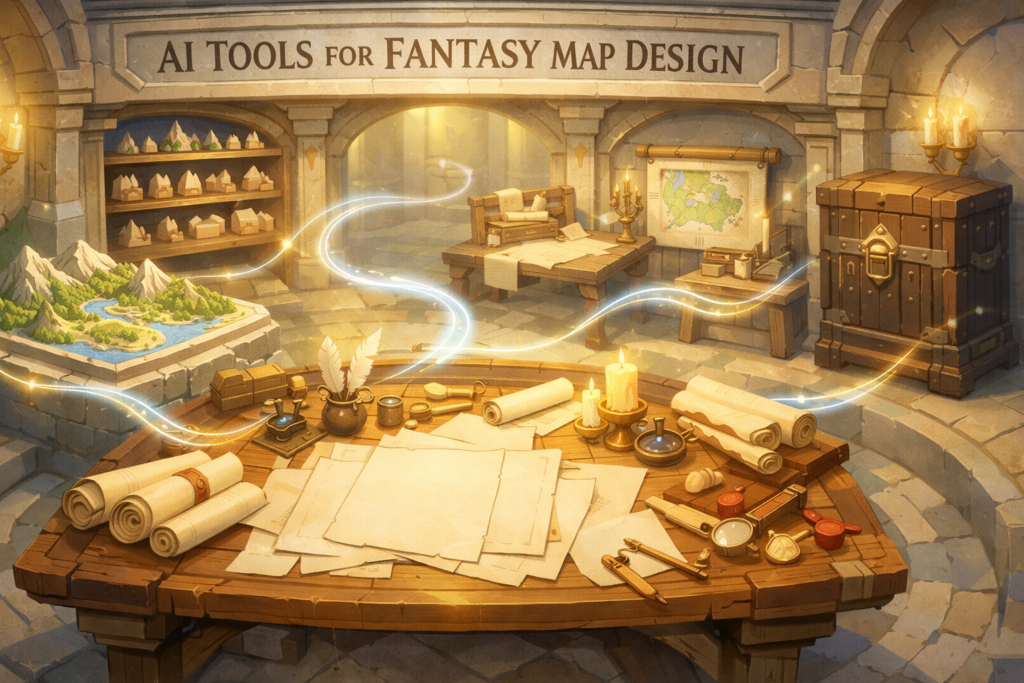
Maps have been a key feature of fantasy narratives. They mark boundaries, carve out paths, affect politics, and ground imagination in something real. For centuries, fantasy cartography used to be based on drawings made by hand and painful revisions. In 2026, that process has changed. Artificial intelligence has emerged as one of the most effective instruments that can be used by the current fantasy cartographers.
AI tools have ceased being fads. They are now creative collaborators who assist writers, game designers, and worldbuilders with visualizing complex worlds more quickly and keeping internal logic. This article examines the use of AI tools to design fantasy maps in 2026 and how writers can use them in a responsible manner to create a more detailed storyworld.
Table of Contents
Why Maps Still Matter in Fantasy Worldbuilding
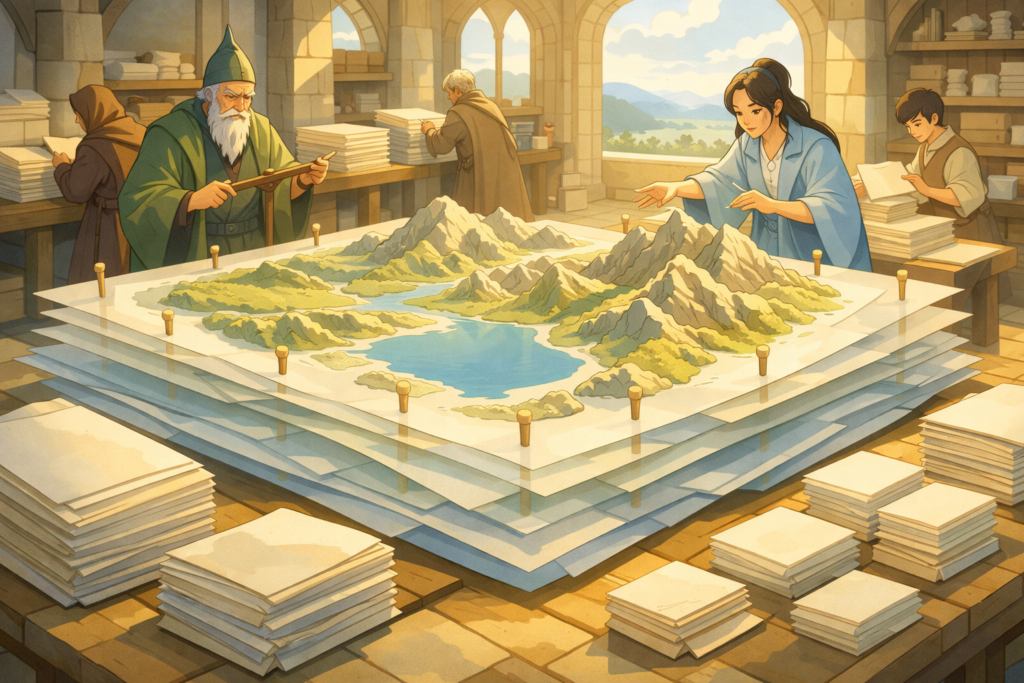
A map does not just indicate where to be. It defines the functioning of the world. Climate is determined by geography. Climate influences culture. Trade, war, religion and migration are influenced by culture. In the absence of a map, such relationships tend to be loose or incoherent.
Spatial logic is anticipated by fantasy readers and players. Travel time must make sense. Boundaries ought to be in accordance with topography. Politics should be affected by natural obstacles. A good map silently provides credibility in a narrative even where it is not on the page.
AI tools allow creators to preserve this logic without creativity or control loss.
Try Summon Worlds for free.


How AI Changed Fantasy Cartography
Non-practical digital map tools were concerned with aesthetics. They gave pleasing results to the eyes, but had to be checked manually. AI technologies in 2026 are different. They understand patterns.
The contemporary systems examine the flow of the terrain, the behavior of rivers, the gradients of the elevation, and the climate distribution. River paths react to the appearance of a mountain range. Natural harbors are naturally created when coastlines are formed. This helps to avoid the general mapping errors that disrupt immersion.
AI is no longer used to replace the cartographer but to aid decision-making. It opens up possibilities and leaves narrative intent in the hands of humans.
From Blank Page to Living Geography
The problem of starting is one of the biggest problems of map design. AI will eliminate that barrier by creating foundational geography out of high-level input.
Artists can determine the world size, climate bias, tectonic activity, or magic. The system then forms the landmasses, seas, and topographical formations, respectively, which follow the above parameters.
The process does not hold the creator down to an outcome. It does not give a final copy; it gives a working draft that can be improved, redefined, or discarded. The value lies in momentum. Space is becoming the world between idea and image in a very brief time, which enables the writers to think spatially at an earlier stage of development.
AI Assisted Terrain Logic
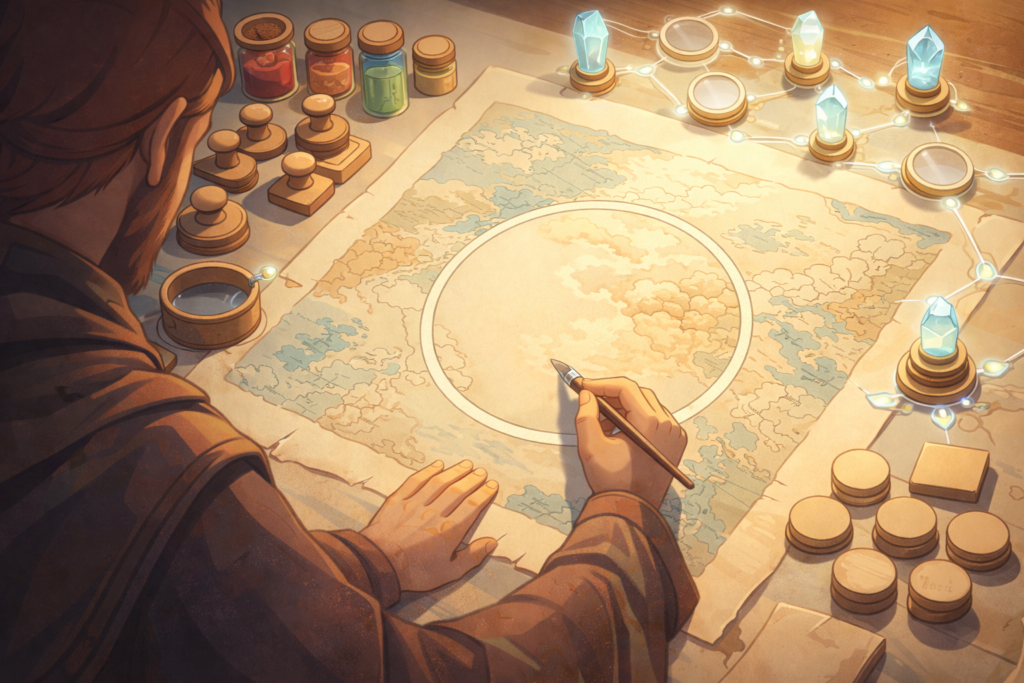
By 2026, AI map tools would perceive geography as a system and not as an image. Water flow is influenced by the height. There is an influence of temperature on vegetation. Settlement density is influenced by distance.
It implies that designers do not need to be hand-compiled to work out all the river origins and mountain passes. AI takes care of the physics, and the creator takes care of the story.
In settings of fantasy that are influenced by magic, AI tools provide the possibility of purposeful breaking of rules. Natural logic can be defied in controlled ways by floating continents, corrupted zones, or enchanted forests. The system is flexible and does not oppose creative intervention.
Cultural Mapping and Political Boundaries
Contemporary AI systems do not just make terrain. They assist in picturing human and non-human presence.
The placement of settlements is now based on the availability of water, defensibility, trade routes, and climate. Natural barriers are addressed by political boundaries. The road networks are developed naturally along the population centers.
This is useful in enabling creators to create realistic civilizations. A capital that is located on a river delta or crossroad will feel justified. In case there are mountains or deserts as the boundaries, war is logical.
Authors wishing to bring together geography with culture, history, and ties between factions frequently resort to websites such as Summon Worlds as a way of maintaining maps tied to narrative systems and not kept as disconnected images.
Iterative Design Without Starting Over
The old map design was prohibitive to revising. Even one change would involve the redrawing of whole regions. In 2026, AI tools consider maps as life forms.
Designers are also able to tweak variables without having to re-write it. Climate change has an impact on vegetation. The rise of the sea level reinvents shorelines. The changing political authority parallels the drawing of boundaries but does not change the landscape.
This flexibility promotes experimentation. The worlds are naturally developing rather than frozen in the early stages of the struggle because of the lack of energy.
Style Control and Aesthetic Consistency
Visual sameness has always been taken as one of the issues with AI-generated maps. By 2026, it have become far better in terms of style control.
Artists can establish the tone of art. Parchment of the old, parchment of the new, hand-inked fantasy, schematic with bare minimum, or painterly. AI is used to make changes to the outputs to fit the selected style without changing structural logic.
This enables maps to fit book covers, game interfaces, or game tone. Congruency enhances immersion through media.
Maps as Narrative Tools
AI maps are no longer reference images. They are storytelling tools.
Dynamic layers can enable creators to trace back in history, land expansion, magically corrupted, or destroyed by the environment. It is possible to present various timelines on the same world map and not confuse them.
This will be of particular use in long storytelling. Maps also change as empires come and go. The spatial memory is experienced by the readers and players, which makes the world seem persistent.
To the user who is curious about geography operating within a completely developed environment, seeing a descriptive storyworld page may be informative regarding the way maps engage with narrative systems.
Ethical Use and Creative Responsibility
The AI tools present significant creative questions. They may give generic results when applied unintentionally. When applied sensibly, they enhance novelty.
The key is authorship. Artificial intelligence must not substitute vision. The narrative themes, cultural bias, and emotional tone are present in the most interesting fantasy maps, which are characterized by their creator.
Producers who do not use AI as a shortcut but as a partner end up making worlds that are personal as opposed to procedural.
Learning Curve and Accessibility
The accessibility of AI map tools has increased in 2026. Interfaces are intuitive. There is no longer a barrier in terms of technical knowledge.
This has made cartography democratic. Maps that were initially only produced by professional artists are now made by independent writers, small studios, and hobbyist game masters.
It is not knowing how to use the tools, but knowing how to restrain oneself. Comprehension of timing between creation and formulation is what differentiates between functional and meaningful maps.
The Future of Fantasy Cartography
There will be further development of AI tools. It will be integrated further with narrative engines, character systems, and simulation tools. In the near future, maps may react to the story events or decisions made by players.
Nevertheless, in spite of this development, there is one fact. Imagination cannot be substituted for technology. It can only give it form.
Authors who want to preserve long-term coherence between maps and lore and the changing story lines usually will find the reading of a related blog article on sustaining coherence over large fantasy worlds valuable.
List of AI Tools for Fantasy Map Generation:
The following AI tools can be used by creators and fantasy worldbuilders to generate maps and build new worlds:
- World Machine
- Gaea
- Summon Worlds
- Inkarnate
- Wonderdraft
- Azgaar’s Fantasy Map Generator
- World Creator
- Midjourney
- DALL·E
- Stable Diffusion
- Dungeon Alchemist
Conclusion
In 2026, AI has become the cartographer’s secret weapon. It accelerates creation, reinforces realism, and supports complexity without overwhelming the creator.
Fantasy map design is no longer about drawing coastlines alone. It is about building systems that support story, culture, and memory. When AI tools are used with intention, they turn maps into living frameworks rather than static illustrations.
Want to know more about utilizing world geography and power structure? Read more!
Want to create your own world? Explore more!
Start building your World!
Disclaimer: Summon Worlds and the content on summonworlds.com are not affiliated with, endorsed by, or sponsored by Wizards of the Coast LLC. Dungeons & Dragons, D&D, and related terms are registered trademarks of Wizards of the Coast. Any references to D&D game mechanics, settings, or terminology are made for educational, commentary, and fan content purposes only. This blog does not reproduce or distribute official D&D content. All original ideas, characters, and creative content in this post are the intellectual property of OpenForge LLC, the parent company of Summon Worlds.