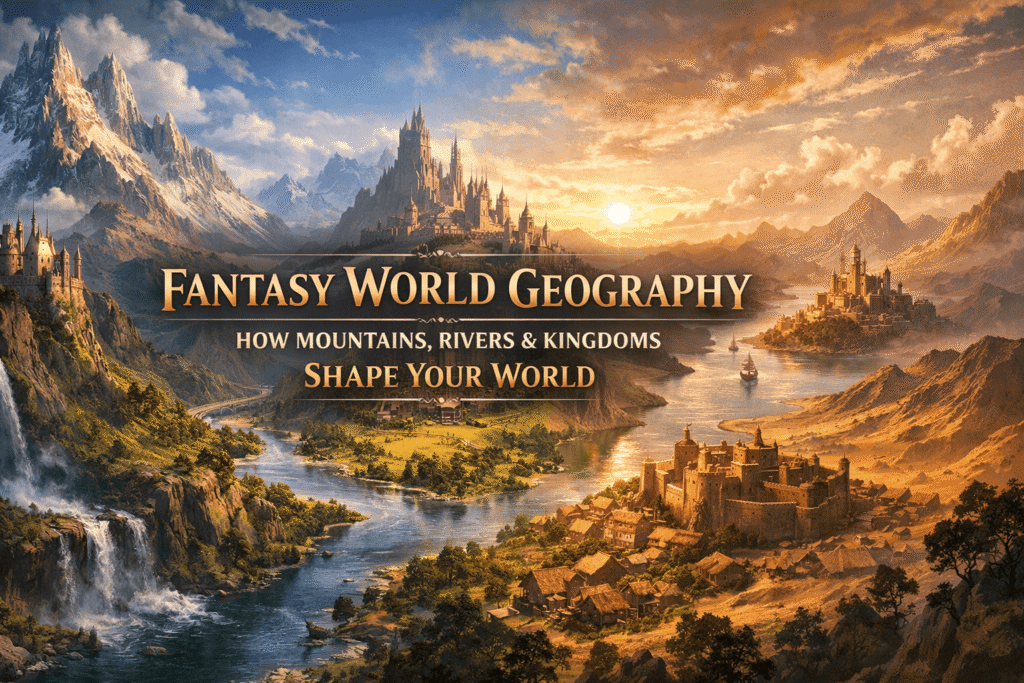
Fantasy World Geography: How Mountains, Rivers, and Kingdoms Shape Your World
Why do some fantasy worlds feel alive while others feel like random maps?
The answer is geography.
In the real world, mountains decide borders, rivers determine cities, and coastlines shape empires. The same rules apply to fantasy worlds. When geography makes sense, your kingdoms, cultures, and conflicts feel believable.
This guide will show you how mountains, rivers, and terrain shape fantasy civilizations, and how creators today use tools like AI worldbuilding platforms such as Summon Worlds to design entire worlds faster.
Table of Contents
Why Geography Is the Hidden Engine of Every Fantasy World
Most beginner worldbuilders start with kingdoms.
But historically, kingdoms come after geography.
In real history:
- Cities formed around rivers
- Trade routes followed valleys
- Mountains created borders
- Deserts isolated civilizations
Geography determines:
- Where people live
- Where wars happen
- How cultures develop
- Which kingdoms become powerful
If your world ignores geography, readers subconsciously feel something is wrong.
But if geography drives the story, your world becomes believable instantly.
Quick rule:
Terrain creates culture → culture creates kingdoms → kingdoms create conflict.
Try Summon Worlds for free.


Mountains: The Natural Borders That Shape Empires
Mountains are one of the most powerful forces in worldbuilding.
They shape everything from politics to mythology.
Why mountains matter
Mountain ranges often:
- Block travel
- Create natural borders
- Form cultural divides
- Protect civilizations
Examples in real history:
- The Himalayas isolated civilizations
- The Alps shaped European warfare
- The Andes created unique cultures
Fantasy worlds follow the same rules.
How mountains influence worldbuilding
Mountains affect:
- Political borders
Kingdoms rarely expand across massive mountain ranges.
Mountains create natural defensive lines.
- Climate
Mountains influence rainfall and weather.
One side may be fertile forests while the other becomes desert.
- Resources
Mountains contain:
- metals
- gemstones
- magical materials in fantasy settings
This makes them centers for dwarven kingdoms, mining cities, or dragon lairs.
A practical worldbuilding trick
Instead of placing mountains randomly:
- Draw tectonic lines across your map
- Create one or two large mountain ranges
- Place kingdoms on the edges, not the middle
This instantly makes your map feel realistic.
Rivers: Why Civilizations Always Form Around Water
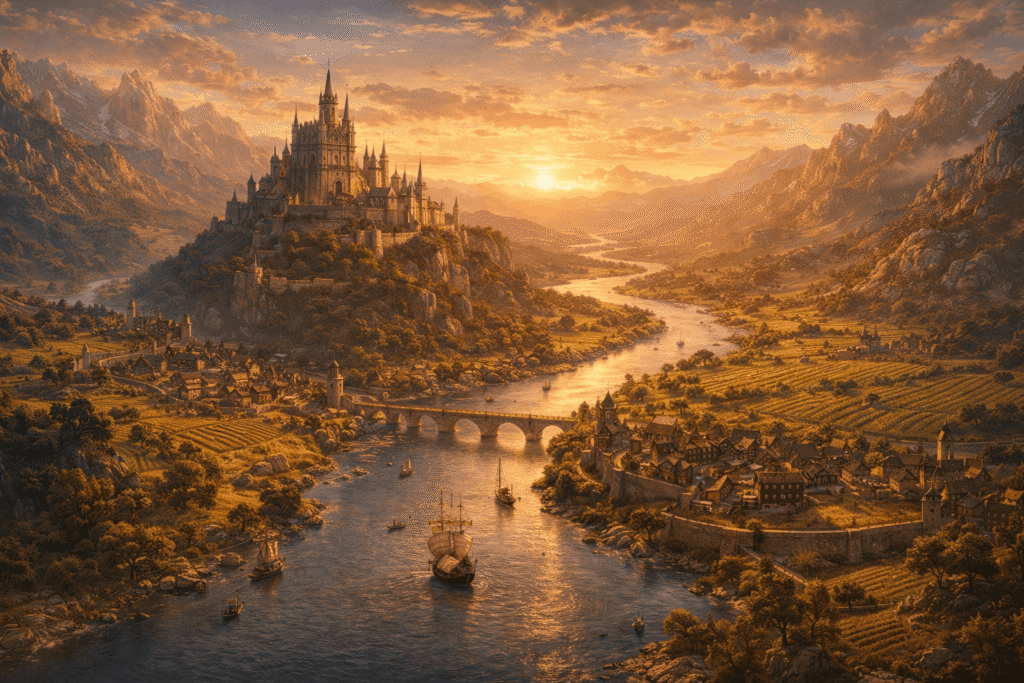
Almost every major civilization in history formed near rivers.
Examples include:
- Nile (Egypt)
- Tigris & Euphrates (Mesopotamia)
- Yellow River (China)
The same rule applies to fantasy worlds.
Why rivers are essential
Rivers provide:
- drinking water
- transportation
- fertile farmland
- trade routes
Because of this, cities almost always form near rivers.
The most common fantasy map mistake
Many fantasy maps show rivers that:
- split unnaturally
- flow uphill
- connect oceans incorrectly
In reality, rivers always follow a simple rule:
Rivers flow downhill and merge together.
They rarely split apart.
How to design believable rivers
Follow these steps:
- Start rivers in mountains
- Flow downhill toward oceans
- Merge smaller rivers into larger ones
- Place cities where rivers meet
These locations become:
- trading hubs
- capitals
- strategic cities
This is where stories happen.
Kingdom Placement: Why Politics Follows Geography
Geography doesn’t just shape land.
It shapes power.
A kingdom with fertile farmland and trade access will become wealthy.
A kingdom isolated in mountains will become defensive and militaristic.
Geography creates different types of kingdoms
River kingdoms
- trade-focused
- wealthy cities
- large populations
Mountain kingdoms
- defensive cultures
- mining economies
- smaller populations
Island kingdoms
- naval power
- trade dominance
- exploration
Desert kingdoms
- caravan trade
- oasis cities
- strong survival cultures
Each terrain type produces different politics and stories.
This is why worlds like Middle-earth or Westeros feel believable.
Their geography shapes the entire narrative.
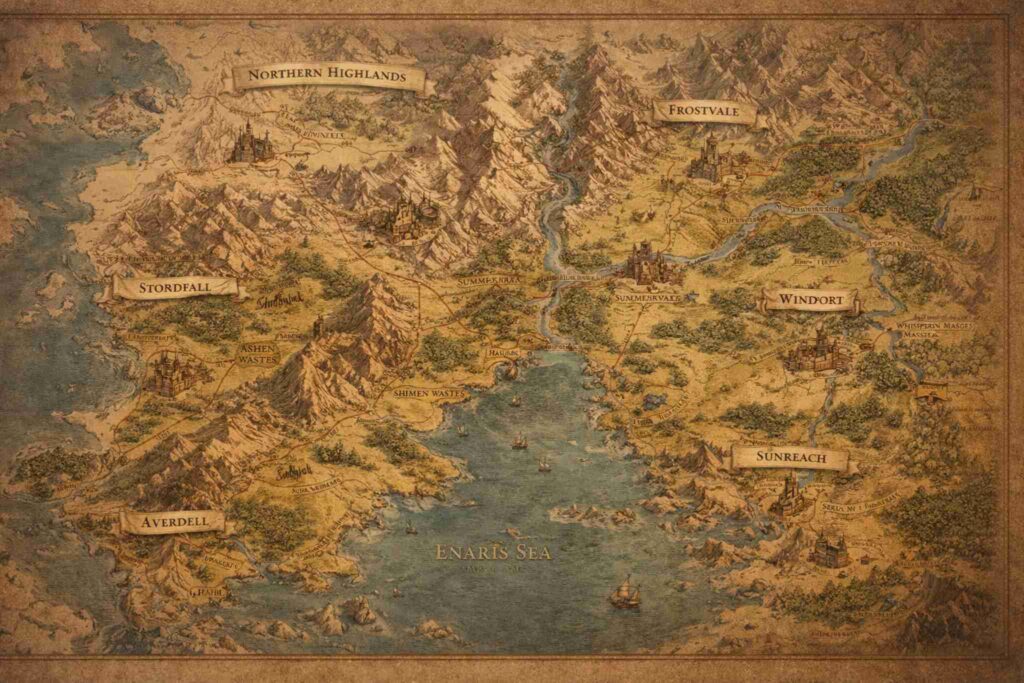
How to Design a Realistic Fantasy Map (Without Burning Out)
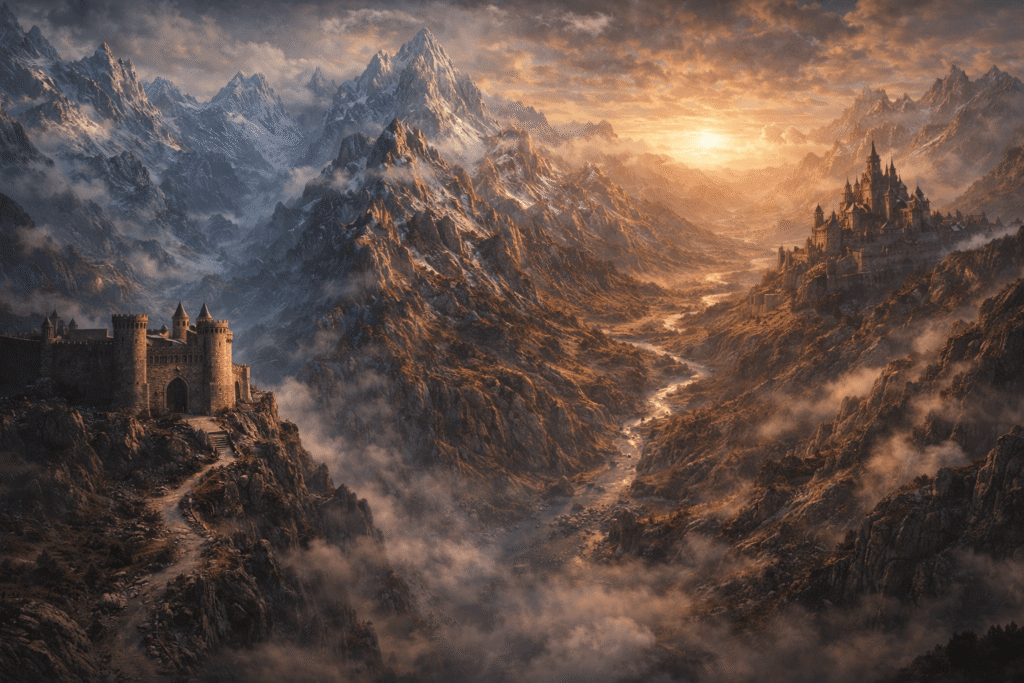
Many creators get stuck here.
Designing a realistic map can feel overwhelming.
But it doesn’t have to be.
Use this simple worldbuilding framework.
Step 1: Draw the continents
Start with large shapes.
Avoid perfect circles.
Real landmasses are irregular.
Step 2: Add mountain ranges
Place 2–4 major ranges.
Mountains should run in long chains.
These will become:
- borders
- cultural divides
- sources of rivers
Step 3: Create rivers
Start rivers in mountains.
Flow them toward the ocean.
Merge rivers naturally.
Step 4: Place cities
Cities form where trade happens:
- river crossings
- river mouths
- coastlines
- mountain passes
Step 5: Place kingdoms last
Once geography exists, kingdoms appear naturally.
This approach makes your world feel realistic instantly.
How AI Tools Help You Build Geography Faster
Modern worldbuilders increasingly use AI tools to speed up world creation.
Instead of spending weeks drawing maps and characters, creators can now generate:
- landscapes
- cities
- kingdoms
- characters
- lore
Apps like Summon Worlds allow creators to build entire worlds with AI assistance.
Inside the app you can:
- generate fantasy locations and landscapes
- create AI characters with backstories
- build worlds with locations and entities
- roleplay with AI characters that understand your world lore
The platform even lets creators bind characters to specific locations, creating immersive storytelling environments where characters understand their world and surroundings.
This means your geography isn’t just a map.
It becomes an interactive story world.
Instead of imagining your kingdoms, you can explore them, visualize them, and roleplay inside them.
Key Takeaways
If you want your fantasy world to feel real, start with geography.
Remember these rules:
- Mountains shape borders
- Rivers create civilizations
- Trade routes create cities
- Geography shapes politics
When terrain drives your worldbuilding, everything else becomes easier:
- stories
- cultures
- conflicts
- characters
And with AI-powered creative tools like Summon Worlds, you can now build entire fantasy worlds faster than ever.
Download the app and start designing your own geography-driven fantasy world today.
Start building your World!
Disclaimer: Summon Worlds and the content on summonworlds.com are not affiliated with, endorsed by, or sponsored by Wizards of the Coast LLC. Dungeons & Dragons, D&D, and related terms are registered trademarks of Wizards of the Coast. Any references to D&D game mechanics, settings, or terminology are made for educational, commentary, and fan content purposes only. This blog does not reproduce or distribute official D&D content. All original ideas, characters, and creative content in this post are the intellectual property of OpenForge LLC, the parent company of Summon Worlds.