Worldbuilding has a funny habit of producing a lot of excellent trouble.
You create the harbor that floods at high tide, the council member accepting bribes, the old war everyone remembers differently, and the Character who knows far more than they admit.
Great.
Now what happens when someone walks into that harbor and makes the wrong person angry?
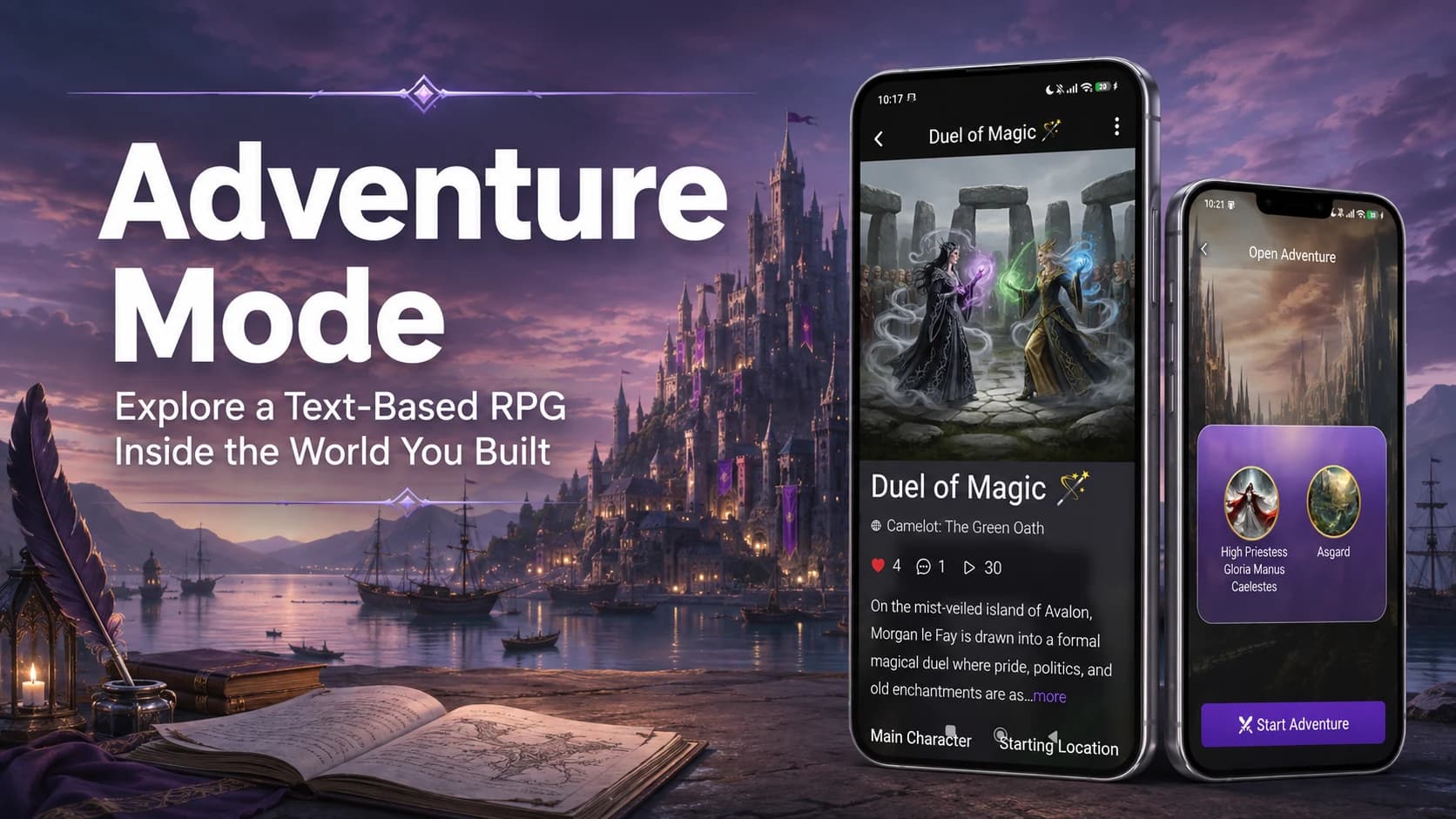
Adventure Mode gives those details somewhere to go. Instead of leaving your World as a collection of Characters, Locations, relationships, and lore, you can step inside it and begin a solo, turn-by-turn text-based RPG.
You built the World.
Now it gets to push back.
What Is Adventure Mode in Summon Worlds?
Summon Worlds Adventure Mode is a solo, turn-by-turn text-based RPG that lets you play as a Character inside a connected World you created. Choose a World, Character, starting Location, and Storyteller, then respond with suggested or original actions as the interactive story unfolds.
The Storyteller establishes the opening scene and handles the rest of the World. The loop is familiar from tabletop roleplaying and other text-based roleplaying games:
The World presents a situation → The player declares an action → The Storyteller responds
Then the cycle begins again.
You handle one thing: What does your Character do next?
You can:
- Choose one of the suggested actions
- Write your own action
- Speak directly to another Character
- Combine dialogue and action in the same turn
- Investigate objects, landmarks, or clues
- Travel to connected Locations when they become available
The adventure is driven by written narration and choices. Generated scene images can support the atmosphere along the way, but Adventure Mode is not an animated or 3D game.
Think less “watch the Character perform.”
Think more “make the next decision.”
Adventure Mode is currently presented as a solo, text-based adventure that draws from the Characters, Locations, relationships, and lore connected to the selected World. For a closer look at the wider format, our guide to using AI chat and roleplay explains what makes a decision-and-response loop feel like a game rather than a story you already know.
Why the World You Built Matters
Adventure Mode does not begin from a blank prompt.
It begins from your World.
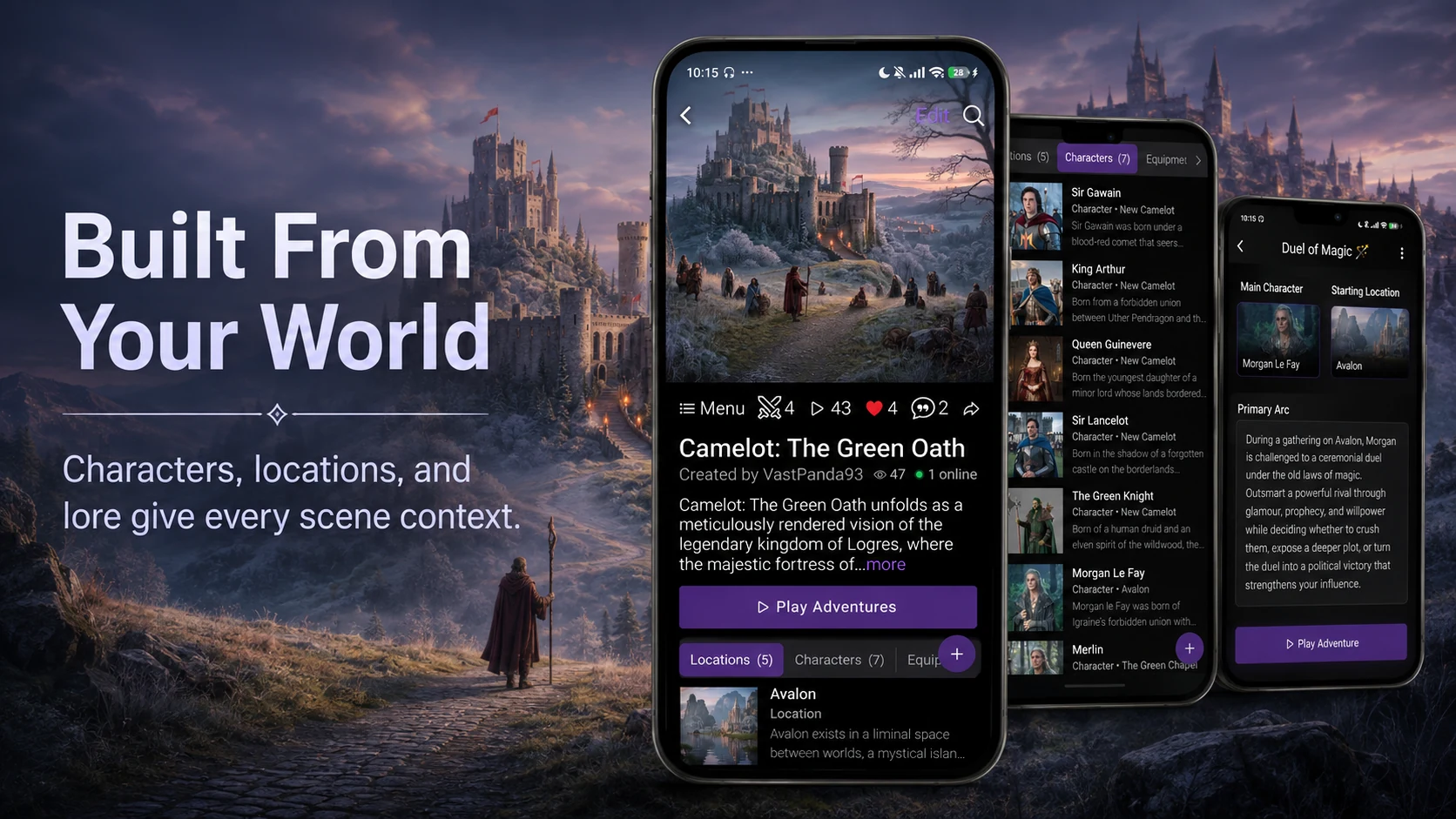
That gives the Storyteller relevant material to draw from when a scene calls for it, including:
- Character identities and histories
- Relationships
- Starting Locations and landmarks
- Equipment and important possessions
- Spells and abilities
- World rules
- Connected lore
Across feedback from our community on Discord, Reddit, and elsewhere, one pattern kept showing up: creators wanted to experience their ideas, not simply store them.
Static creations did not always feel alive. People wanted to step inside what they had built and find out what happened when their Characters were forced to make decisions.
That is the jump Adventure Mode is built around. It turns Summon Worlds from a place where your ideas live into a worldbuilding adventure app you can actually step inside.
More lore is not always better.
Relevant lore is better.
You do not need a completed encyclopedia before playing. One Character, one Location, and a few meaningful connections are enough to begin. The complete worldbuilding template and checklist can help establish the foundation, while the guide to fantasy city design can turn the starting Location into somewhere with its own people, tensions, landmarks, and identity.
How to Start an Open Adventure
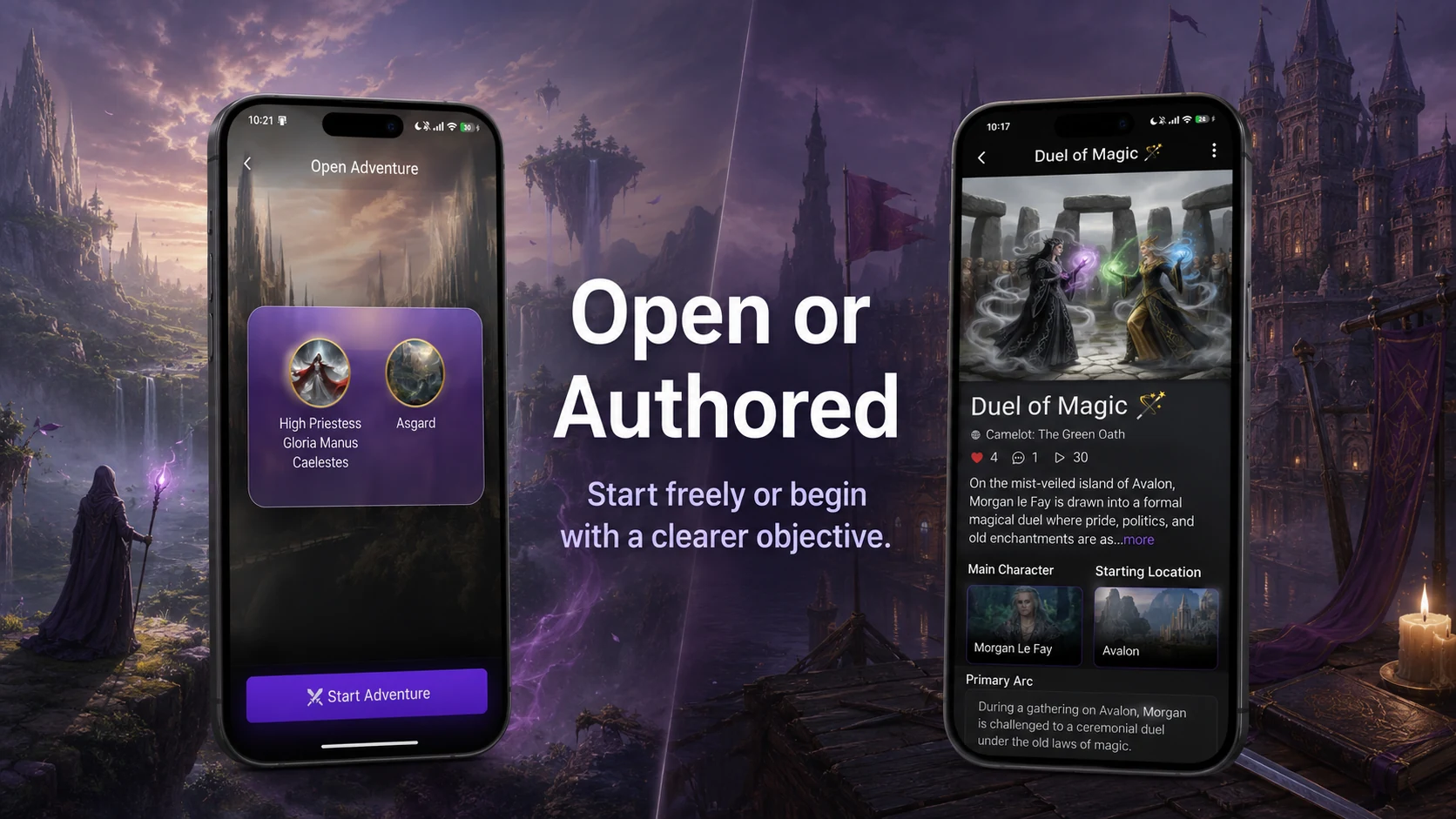
An Open Adventure begins without an author-defined Primary Arc or Opening Hook.
You arrive with a Character and a place.
Not a prewritten route.
To begin:
- Choose Open Adventure.
- Select an existing World.
- Choose a Character connected to that World.
- Select the starting Location.
- Choose the Storyteller whose narration style fits the experience you want.
- Review the Adventure settings or begin with the defaults.
- Start the Adventure and respond to the opening scene.
The Storyteller creates an immediate situation, and the turn-by-turn interactive story develops through your decisions.
An Open Adventure works well when you want to:
- Explore a Location
- Roleplay a Character freely
- Discover possible conflicts
- Follow an unanswered question
- See what kind of interactive story naturally emerges from the World
- Begin without preparing a specific objective
Open does not mean empty.
It means the route has not been chosen yet.
The World, Character, starting Location, and Storyteller provide the foundation. The direction emerges from what the player decides to do next.
How Does an Authored Adventure Work?
An Authored Adventure begins with a clearer problem and direction created in advance.
The creator selects the Main Character and Starting Location, then adds:
- Public Description
- Primary Arc
- Opening Hook
The Public Description explains the experience to the player. The Primary Arc gives the Adventure its central direction. The Opening Hook creates the situation that starts everything moving.
This structure works especially well for:
- Mysteries
- Rescues
- Heists
- Political conflicts
- Survival scenarios
- Character-specific missions
The creator establishes the problem and intended objective.
The player still decides how to respond.
The creator defines the problem.
The player decides the route.
That distinction matters. An Authored Adventure has more direction than an Open Adventure, but that does not mean every scene, decision, or outcome has already been written.
The player can still approach the problem cautiously, recklessly, diplomatically, or with the kind of plan that makes perfect sense right up until someone opens the wrong door.
Open Adventure vs. Authored Adventure
The main difference is how much direction exists before the first turn.
| Adventure type | How it begins | Best for |
|---|---|---|
| Open Adventure | Begins with a World, Character, Location, and Storyteller without a predefined Primary Arc | Free exploration, Character roleplay, and discovering stories through play |
| Authored Adventure | Begins with a Public Description, Primary Arc, and Opening Hook created in advance | Mysteries, missions, heists, rescues, and stories with a clearer objective |
An Open Adventure asks: What could happen here?
An Authored Adventure asks: How will this Character deal with the problem already waiting for them?
Both are still interactive. Both develop one decision at a time.
What Does a Turn Feel Like?
Suppose your World already establishes three facts:
- Captain Voss patrols the evening market.
- Haruk owns a spice stall there.
- Your Character owes Haruk money.
A turn in this text-based RPG might unfold like this:
Dungeon Master: The market is closing for the evening. Across the square, Captain Voss watches you for a moment too long, one hand resting on her sword.
You: I keep walking and slip into Haruk’s spice stall, using the crowd to block Voss’s view.
Dungeon Master: Haruk looks up from a sack of pepperroot. “Back already? You still owe me for last time.” Behind you, boots scrape across the wet stones.
The scene is not inventing an unrelated cast and setting from nothing. It is using people, places, and relationships already connected to the World.
You can respond with a detailed paragraph, a spoken line, or one short action:
I ask Haruk where the back exit leads.
Suggested actions are there when you need them.
They are not the edge of the map.
Writing your own response remains part of the turn-by-turn experience. Your decision gives the Storyteller something new to answer. The comparison of AI roleplay and traditional roleplay explores how that responsive exchange differs from a fixed narrative.
How to Adjust an Adventure
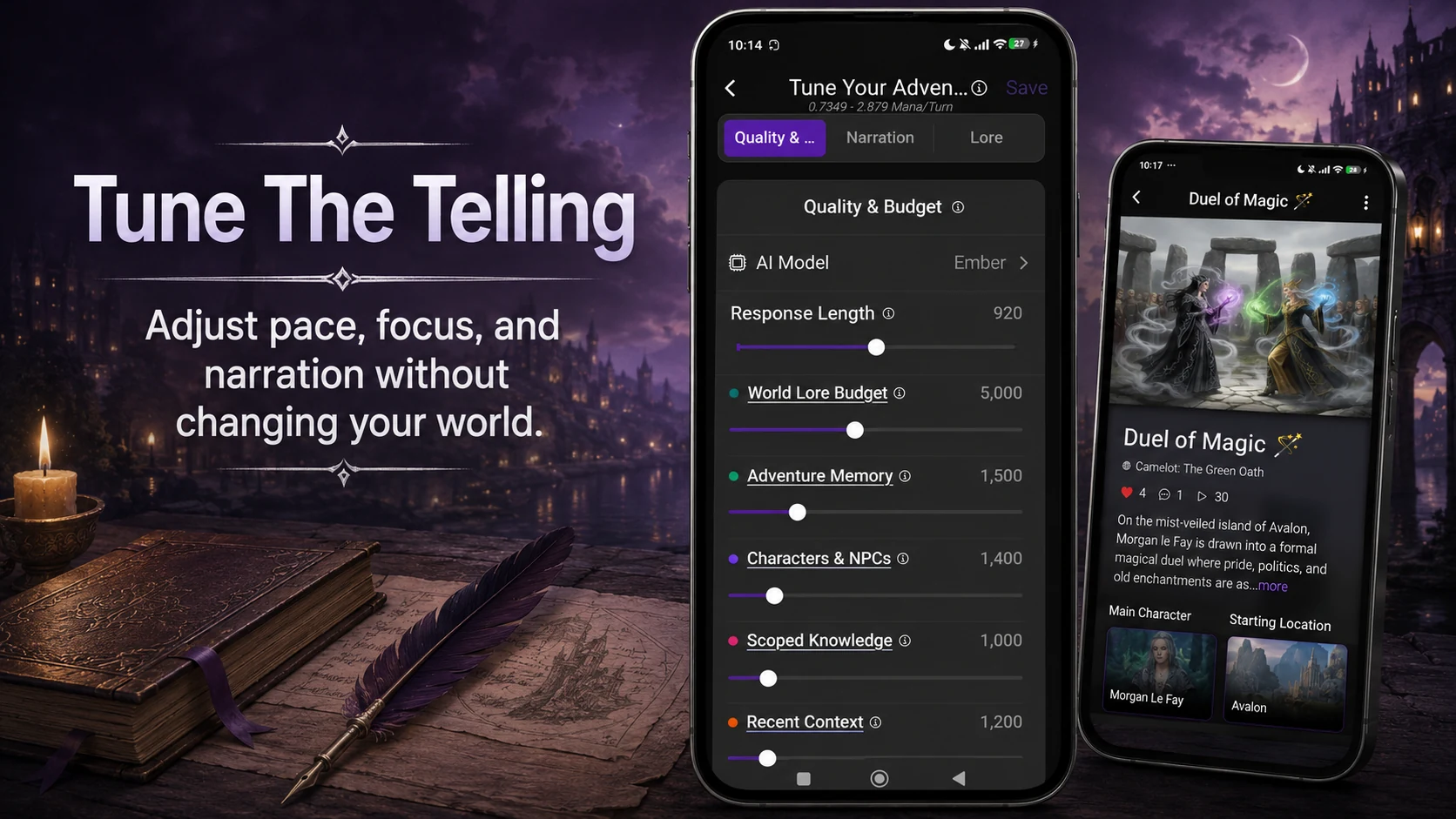
Adventure settings let you shape how the interactive story is presented without permanently rewriting the underlying World.
Current presentation controls may include:
- Narrator, based on the selected Storyteller
- DM Point of View: Second Person or Third Person
- Response Length
- Choice Frequency
- NPC Dialogue Density
- Character Presence
- Momentum Assist
- Objective Focus
- Readability & Pace
The default settings provide a balanced starting point. After playing a few turns, you can adjust them depending on the experience you want.
Shorten the responses for quicker exchanges.
Increase NPC dialogue for a more conversational story.
Slow the pace for an atmospheric mystery.
Strengthen Objective Focus when you want the Adventure to stay closer to its central problem.
These settings influence presentation, pacing, and how frequently certain story elements appear. They do not replace the Characters, Locations, relationships, and lore already connected to the World.
The World stays the same.
The telling changes.
Begin With One Character and One Place
You do not need every kingdom, century, faction, and bloodline finished before beginning.
Choose a Character you understand.
Place them somewhere with a useful relationship, conflict, clue, or unanswered question.
Choose Open or Authored.
Pick a Storyteller.
Then take the first turn.
The World provides the foundation.
Your decisions determine what happens next.
Start your first adventure in Summon Worlds Adventure Mode.
Frequently Asked Questions
Is Summon Worlds Adventure Mode a text-based RPG?
Yes. Summon Worlds Adventure Mode is a solo, turn-by-turn text-based RPG in which you play as a Character inside a connected World you created. You choose actions while the Storyteller narrates how the World responds.
What is the difference between an Open Adventure and an Authored Adventure?
An Open Adventure begins without a predetermined Primary Arc or Opening Hook, allowing the story to develop freely from the selected World, Character, and Location. An Authored Adventure begins with a central problem, objective, and opening situation created in advance.
Do I need a completed World to use Adventure Mode?
No. One Character, one starting Location, and a few meaningful connections are enough to begin. You can continue expanding the World as the Adventure reveals what it needs.
Can I write my own actions in Adventure Mode?
Yes. You can choose a suggested action or write an original response. Original responses can include dialogue, physical actions, investigation, questions, or a combination of several things.
Is Adventure Mode an animated or 3D game?
No. Adventure Mode is a written, turn-by-turn experience. Generated scene images can support the atmosphere, but the story progresses through narration, choices, and written player responses.