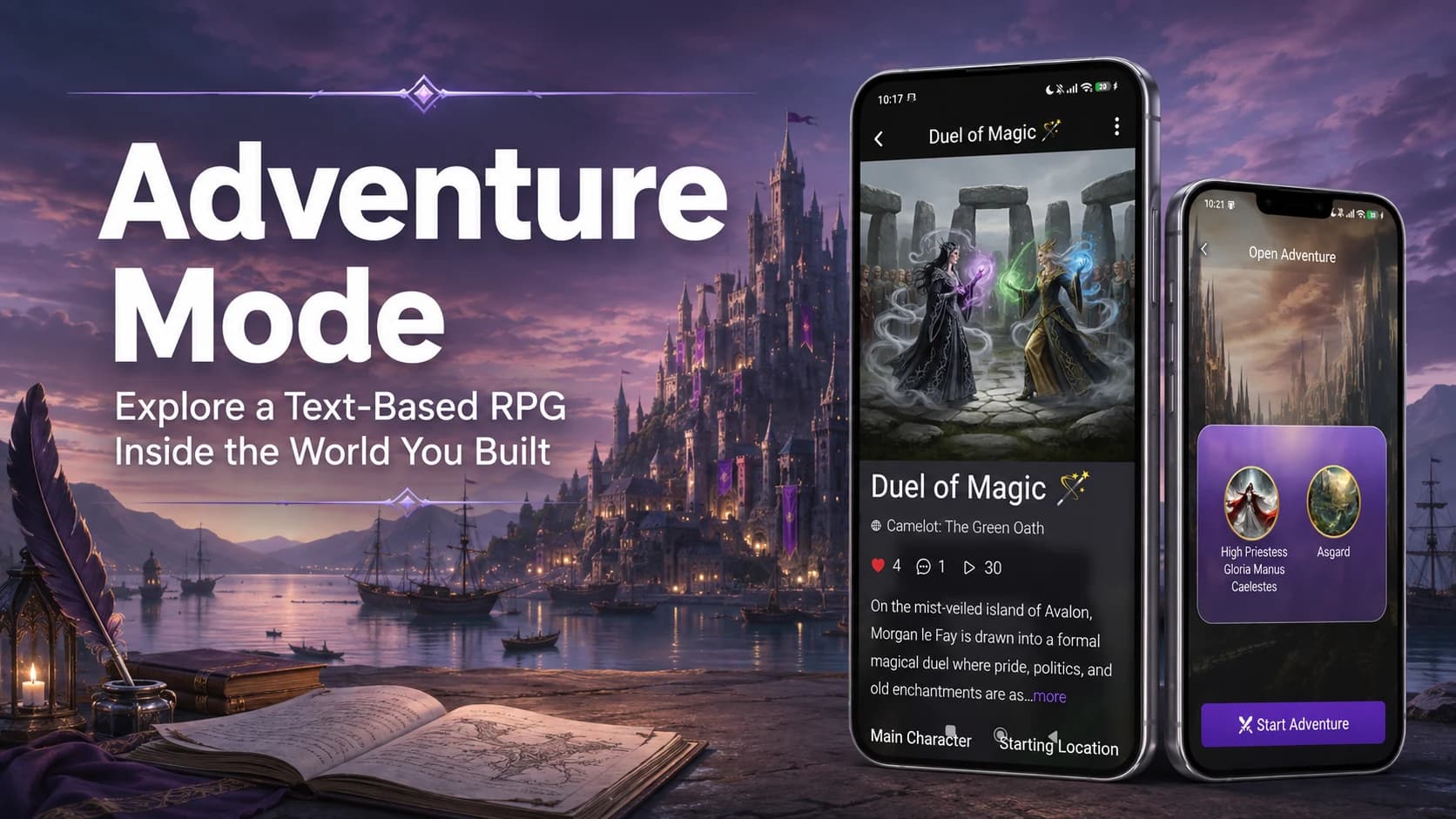
The same ship can leave the same harbor under the same impossible sky and somehow feel like three completely different stories.
With one Narrator, the moment becomes the beginning of a grand voyage.
With another, the ship feels as though it already knows who will not survive.
With a third, the most important detail is not the sails, the crew, or the stars. It is the officer watching your hands and pretending not to.
That is what the Narrator setting changes in Summon Worlds Adventure Mode.
Your World, Character, and starting situation remain the foundation. The Narrator shapes how the Storyteller presents them: what the prose lingers on, how tension enters a scene, and what kind of atmosphere follows your Character through the story.
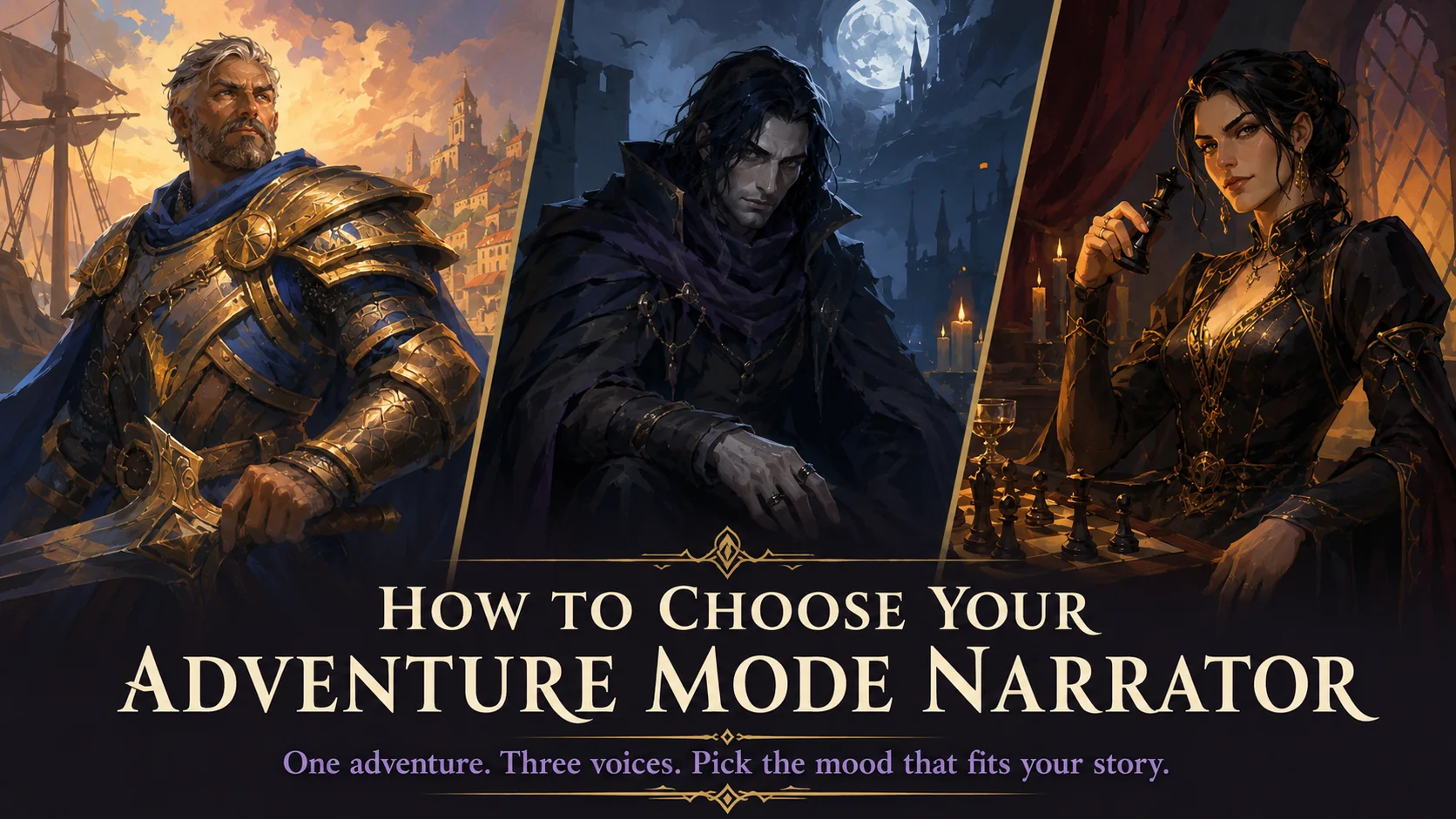
Adventure Mode currently includes three Narrators:
- Orin the Bold
- Morvain the Hollow
- Lysara the Veiled
Here is how to choose the one that fits the Adventure you want to experience.
Which Adventure Mode Narrator should you choose?
Choose Orin the Bold for heroic scale, momentum, grand environments, and visible stakes.
Choose Morvain the Hollow for Gothic atmosphere, intimate danger, unseen threats, and the sense that something is already wrong.
Choose Lysara the Veiled for political intrigue, suspicious conversations, shifting alliances, and motives hidden beneath polite behavior.
| Narrator | Storytelling style | Best suited for |
|---|---|---|
| Orin the Bold | Epic, grand, and adventurous | Voyages, quests, wars, rescues, and high-stakes missions |
| Morvain the Hollow | Dark, intimate, and ominous | Horror, supernatural mysteries, curses, ruins, and haunted Locations |
| Lysara the Veiled | Subtle, political, and suspicious | Court intrigue, espionage, factions, secrets, and social mysteries |
There is no single best Narrator.
The right choice depends on which part of the Adventure you want the prose to amplify.
What does the Narrator change?
The Adventure Mode Narrator changes the tone, emphasis, and atmosphere of the story's presentation.
Each Narrator has a different personality and prose style that they tend to bring into the Adventure. That can affect:
- The tone of scene descriptions
- Which details receive attention
- How danger or uncertainty is introduced
- The emotional weight of major moments
- Whether a scene feels heroic, ominous, or politically charged
The Narrator does not replace your World's lore or change who your Character is. It changes the storytelling lens through which those details are presented. That responsive presentation is part of what makes AI roleplay different from traditional roleplay.
Think of it like giving the same script to three different directors.
The castle is still haunted.
The difference is whether the camera begins on the towering battlements, the candle going out behind you, or the noble beside the door who very clearly knew this was going to happen.
That is why Narrator selection matters. It does not decide the facts.
It decides which facts feel important first.
Why the same opening feels so different
The same starting situation can feel heroic, threatening, or politically charged depending on the Narrator presenting it.
The examples from the same introductory shipboarding scene make the distinction clear.
All three versions involve Sarah Hawkins boarding the RLS Legacy. The ship still has ethereal sails. Captain Amelia is still aboard. The harbor still matters. The Character is still arriving into the same larger situation.
But the emphasis changes:
- Orin notices the deck, rigging, ship motion, crew rhythm, and the sense that the voyage is already pulling away from shore.
- Morvain notices strange smells, a too-watchful officer, hidden tension, and the sound of glass breaking somewhere below deck.
- Lysara notices social signals, cargo insignia, a slate, a figure watching the arrivals, and the possibility that several people already know more than they are saying.
Same ship.
Same Character.
Different pressure.
That is the most useful way to think about the setting: not as "which one is best," but as which part of the Adventure you want the prose to amplify.
Choose Orin the Bold for scale and forward motion
Official style: Epic, grand, adventurous prose with scale, momentum, and heroic consequence.
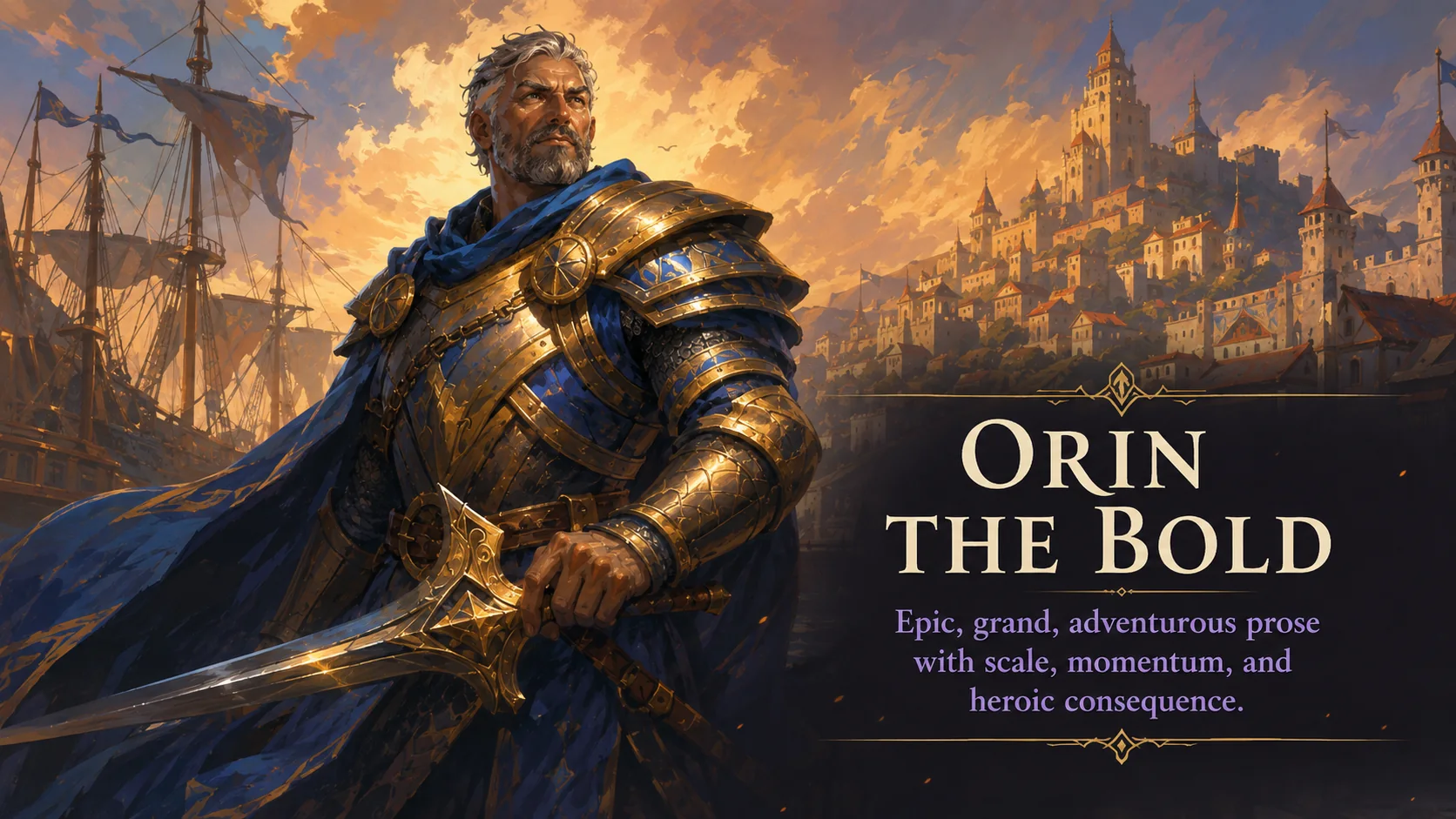
Orin the Bold is the Narrator for Adventures that should feel large.
His prose tends to notice the sweep of a Location: the deck of a starship, the movement of a crowd, the reach of a fortress wall, the scale of a battlefield, or the forces carrying the story toward something important.
In the sample introduction, Orin notices practical ship details—linseed oil, brass railings, crew movement, mooring lines—but he keeps widening the frame toward ethereal sails, stellar wind, and the cosmic current waiting beyond the harbor.
The effect is momentum.
Even before the ship leaves, it already feels as if the Adventure has begun moving.
What kinds of Adventures suit Orin?
Orin works especially well for:
- Heroic fantasy
- Expeditions and voyages
- War stories
- Monster hunts
- Rescues and escapes
- Treasure quests
- Survival journeys
- High-stakes Authored Adventures
He is also a strong fit for Characters who are about to make very visible mistakes in very public places.
A useful rule of thumb is simple:
Choose Orin when the story should feel like it is heading somewhere bigger than the current room.
That might mean:
- A forbidden city on the horizon
- A kingdom-level threat
- A dangerous crossing
- A mission with visible stakes
- A Character stepping into a role they may not be ready for
Orin in an Open Adventure vs. an Authored Adventure
In an Open Adventure, Orin helps exploration feel purposeful. Even when the player does not begin with a fixed mission, the setting can feel charged with possibility.
In an Authored Adventure, he is especially effective when the objective is already clear. If the Character must protect a city, cross an impossible sea, retrieve something powerful, or prevent a catastrophe, Orin's voice helps the mission feel suitably enormous.
Choose Orin when you want to feel:
- Inspired
- Adventurous
- Urgent
- Bold
- Slightly concerned that the next decision may become part of a legend
Choose Morvain the Hollow for intimate danger
Official style: Dark, velvet menace, old stone, candlelight, and intimate danger.
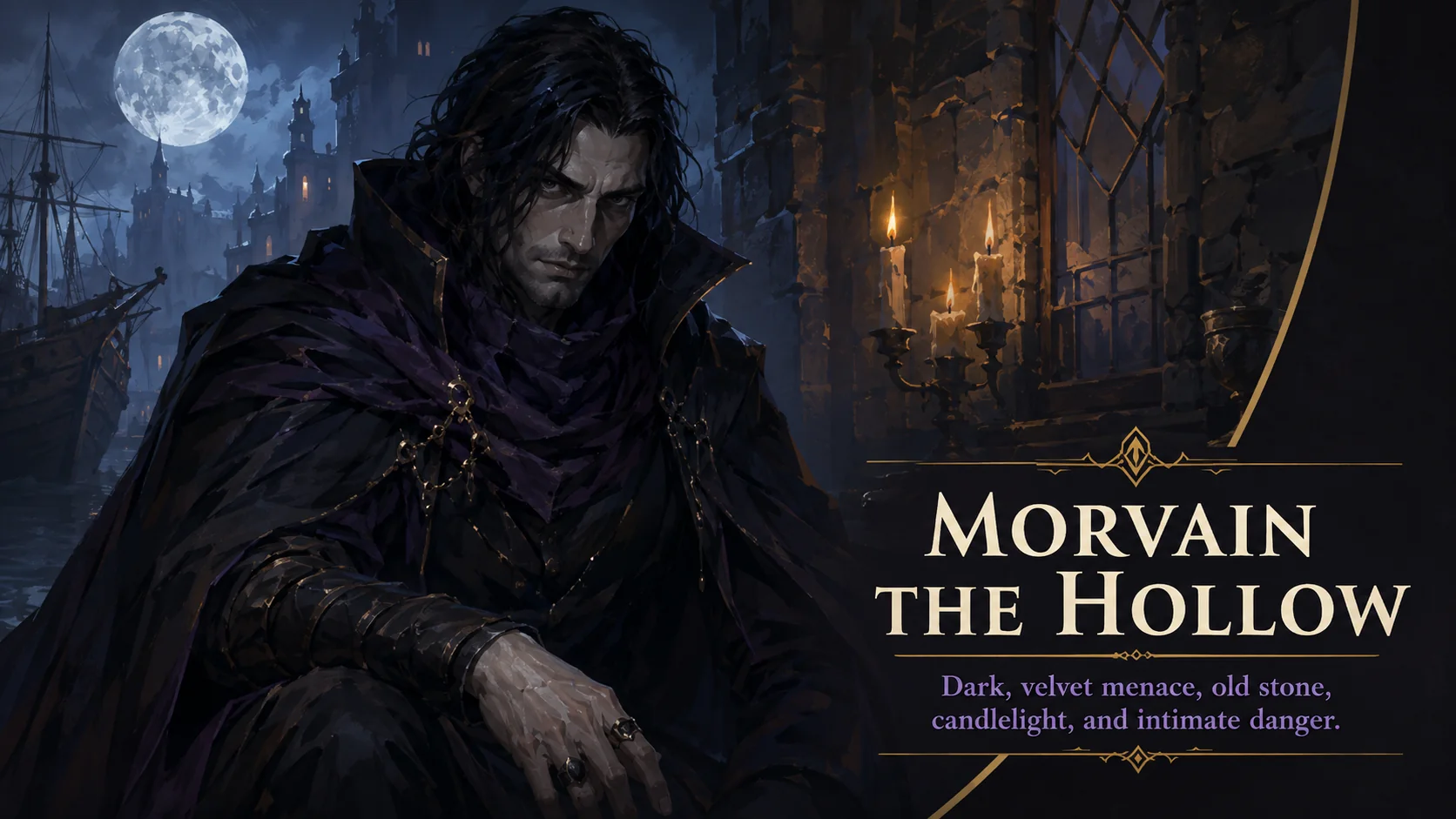
Morvain the Hollow is the Narrator for Adventures that should feel unsettling, close, and quietly dangerous.
He does not need an army on the horizon to make a scene threatening.
A strange smell, a broken glass, a quiet footstep, or one person looking half a second too long can do the job perfectly well.
In Morvain's sample, the RLS Legacy is still a remarkable vessel with ethereal sails and a crystal compass. But the prose keeps drawing the player toward what feels wrong:
- Salt that is not water
- Polish that is not wax
- A watchful officer
- A satchel receiving too much attention
- Glass breaking somewhere below deck
The danger remains mostly unseen.
That is exactly why it works.
Morvain's strength is the feeling that something has already entered the scene and is waiting for the player to notice.
What kinds of Adventures suit Morvain?
Morvain is a natural fit for:
- Gothic fantasy
- Haunted Locations
- Supernatural mysteries
- Horror-leaning Adventures
- Cursed objects
- Isolated houses and mansions
- Ruins, tombs, and underground spaces
- Stories where something is wrong long before anyone explains why
Also, yes, Adventures where opening the basement door is clearly a terrible idea—but the basement is unfortunately where the plot lives.
Morvain works best when:
- The threat is personal
- The source of danger is unclear
- The player should feel watched
- Small details matter more than spectacle
- The scene should feel close rather than grand
A battlefield may be dangerous.
So is a quiet corridor when the candle has just gone out and someone is breathing on the other side of the wall.
Morvain in an Open Adventure vs. an Authored Adventure
In an Open Adventure, Morvain can make wandering feel risky in a very immediate way. A casual choice to inspect a hallway or speak to the wrong person can begin carrying tension quickly.
In an Authored Adventure, he is especially strong when the premise already involves something hidden, cursed, corrupted, or emotionally close to the Character.
Choose Morvain when you want to feel:
- Unsettled
- Alert
- Cautious
- Claustrophobically curious
- Fully aware that the safest option is probably to leave, and equally aware that you are not going to
Choose Lysara the Veiled for intrigue and hidden motives
Official style: Intrigue, subtle manipulation, shifting alliances, and veiled threats. Every word carries intent, and nothing is ever said without a reason.
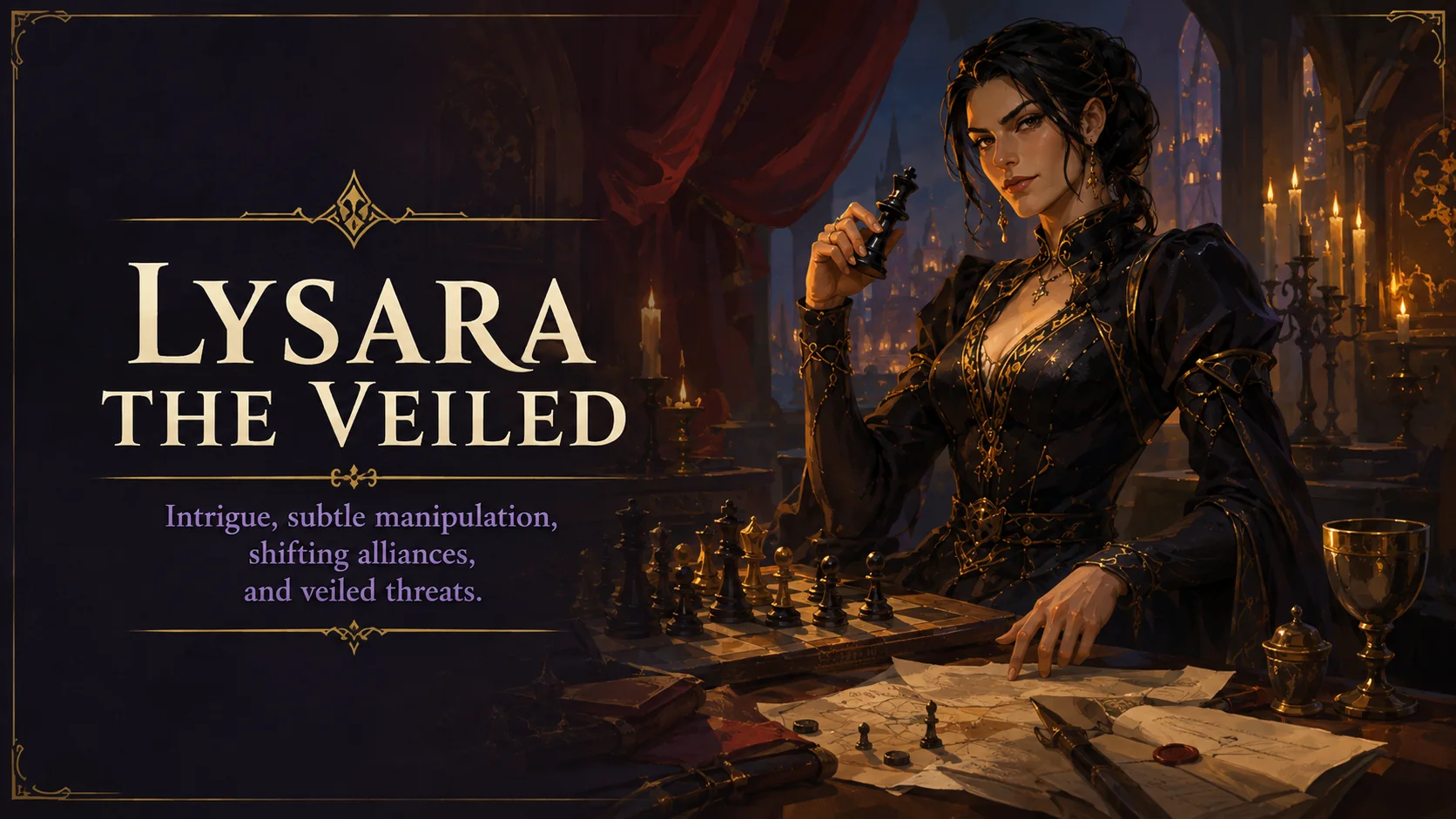
Lysara the Veiled is the Narrator for Adventures driven by secrets, social pressure, and people whose motives are not immediately clear.
She is interested in what people are not saying.
Her scenes tend to draw attention toward status, observation, concealed information, and the small social signals suggesting a larger conflict beneath the surface.
In Lysara's sample, the player arrives aboard the same ship, but the focus shifts:
- An officer studies the passenger with a practiced eye
- Captain Amelia expects everyone at orientation
- Cargo bears a trading consortium insignia
- One crate splits just enough to reveal something metallic
- A figure watches the new arrivals with quiet interest
Nothing openly attacks the player.
No one announces a conspiracy.
Naturally, this means there is almost certainly a conspiracy.
What kinds of Adventures suit Lysara?
Lysara is especially well suited for:
- Political fantasy
- Court intrigue
- Espionage
- Rival factions
- Crime stories
- Social mysteries
- Succession disputes
- Mercantile or guild conflicts
- Adventures built around secrets, favors, alliances, and leverage
She is particularly effective in Worlds where relationships already matter:
- Factions
- Enemies
- Alliances
- Social class
- Hidden loyalties
- Formal institutions
- Polite people behaving suspiciously politely
Lysara works best when:
- Conversation matters as much as combat
- Information is unevenly distributed
- The player should notice status and behavior
- Tension should come from implication rather than immediate violence
- A room full of civil people feels more dangerous than an alley full of knives
Lysara in an Open Adventure vs. an Authored Adventure
In an Open Adventure, Lysara can make a simple arrival or conversation feel loaded before the player even knows why.
In an Authored Adventure, she shines when the central problem involves motives, trust, hidden agendas, faction interests, or conflicting truths.
A polite invitation can feel dangerously close to a test.
And a test can feel suspiciously close to a threat.
Choose Lysara when you want to feel:
- Suspicious
- Observant
- Strategically curious
- Socially off-balance
- Aware that everyone in the room may be technically telling the truth and somehow becoming less trustworthy with every sentence
The same Adventure, three different genres
The Narrator can make the same underlying premise feel like a different genre without changing the facts of the World.
Suppose your Character boards a ship carrying a sealed package.
With Orin, the package may feel connected to the voyage's larger destiny.
With Morvain, it may feel cold against the Character's side while something moves below deck.
With Lysara, the central question becomes who already knows the Character has it—and why the captain has ordered everyone into the same room.
The underlying fact has not changed. The package is still sealed. The Character is still aboard the ship. The World's lore remains the same.
What changes is the atmosphere surrounding the fact.
That makes Narrator selection less about choosing the "best" option and more about deciding which part of the Adventure you want the prose to prioritize:
- Orin: Scale, momentum, and visible consequence
- Morvain: Unease, sensory tension, and intimate danger
- Lysara: Motives, social pressure, and hidden information
Match the Narrator to the heart of your Adventure
Still undecided?
Match the Narrator to the question at the heart of your Adventure.
Orin asks: What great challenge lies ahead?
Morvain asks: What is waiting in the dark?
Lysara asks: Who benefits if you believe the wrong person?
All three are excellent questions.
Some are simply more dangerous to answer.
For a broader comparison of how the starting structure affects the experience, the guide to Open Adventures and Authored Adventures explains when to begin with free exploration and when to create a clearer premise, goal, and opening situation.
Start with the mood you want
You do not need to predict every turn before choosing a Narrator.
Start with the emotional experience you want from the opening scene.
Do you want to feel inspired, unsettled, or suspicious?
Pick the voice that gets you closest.
Then choose your Character, enter the World, and see how differently the same place can speak. If this is your first interactive story, our introduction to using AI chat and roleplay explains the decision-and-response loop before you begin.
Choose your Narrator and begin an Adventure.
Frequently asked questions
What does the Narrator change in Adventure Mode?
The Narrator changes the storytelling lens used to present an Adventure. Narrator selection can affect tone, atmosphere, description, emotional emphasis, and how danger or uncertainty enters a scene. It does not replace the World's lore or change the Character's identity.
Which Adventure Mode Narrator is best for heroic fantasy?
Orin the Bold is the strongest fit for heroic fantasy, large-scale quests, dangerous voyages, rescues, battles, and Adventures with visible stakes. His prose emphasizes momentum, scale, and heroic consequence.
Which Narrator should I choose for horror or dark fantasy?
Morvain the Hollow is designed for Gothic atmosphere, unseen threats, supernatural mysteries, and intimate danger. His narration tends to emphasize sensory details and the feeling that something is wrong before the source of the danger becomes clear.
Which Narrator works best for political intrigue?
Lysara the Veiled works especially well for political fantasy, espionage, rival factions, social mysteries, and Adventures built around secrets or hidden motives. Her narration draws attention to status, behavior, observation, and what people leave unsaid.
Do Narrators work in both Open and Authored Adventures?
Yes. Each Narrator can shape both Open and Authored Adventures. In an Open Adventure, the Narrator influences how exploration and emerging situations feel. In an Authored Adventure, the Narrator shapes how the established premise, objective, and Opening Hook are presented.