Every fantasy story has to happen somewhere. That somewhere does far more work than it usually gets credit for.
Before the first scene—and often before your hero even has a name—you are deciding what kind of world the story lives in. Get that choice right and everything downstream becomes easier. Your characters make sense, the rules hold, and the map stops arguing with you.
What are the three kinds of fantasy worlds?
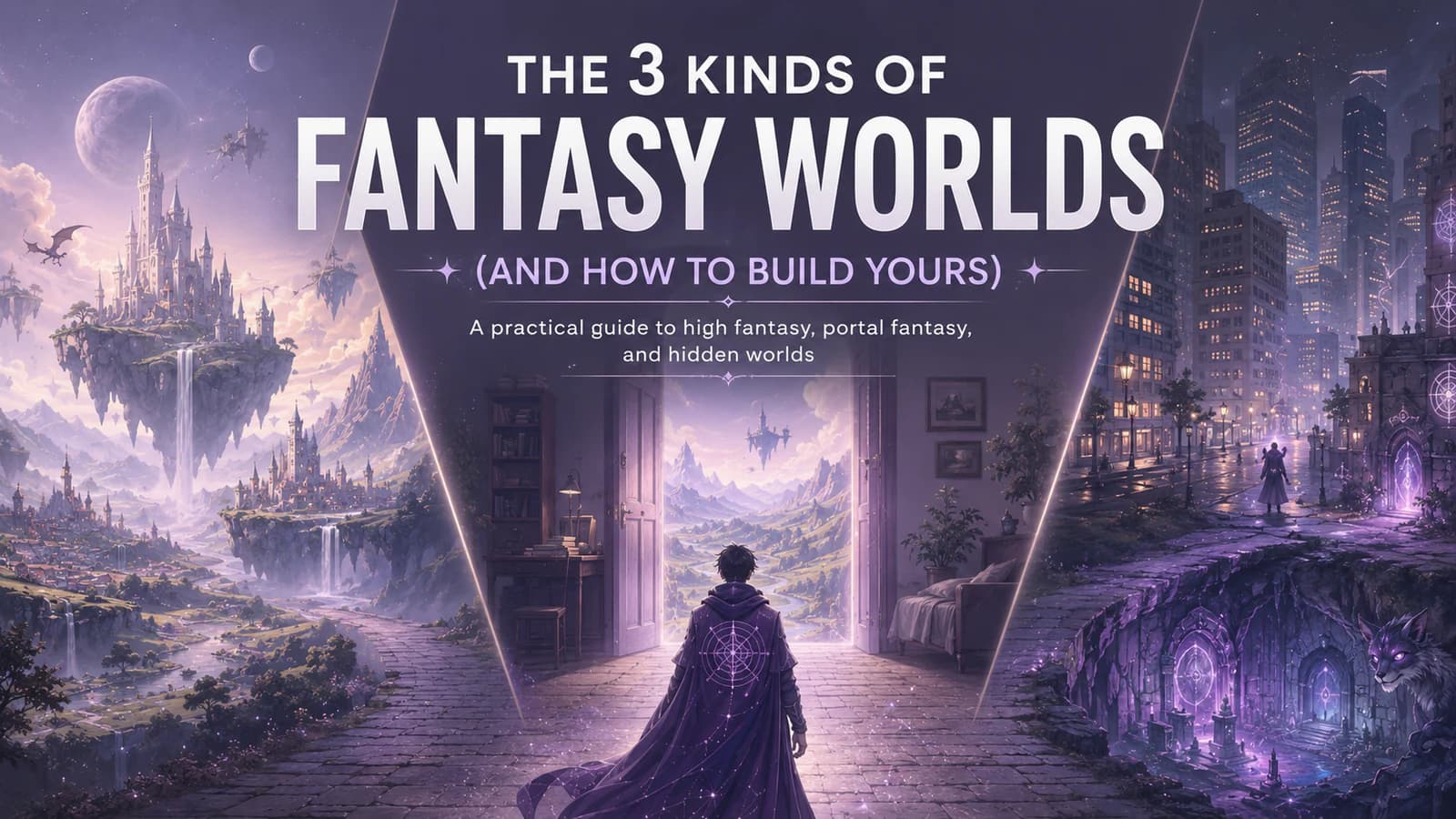
The three kinds of fantasy worlds are fully imagined worlds, portal worlds, and hidden worlds. Fully imagined worlds exist apart from Earth, portal fantasy connects our world to a magical one, and hidden-world fantasy places secret magic inside an otherwise recognizable reality.
In quick terms:
- Fully imagined worlds live entirely in a made-up place, with no Earth in sight. This is commonly associated with high fantasy.
- Portal worlds begin in our reality, then cross into somewhere fantastical through a doorway, object, event, or other threshold.
- Hidden worlds keep the real world in place while magic operates secretly underneath it, as it often does in low, urban, or contemporary fantasy.
Genre labels overlap, and not every story fits a perfect box. Still, these three types of fantasy worlds provide a useful starting point because each creates a different relationship between the invented setting and the real world.
If you have the seed of a setting but are not sure which structure fits it, our fantasy world generator guide shows how to turn that first premise into people, places, rules, and conflicts you can evaluate together.
1. Fully imagined worlds: fantasy from page one
What is a fully imagined fantasy world?
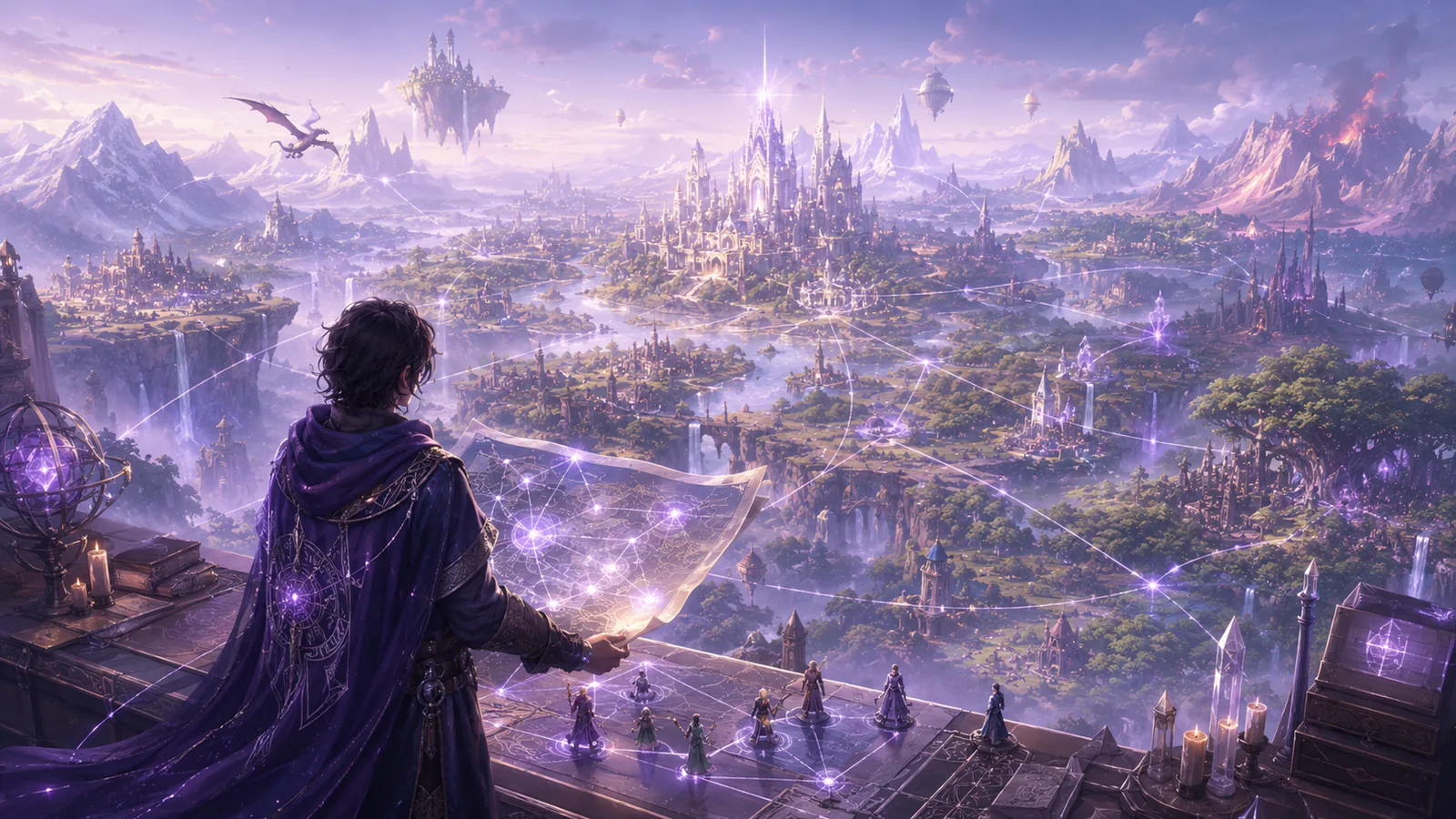
A fully imagined world has its own geography, cultures, history, and internal logic, with no version of Earth anywhere in sight. Middle-earth in The Hobbit, Alagaësia in Eragon, and the vast setting of The Eye of the World all place the reader somewhere else from the opening pages. Nobody stops to explain how they arrived because, for the characters, this world is home.
These settings are often called secondary worlds and are strongly associated with high fantasy. They offer enormous creative freedom, but they also ask the most of a worldbuilder up front. If you are not borrowing a familiar nation, religion, economy, or landscape from reality, every mountain range, rival kingdom, and local god must be invented—and should still feel as though it belongs beside everything else.
Classic examples of fully imagined worlds
Ursula K. Le Guin's Earthsea makes true names the basis of magic. Brandon Sanderson's Mistborn uses a magic system precise enough to feel scientific. Terry Pratchett's Discworld is fantastical in shape but deeply human in its institutions, while George R.R. Martin's Westeros can make politics more dangerous than dragons. Each setting suggests that history happened before the reader arrived: old wars shaped borders, trade influenced cities, and faith changed laws.
How to build a high-fantasy world from scratch
Do not begin by filling an entire map. Start with one location and the people arguing inside it. A town facing a water shortage will reveal its class system, leadership, economy, geography, and beliefs much faster than a list of disconnected facts.
Use this order when deciding how to build a fantasy world:
- Choose the world's core promise. What can happen here that could happen nowhere else?
- Create one important location. Give it a purpose, a problem, and a reason people stay.
- Add a character shaped by that place. Decide what they love about it and what they desperately want to change.
- Define three dependable rules. These may govern magic, politics, nature, or social life.
- Expand only when the story creates pressure. Build the neighboring kingdom when someone needs to flee there, invade it, or bargain with it.
A connected setup makes that expansion easier. In Summon Worlds, you can create the World, attach Locations, and add the Characters who live in those places. A city remains connected to its kingdom, while a character's history remains connected to the city that raised them. For more on tying a person's past to the setting, read our guide to avoiding common fantasy character backstory mistakes.
If you need to see a place before you can describe it, visualize key locations as you build. An imagined throne room can reveal where petitioners wait, how guards control the doors, and what the ruler wants visitors to notice.
2. Portal worlds: the fantasy you enter from ours
How portal fantasy works
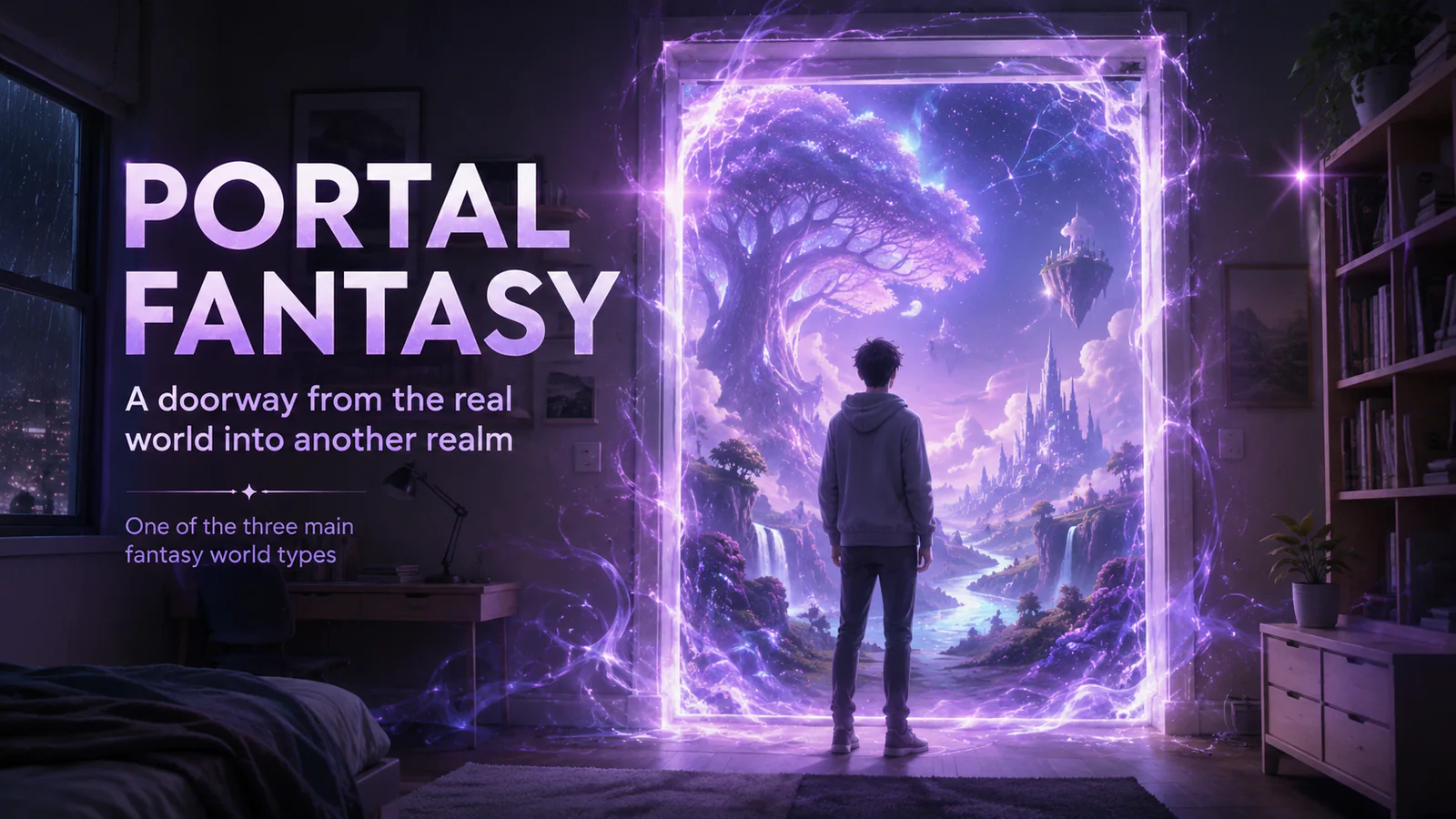
Portal fantasy opens in an ordinary, recognizable reality and pulls a character—and therefore the reader—through a threshold into somewhere strange. The threshold might be a wardrobe in The Chronicles of Narnia, a tesseract in A Wrinkle in Time, or a rabbit hole in Alice's Adventures in Wonderland. One moment the character is at home; the next, the rules of reality have changed.
The appeal comes from contrast. The fantasy world feels especially magical because the reader has just left a schoolyard, apartment, kitchen, or suburban street behind. That means portal fantasy requires you to build two settings and one extremely important connection between them.
Portal-fantasy stories that use the doorway well
Philip Pullman's His Dark Materials crosses through openings cut in the air. Neil Gaiman's Coraline finds horror behind a door to a slightly wrong version of home. The Wizard of Oz carries a Kansas farmhouse into another land, while Spirited Away sends a child through a tunnel into a bathhouse for spirits. Each story asks whether the traveler can return and whether home will still feel like home afterward.
High fantasy vs. portal fantasy
The simplest distinction between high fantasy and portal fantasy is the character's relationship to Earth. High fantasy generally takes place entirely in an invented secondary world. Portal fantasy begins in a familiar reality and crosses into a fantastical setting.
Both can contain epic quests, invented languages, kingdoms, and elaborate magic. The difference is structural. A high-fantasy protagonist usually understands the world's ordinary rules, while a portal-fantasy protagonist can discover those rules alongside the reader. That makes the newcomer a natural source of questions and explanations.
How to build two worlds and a doorway
Keep the ordinary and fantasy sides distinct while planning. List the people, places, obligations, and fears the protagonist leaves behind. Then build the destination around strong contrasts. If home is rigid, perhaps the new world is dangerously changeable. If home is lonely, the destination might make relationships literally magical.
Treat the portal as a piece of worldbuilding rather than a convenient plot button. Ask:
- Where is the doorway, and why does it exist there?
- Who can find, open, or survive it?
- Does time pass differently on either side?
- What does crossing cost?
- Who benefits from keeping it open or closed?
- What can travel back through it?
A doorway with rules creates decisions. A doorway that opens whenever the plot needs help usually creates plot holes.
3. Hidden worlds: magic tucked inside ours
What is hidden-world fantasy?
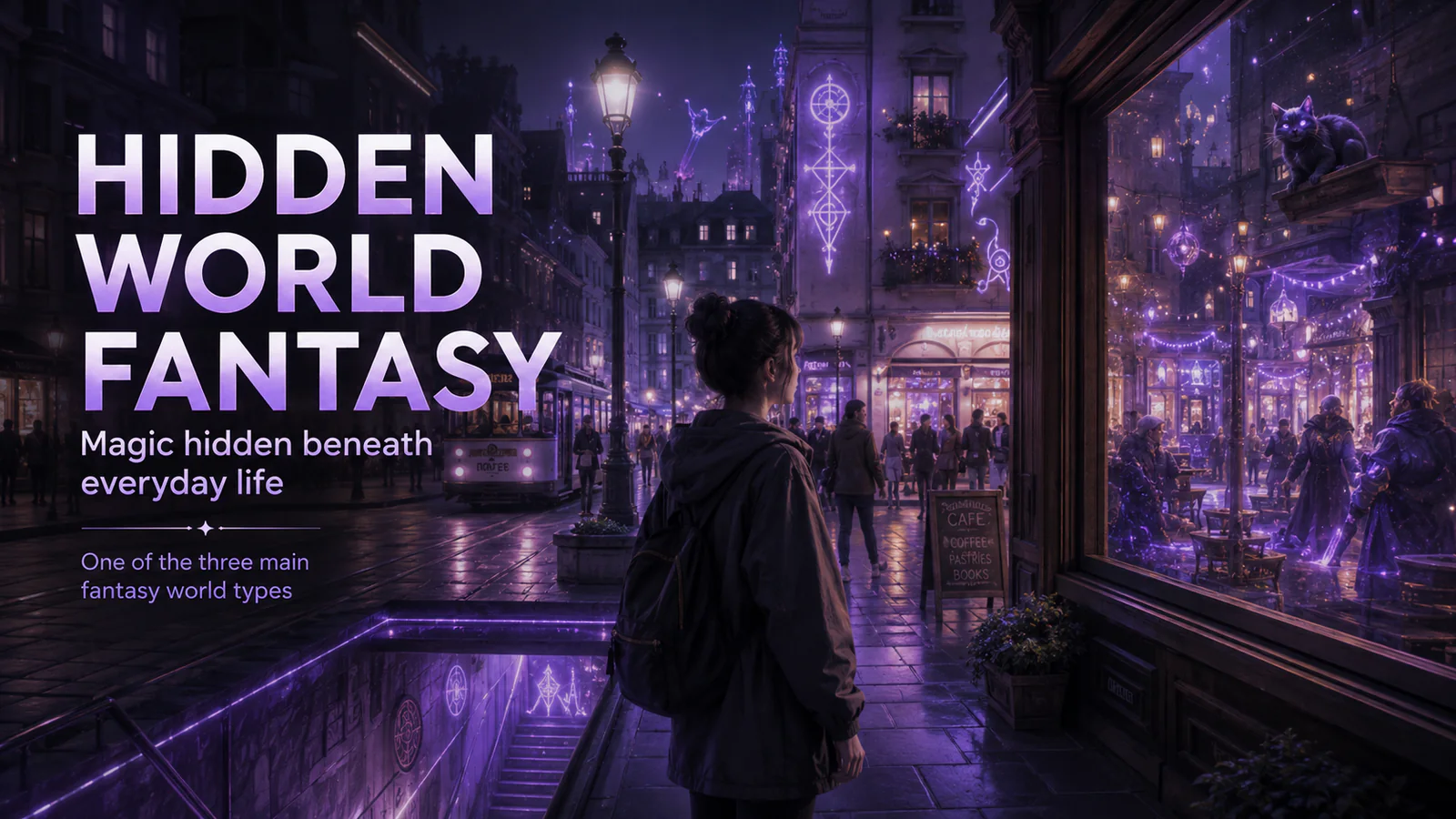
Hidden-world fantasy never fully leaves reality. Instead, it reveals that magic has been operating beneath everyday life all along. Percy Jackson discovers that the Greek gods remain active in The Lightning Thief. Artemis Fowl encounters fairies whose technology surpasses humanity's. Familiar streets, schools, and businesses remain in place, but the rules underneath them turn out to be different.
This structure appears across hidden world fantasy, urban fantasy, contemporary fantasy, and some forms of low fantasy. Those labels are not exact synonyms: low fantasy can also describe magic intruding into an otherwise ordinary world without a vast secret society. What matters here is the central relationship—our recognizable reality remains present, and the fantastic must survive contact with it.
Familiar examples of hidden magic
The Harry Potter series hides a magical society behind barriers most people cannot perceive. The Dresden Files gives modern Chicago a working wizard, while Neverwhere builds a society beneath London from places and people the city has forgotten. Their connecting thread is the masquerade: someone prevents the wider world from learning the truth. The setting becomes richer once you decide who maintains that secret and what the effort costs.
How to keep hidden magic believable
This kind of fantasy worldbuilding is deceptively difficult because readers already understand the surface setting. If monsters appear at a shopping mall, why has nobody posted a convincing video? If magic can heal serious injuries, why has it not transformed medicine? If a secret council controls the city, what happens when its decisions collide with public institutions?
Build the concealment system as carefully as the magic system:
- Detection: What evidence does magic leave behind?
- Explanation: How are sightings dismissed, altered, or contained?
- Enforcement: Who responds when someone breaks secrecy?
- Incentive: Why do magical people agree to remain hidden?
- Failure: What happens when the masquerade cracks?
Pressure-test these rules through characters. Ask a magical investigator how they contain evidence, or ask a fairy accountant how an underground economy interacts with human banks. If the answers contradict one another, you have found either a plot hole or the seed of a conflict.
How to choose the right kind of fantasy world
Choose the structure that creates the experience you want the reader to have.
- Pick a fully imagined world when discovery should come through cultures, history, travel, and conflict inside a place that belongs wholly to your characters.
- Pick a portal world when crossing the boundary, comparing two lives, or deciding whether to return is central to the story.
- Pick a hidden world when the tension comes from secrecy, double lives, or magic colliding with systems the reader already knows.
You may not know the answer immediately. Some stories begin as one type and become another as the writing reveals what they need. A hidden magical door might eventually lead to a full secondary world. A portal may close forever, forcing the visitor to treat the destination as home. Categories are tools, not fences.
Your setting should also create pressure on the cast. Once the world's rules are clear, use our fantasy character-building guide to create people whose desires and flaws belong to that setting.
Then connect those pressures to events with this guide to building fictional worlds that drive the plot, so the setting changes what your characters can choose and what their choices cost.
When you are ready to turn those world rules into conflict, see how Fantasy AI can help shape story arcs while keeping your creative decisions in control.
Build a fantasy world with friends
You do not have to create alone. Turn a World into a Shared World so collaborators can develop locations, characters, and lore from the same source of truth instead of trading scraps across group chats. One person might shape geography, another factions, and another characters. See the Getting Started with Shared Worlds guide for the collaboration workflow.
Try this: build your first world tonight
Pick the group that makes you want to write, then choose one seed.
Fully imagined world prompts
- A desert kingdom where water is the only currency and the royal family controls the last working well.
- A cluster of floating islands where each island speaks a different language and all trade happens by airship.
- A world where dead gods became mountains that people mine for raw magic.
Portal-world prompts
- A child finds a door in their new apartment that opens only during thunderstorms.
- A grandmother's attic leads to the country she left, frozen in the exact year of her departure.
- An abandoned subway station runs one extra train that nobody is supposed to board.
Hidden-world prompts
- The city's pigeons form a surveillance network controlled by an ancient, bored guild.
- Every lighthouse keeper along the coast is secretly holding one particular creature at bay.
- A 24-hour diner serves only the recently dead—and a living person has just been hired for the night shift.
The complete action item fits on one line: create the World, add its first Location, and give it one Character with strong opinions about the place. That is a world. Everything else can grow outward from there.
Frequently asked questions
What are the three kinds of fantasy worlds?
The three kinds of fantasy worlds are fully imagined worlds, portal worlds, and hidden worlds. Fully imagined worlds exist independently of Earth, portal worlds connect Earth to a fantasy realm, and hidden worlds place secret magic within a recognizable reality.
What is the difference between high fantasy and portal fantasy?
High fantasy generally takes place entirely in an invented world with no direct connection to Earth, as in The Hobbit. Portal fantasy starts in the real world and moves a character into a fantastical one through a doorway or threshold, as in The Chronicles of Narnia.
How do I start building a fantasy world?
Start small. Choose one location, define the problem affecting it, and create a person who lives there. Add three dependable rules, then expand the world only when the story needs another place, culture, faction, or piece of history.
Which kind of fantasy world is easiest to write?
It depends on your strengths. Fully imagined worlds offer the most freedom but require more invention. Portal fantasy gives the reader a familiar viewpoint character. Hidden-world fantasy can be the trickiest because its magic must remain believable beside modern reality.
Can I build a fantasy world with friends?
Yes. A Shared World lets multiple creators develop the same connected universe so locations, characters, and lore remain together rather than being scattered across separate notes and conversations.