Petrichor Prime
Locations
Browse the public locations that belong to this world. Select a card to read more.
Public locations roster

The Palace of the Last Sovereign
Entombed beneath the fractured remnants of Escobare, the Palace of the Last Sovereign rises from a volcanic plateau within an immense subterranean cavern, a testament to the architectural ambitions of a civilization that vanished nine centuries ago during the cataclysm known as the Great Silence. The palace sprawls across the black stone elevation, its obsidian and marble walls still gleaming despite the weight of centuries, adorned with intricate carvings that chronicle the reigns of thirteen sovereigns and their greatest achievements, though time and seismic activity have weathered many into illegibility. Towering spires pierce the darkness toward the cavern roof, where clusters of violet crystals cast an eerie phosphorescence over the desolate complex, their glow now the palace's only illumination since the ancient magical systems failed long ago. Colossal statues of ancient rulers stand sentinel along the approach routes, their features eroded by moisture and mineral deposits, though locals whisper that some have shifted position—a claim impossible to verify given the rarity of visitors to this forsaken place. The grand ceremonial bridges connecting the palace to the surrounding royal district lie in ruins, their collapsed spans creating treacherous passages that would-be explorers must navigate with extreme caution. At the heart of the palace stands the Hall of Thirteen Thrones, a magnificent domed chamber where the mummified remains of Lord Azharek Voss still occupy the royal seat, preserved by the palace's lingering crystalline energies and the dry subterranean air. The palace remains abandoned save for the creatures that have adapted to its darkness, the slow decay of its incomparable materials, and the faint resonance of Resonant Glass that occasionally hums with inexplicable energy in the depths of night.
View details
The Chasm of Forgotten Names
Deep beneath the crumbling ruins of Escobare lies a catastrophic geological wound that has shaped the fate of an entire civilization. This immense fracture splits the bedrock of the Underdark for miles, its opposing cliff faces separated by an abyss so vast that no light has ever revealed its bottom. The obsidian walls gleam with an otherworldly sheen, their surfaces carved with thousands upon thousands of names—a grim testament to those lost to the chasm's depths across countless centuries. Skeletal remains of once-grand Escobari architecture cling desperately to the precipice: toppled temples, fractured towers, and the skeletal frameworks of ancient excavation platforms now serve only as monuments to a vanished empire. Rotted rope bridges and corroded chains hang uselessly into the darkness, their purposes long forgotten, while broken staircases lead nowhere, their endpoints shattered and scattered into shadow. Within the endless void, ethereal lights of pale blue, ghostly violet, and sickly green drift and pulse with an unsettling sentience, sometimes arranging themselves into geometric patterns before dispersing into chaos. An ancient, resonant hum emanates from the unfathomable depths below, distorting the very air above the chasm and causing the surrounding stone to vibrate with an energy that feels neither natural nor entirely benign. The ruins surrounding the chasm stand abandoned and decaying, their once-grand halls now silent except for the wind that howls perpetually from the abyss, carrying with it the faint whispers of those whose names have been swallowed by time and darkness.
View details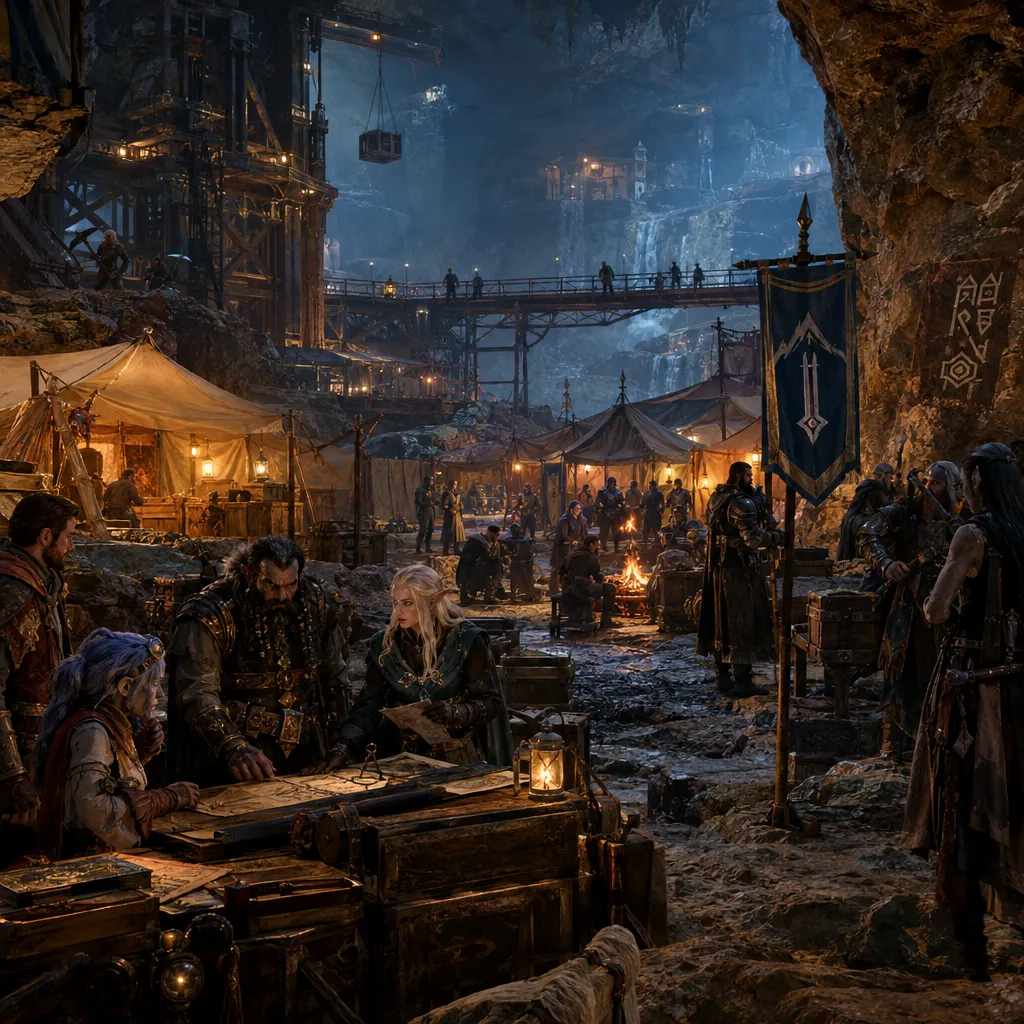
Helgar's Expedition
Helgar's Expedition represents one of the most significant archaeological endeavors in the deep caverns, led by the visionary dwarf scholar Helgar Stonevein and comprising a diverse coalition of Dark Dwarves and Deep Gnomes. Established to unearth and preserve the forgotten histories of the ancient subterranean cities, the expedition maintains a sprawling base camp filled with laboratories, archival chambers, and carefully catalogued artifact repositories. Helgar's strict protocols regarding the containment of dangerous magical items have earned the expedition respect among scholarly circles, though this same policy has created considerable friction with opportunistic merchants and ambitious treasure seekers who view the site as a potential source of wealth. The expedition operates under principles of neutral good governance, balancing the pursuit of knowledge with genuine concern for the welfare of the surrounding cavern communities and the responsible stewardship of powerful relics. A formidable security force, comprising seasoned warriors and battle-tested scouts, maintains constant vigilance around the excavation sites and artifact vaults, ensuring that no dangerous discoveries leave the expedition's control. The combination of genuine scholarly passion and martial preparedness has transformed Helgar's Expedition into a stable haven of learning where researchers can work without fear of raids or theft. Tensions with external factions—including surface kingdom diplomats seeking rare artifacts and independent prospectors denied access to promising dig sites—simmer beneath the surface but have not yet destabilized the expedition's operations. The site attracts adventurers seeking employment as guards, guides, or research assistants, making it a natural gathering point for those interested in exploration, history, and the mysteries of the deep world.
View details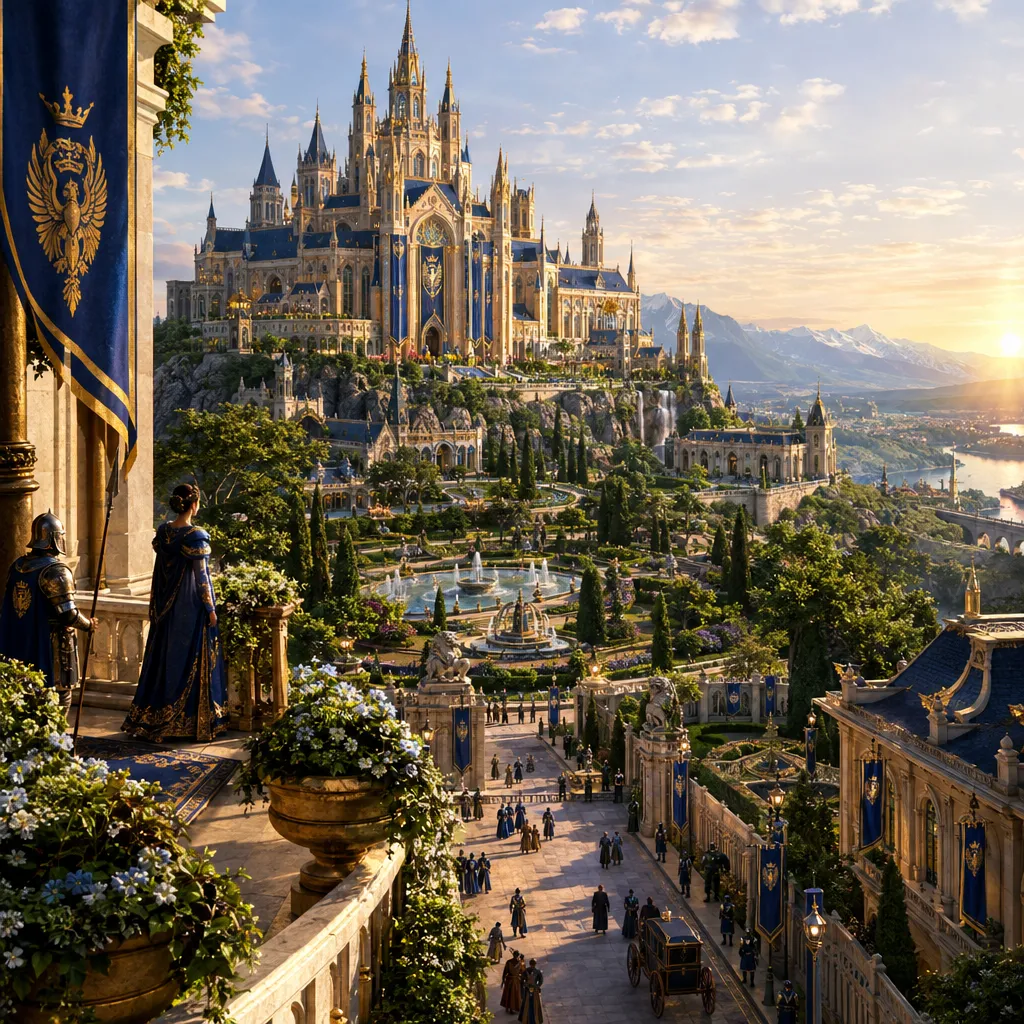
Crownspire
Perched atop the kingdom's most prominent elevation, Crownspire stands as the gleaming heart of royal authority and political power. The district's defining structure, the Palace of the Seven Crowns, rises majestically at its center—a architectural marvel whose towers and spires can be seen from nearly every corner of the realm, serving as a constant reminder of unified sovereignty. The palace itself houses the seven ancient crowns, each representing one of the petty kingdoms that centuries ago pledged themselves under a single banner, creating the foundation of modern Alderan. Radiating outward from this magnificent seat are lavish noble estates, their manicured grounds and ornate facades reflecting generations of accumulated wealth and influence. Government ministries occupy carefully positioned buildings along the district's tree-lined avenues, where the machinery of state administration operates with practiced efficiency. The Kingsguard maintains an ever-vigilant presence throughout Crownspire, their polished armor and disciplined formations a testament to the security and order that characterizes this thriving district. Sculpted gardens showcase the finest horticultural achievements, filled with rare flora and artistic stonework that attracts scholars and aesthetes alike. Access to the innermost palace grounds remains strictly regulated, with guards carefully vetting visitors and verifying legitimate business before permitting entry. The district bustles with purposeful activity—nobles conducting affairs of state, merchants fulfilling exclusive commissions, and couriers carrying important dispatches between ministries. Despite its grandeur and exclusivity, Crownspire remains accessible to common citizens with proper reason to visit, allowing the kingdom's subjects to witness the splendor of their unified realm.
View details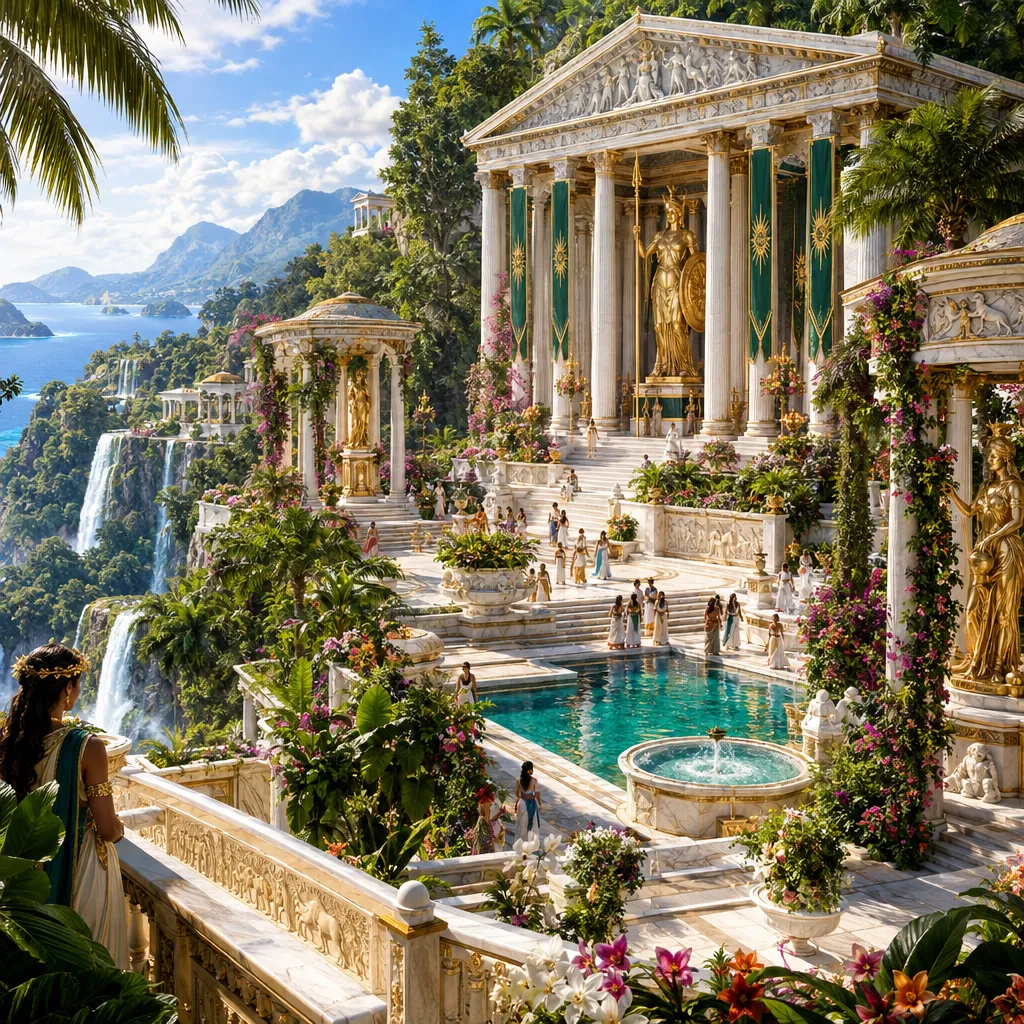
The Sacred Gardens of Thalassara,
The Sacred Gardens of Thalassara stand as one of the most magnificent spiritual sanctuaries ever constructed, a sprawling temple complex that rises majestically from the emerald jungle canopy of the Westerly Isles. Built upon the legendary marble terraces of Thalassara itself, the ancient capital of the Amazon civilization, these gardens represent millennia of devotion to the Three Divine Mothers—Thessara the Spear-Mother, Sylthene the Verdant Mother, and Nerathia the Tide-Mother. Pristine white marble and polished ivory limestone structures grace the landscape, their Ionic and Corinthian columns soaring skyward among colossal tropical trees, while intricate carvings depict legendary warrior queens and sacred mythological narratives. The Great Temple of Thessara dominates the center, an awe-inspiring Hellenistic sanctuary crowned by a towering golden statue of the Spear-Mother herself, her radiant spear and shield catching sunlight that filters through emerald banners embroidered with golden sunbursts. Crystal-clear turquoise pools reflect the ornate architecture, their waters fed by cascading waterfalls and decorative fountains that create a symphony of flowing water throughout the gardens. Bronze and gold statues of the Three Divine Mothers stand within open-air shrines, each surrounded by luxuriant displays of exotic orchids, flowering vines, and fragrant tropical blossoms that perfume the air. Today, the gardens thrive as a vital pilgrimage destination, meticulously maintained by devoted priests and priestesses who oversee daily rituals, healing ceremonies, and spiritual instruction for seekers from across the known world. Pilgrims arrive year-round seeking wisdom, miraculous healing, and communion with the divine, their presence ensuring the gardens remain vibrant centers of faith, culture, and sacred knowledge.
View details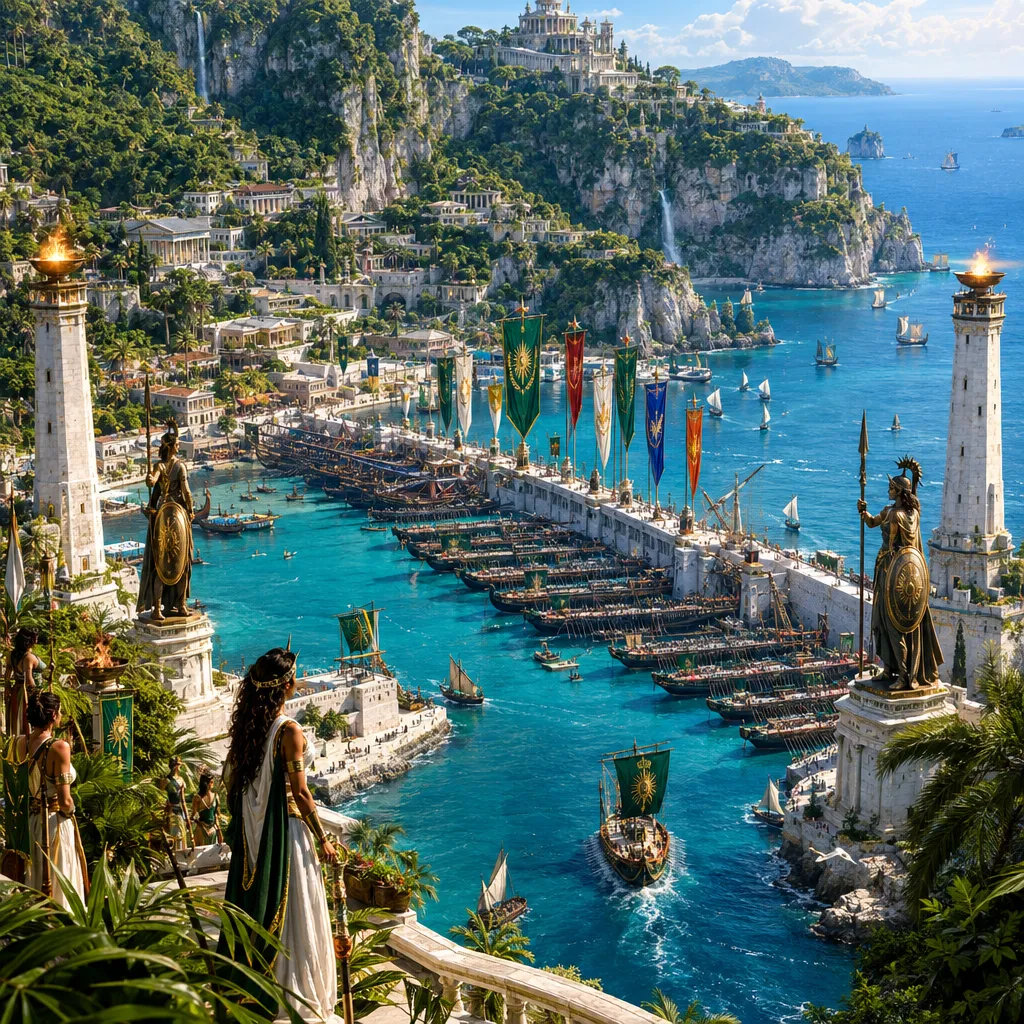
The Harbor of Seven Banners
The Harbor of Seven Banners stands as the gleaming jewel of Thalassara, a magnificent port city hewn from the very heart of the Westerly Isles where an ancient Amazon civilization reached its zenith of power and prosperity. Cradled within an enormous crescent bay, the harbor is framed by soaring white limestone cliffs draped in verdant jungle growth, creating a natural fortress of breathtaking grandeur. Crystalline turquoise waters lap against pristine white marble seawalls reinforced by imposing defensive towers and elaborate coastal fortifications, while twin marble lighthouses crowned with eternal bronze braziers mark the harbor's entrance like sentinels of stone. Colossal bronze statues of legendary warrior queens stand vigilant upon the breakwaters, their spears and shields catching the tropical sunlight as merchant vessels and military galleys pass beneath their watchful gaze. Seven towering flagpoles bearing the emerald, crimson, ivory, and royal-blue banners of the island kingdom's provinces dominate the central seawall, with the royal standard proudly displaying a golden spear beneath a seven-rayed sun encircled by an emerald wreath. The military docks overflow with the kingdom's formidable war fleet—sleek triremes and powerful warships that have secured Thalassara's dominance over the surrounding seas for generations. Bustling commercial quays teem with merchants from distant lands, their vessels laden with exotic spices, fine textiles, and precious goods that fuel the city's legendary wealth and influence. The harbor remains a thriving nexus of trade, military might, and cultural exchange, where the Amazon civilization's maritime legacy continues to flourish under the eternal tropical sun.
View details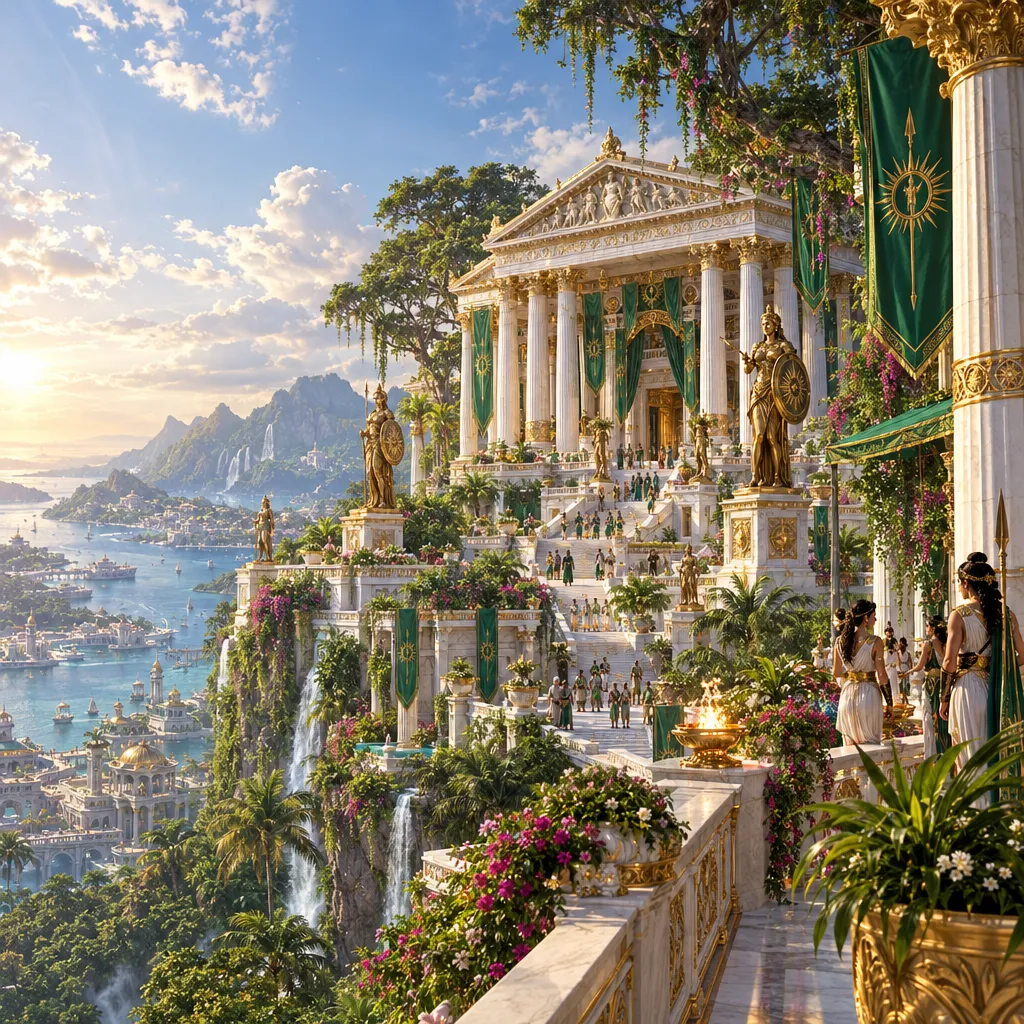
The Royal Acropolis
Perched majestically upon the highest of seven terraced hills that rise from the heart of Thalassara, the Royal Acropolis stands as a testament to centuries of Amazon civilization's artistic and architectural excellence. Constructed from luminous white marble quarried from distant mountains and polished ivory limestone, the complex gleams brilliantly in the tropical sun, its surfaces adorned with intricate bronze and gold ornamentation that catches the light like captured flames. Towering Corinthian columns, some reaching heights of forty feet, support magnificent triangular pediments carved with elaborate bas-reliefs chronicling the legendary deeds of Amazon queens, their military triumphs, and the mythical founding of their glorious kingdom. The ceremonial approach features grand marble staircases ascending in graceful tiers, guarded at the summit by colossal bronze statues of shieldmaidens whose spears and circular shields gleam with meticulous polish and recent maintenance. At the heart of this architectural wonder rises the Palace of the Emerald Crown, Queen Cersia's magnificent residence, where multiple columned halls, open-air courtyards, and golden-roofed pavilions create spaces both grand and intimate for governance and celebration. Vibrant emerald-green banners bearing the golden seven-rayed sun symbol flutter constantly from towering columns, while fragrant flowering vines cascade across marble balconies in a harmonious blend of civilization and nature. Ancient jungle giants rise between the marble structures, their massive trunks creating natural supports for hanging gardens that overflow with exotic blooms and trailing vegetation. The complex thrums with purposeful activity as scholars, artisans, guards, and servants maintain the grounds and structures with evident pride, while merchants and dignitaries regularly ascend the great stairs for audiences with the Emerald Sovereign. Every plaza and pavilion displays the wealth and cultural vitality of a pros
View details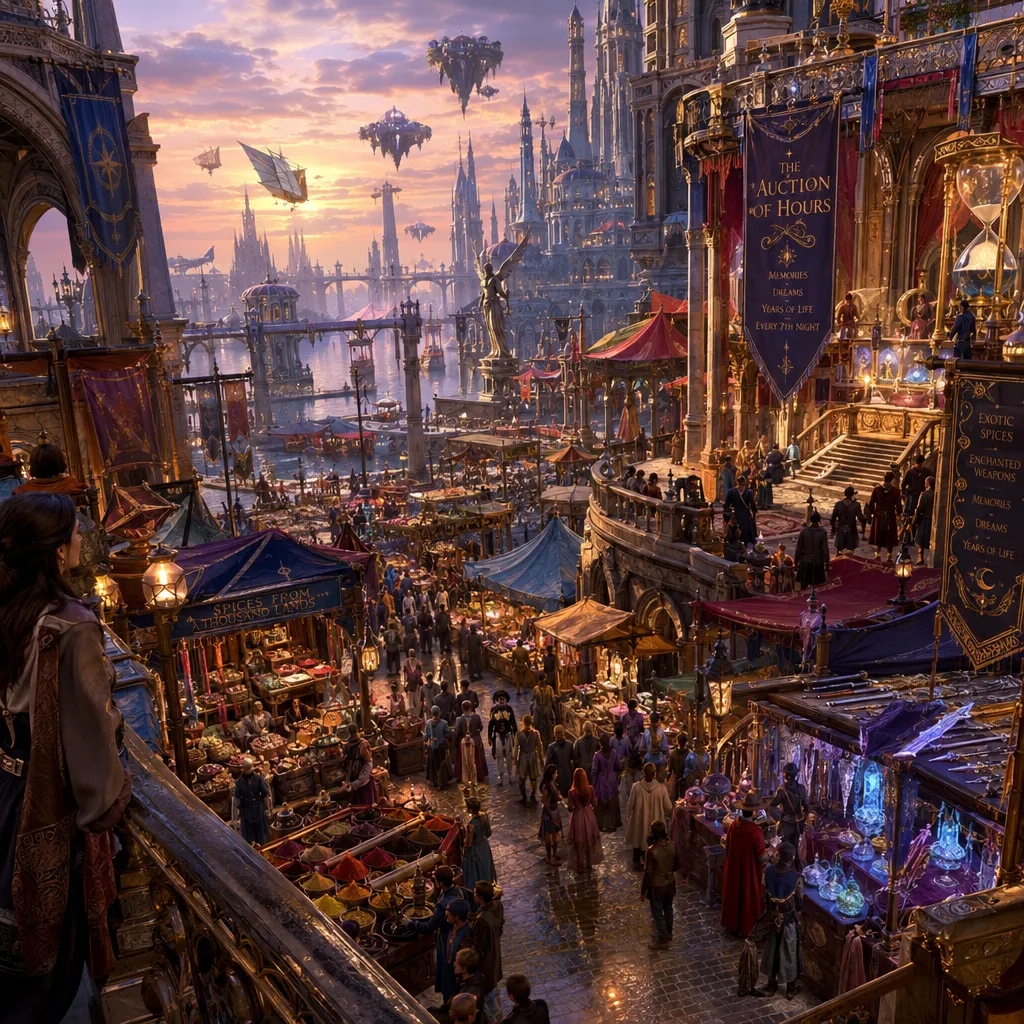
The Thousandfold Bazaar
Nestled within the labyrinthine streets of the merchant quarter, The Thousandfold Bazaar sprawls across nearly forty city blocks in a chaotic tapestry of stalls, shops, and open-air markets that never fully close. Founded over three centuries ago as a neutral ground between rival trading houses, it has evolved into the most vibrant commercial hub in the known world, where legitimate merchants operate alongside enigmatic dealers who traffic in commodities far stranger than conventional goods. The air perpetually thrums with haggling voices, the clinking of coin, and the sizzle of food vendors preparing delicacies from a hundred distant lands, while exotic spices perfume every corner and enchanted weapons gleam temptingly from merchant displays. Beyond the ordinary trade in silks and gemstones, The Thousandfold Bazaar has become infamous for its shadier commerce—brokers openly exchange bottled memories, crystallized dreams, and even years of life itself, drawing both desperate seekers and unscrupulous collectors. Every seventh night, the legendary Auction of Hours convenes in the Bazaar's grand rotunda, where the rarest and most controversial lots come under the hammer, drawing wealthy bidders from across the realm. The district thrives with constant activity, its prosperity evident in the well-maintained architecture, the presence of numerous guards and arbiters ensuring commerce flows smoothly, and the steady stream of adventurers, nobles, and common folk seeking fortune or rare acquisitions. Despite its energy and opportunity, The Thousandfold Bazaar remains a place of calculated danger, where contracts are binding, theft is met with swift justice, and one must always question the true cost of any bargain struck in its shadowed alleys.
View details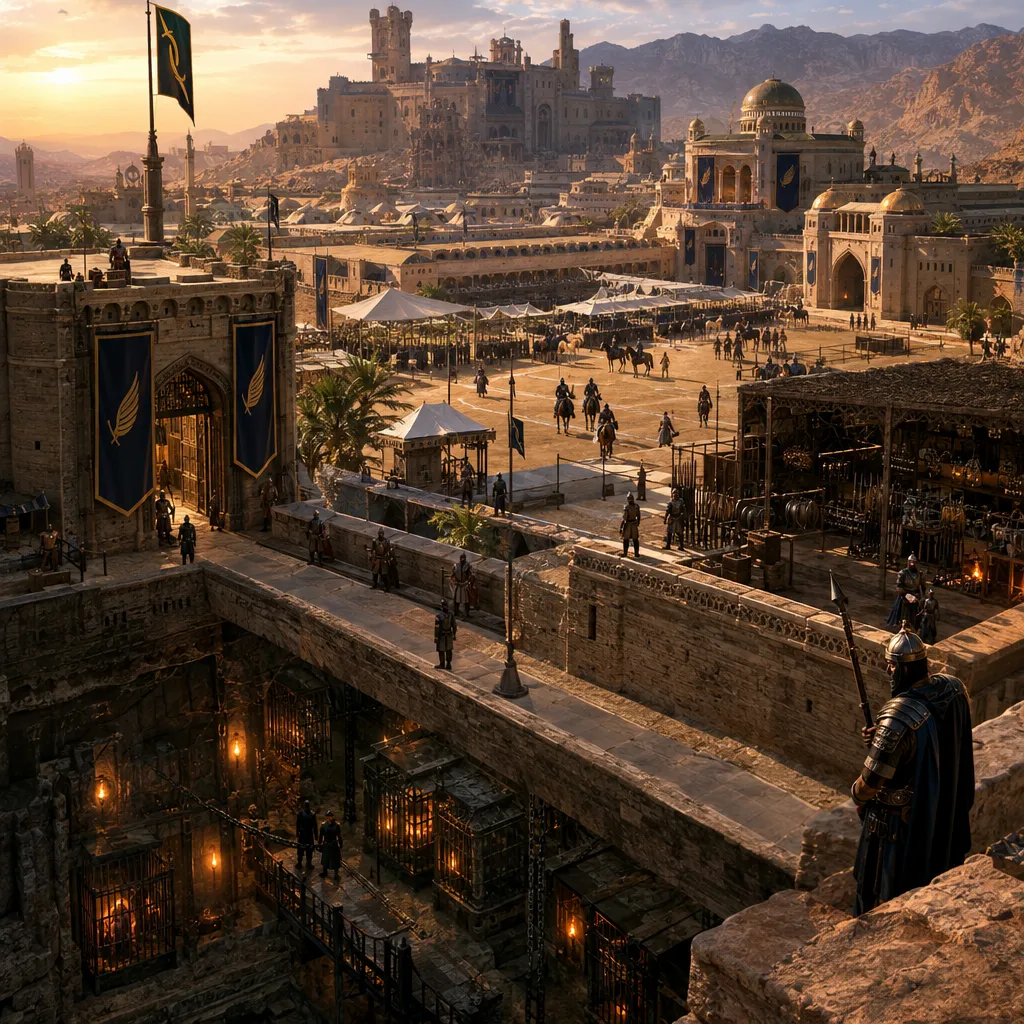
The Iron Crescent
The Iron Crescent stands as Qasrath's formidable military nerve center, a sprawling fortress district dominated by imposing stone fortifications and the rhythmic clang of smithies working day and night. The compound's upper levels house extensive barracks capable of quartering thousands of soldiers, their geometric layout reflecting centuries of martial tradition and strategic refinement. Sprawling cavalry grounds occupy the eastern reaches, where the city's mounted forces train relentlessly, their thundering drills a constant reminder of Qasrath's military might. Massive armories line the inner walls, their vaults containing an arsenal of weapons and armor accumulated through generations of conquest and conflict. At the district's heart rises the austere headquarters of the Gilded Scimitars, the elite military order whose commanders shape Qasrath's strategic ambitions. The fortress's oppressive atmosphere intensifies when descending into its depths, where a heavily guarded subterranean prison complex holds those deemed threats to the state—political dissidents, sorcerers of questionable allegiance, and creatures too dangerous for conventional confinement. Magical wards and iron seals reinforce this underground labyrinth, maintained by specialized guards trained in both martial combat and arcane suppression. The Iron Crescent pulses with constant activity: marching columns, weapons drills, supply convoys, and the ever-present tension of a military establishment perpetually prepared for war or internal threat.
View details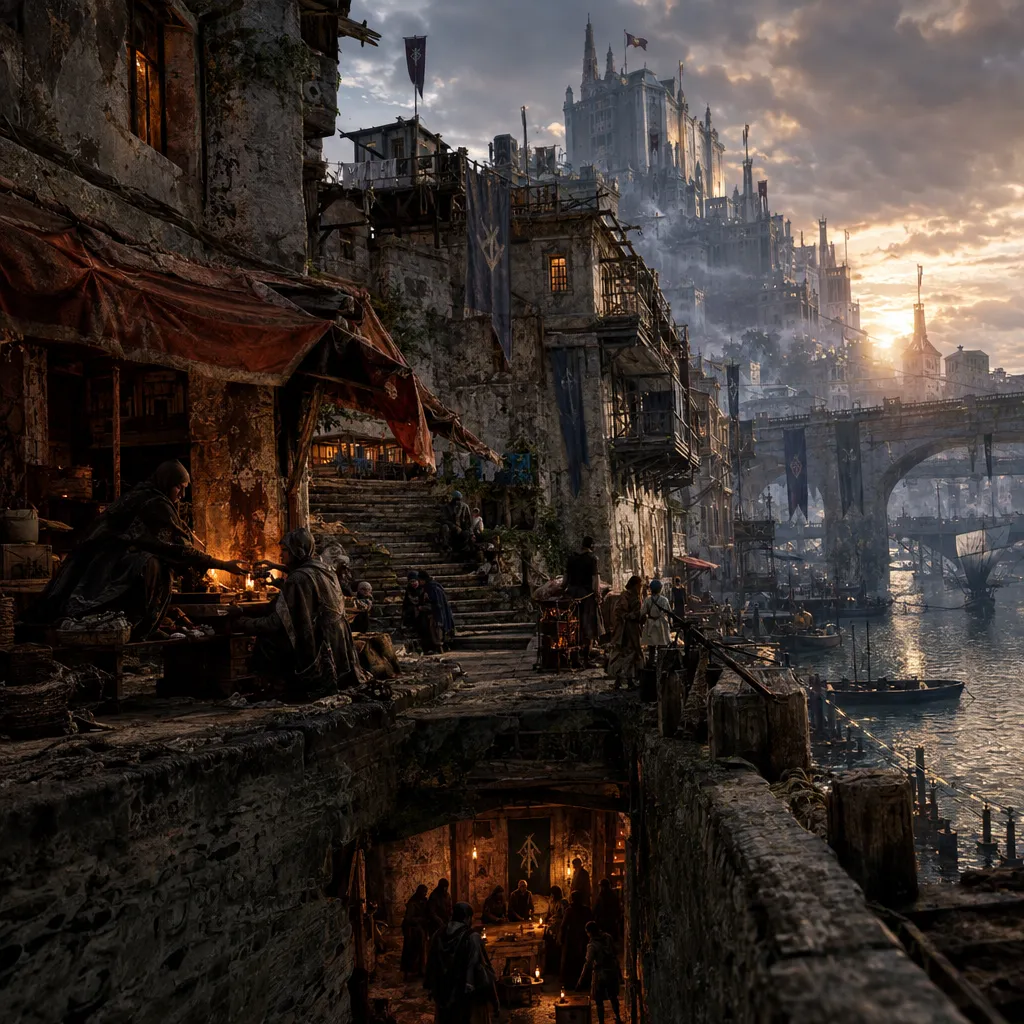
The Dust Warrens
Once a thriving mercantile quarter, the Dust Warrens have devolved into a sprawling slum of cramped tenements, crumbling warehouses, and interconnected hovels that seem to shift with the wind. The district earned its name from the perpetual haze of pulverized stone and refuse that hangs over its narrow streets, a byproduct of decades of neglect and the constant excavation of underground tunnels by desperate residents seeking shelter and space. Poverty pervades every corner, with families crowded into single rooms and laborers working grueling shifts for pittances barely sufficient to purchase bread and water. A grim economy has emerged wherein the most vulnerable sell years or months of their remaining lifespans to wealthy merchants and collectors, their vitality literally drained away in exchange for survival coin. Infrastructure crumbles visibly—collapsed buildings remain uncleared, sewage runs openly through gutters, and fires frequently ravage entire blocks with little resistance from authorities who have abandoned the district entirely. Beneath the surface, a network of hastily carved chambers and tunnels serves as refuge for the Unbound Hour, a shadowy resistance movement that smuggles the desperate out of debt contracts and plots against the systems that have reduced the Warrens to such desperation. Disease spreads readily through the overcrowded conditions, and violence between rival gangs competing for territorial control and survival resources has become routine. The few remaining services—black market healers, unscrupulous moneylenders, and smugglers—operate in the shadows, exploiting the residents' vulnerability while simultaneously being their only lifeline. The Warrens represent a society at its breaking point, where hope has become a luxury most cannot afford.
View details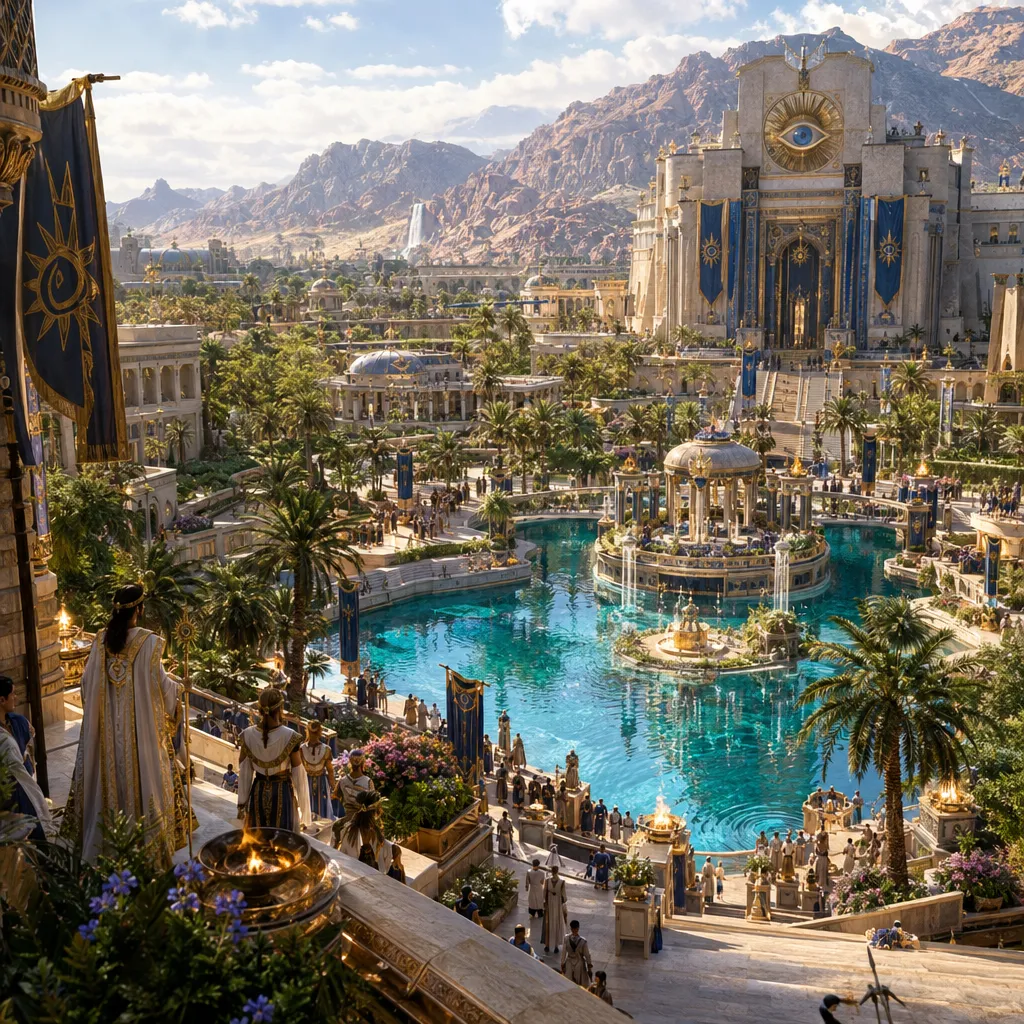
The Sacred Waters
Nestled in the heart of Qasrath, the Sacred Waters represent the spiritual epicenter of an entire civilization, drawing pilgrims and devotees from across the realm to witness the legendary Eye of Sahmera—a crystalline spring whose waters are said to hold prophetic visions and divine wisdom. The oasis thrives with constant activity, its perimeter adorned with magnificent marble temples that have stood for centuries, their spires catching the desert sun and casting ethereal shadows across the manicured ceremonial gardens below. Elaborate stone aqueducts channel the sacred waters through intricate channels, nourishing rare flowering plants and creating an oasis of unnatural verdancy in the surrounding arid wasteland. The priesthood maintains strict protocols governing access to the waters, with only the highest-ranking clergy and nobility permitted to drink directly from the Eye, while common visitors may participate in purification rituals at designated outer pools. Throughout the year, the Sacred Waters host grand religious festivals and prophetic ceremonies, with crowds gathering to hear the pronouncements of the High Seers who commune with divine forces at the main temple's inner sanctum. The thriving settlement supports numerous pilgrimage services, including elaborate guest houses, scriptoriums where sacred texts are copied, and markets selling ritual oils and ceremonial vestments. Vigilant temple guards patrol the grounds constantly, maintaining the sanctity of the site while welcoming legitimate visitors and ensuring the waters remain uncontaminated. Local legends speak of miraculous healings and divine interventions that occur within the gardens, fueling a steady stream of hopeful seekers who journey across deserts to touch the blessed springs.
View details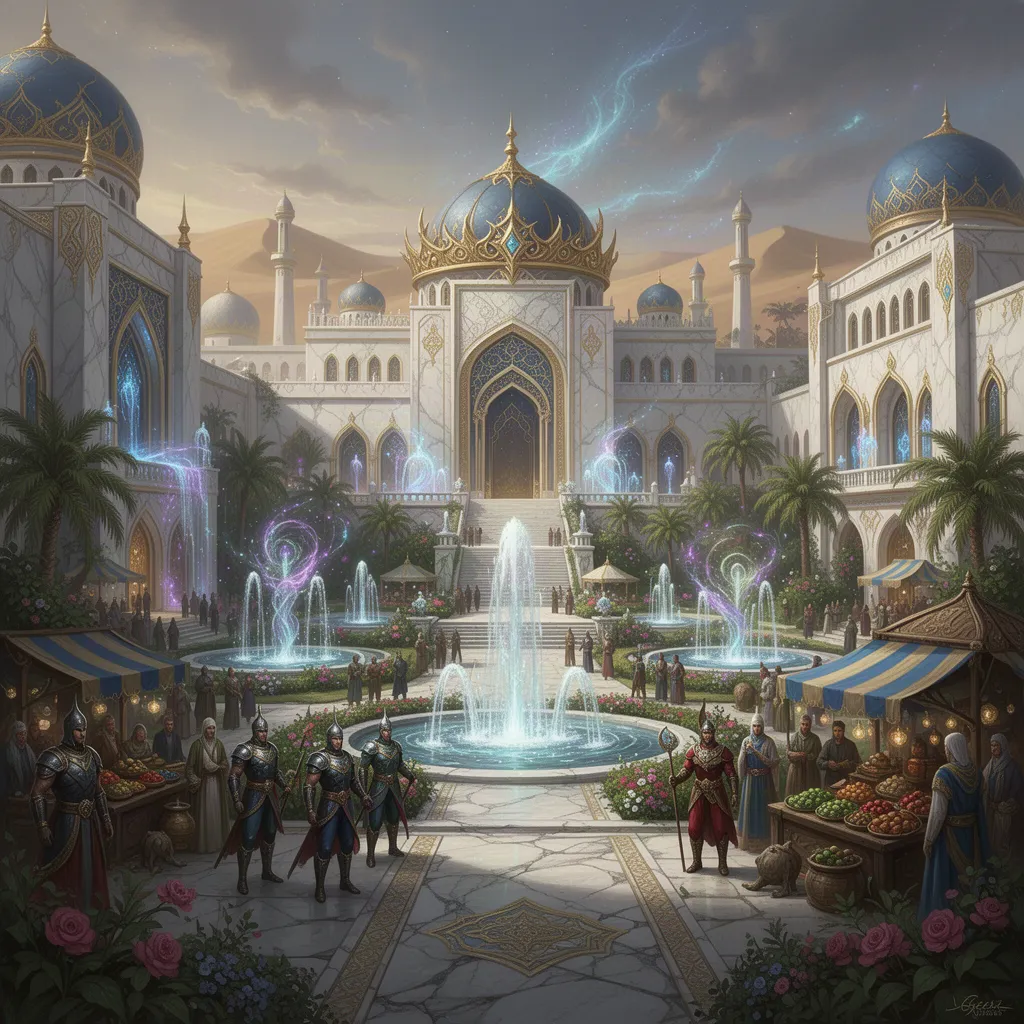
The Gilded Crown
Nestled within the heart of the desert metropolis, The Gilded Crown stands as a testament to centuries of mercantile dominance and accumulated wealth. Seven grand palaces rise majestically from this exclusive quarter, each one the ancestral seat of a merchant house whose trading networks span continents and whose influence shapes the very fabric of regional politics. The district's winding avenues are lined with marble facades inlaid with precious metals, their surfaces catching the sunlight in dazzling displays of opulence. Meticulously maintained botanical gardens flourish throughout the quarter, defying the harsh desert climate through a combination of sophisticated irrigation systems and powerful enchantments that preserve their verdant beauty year-round. At the district's heart stands the Palace of Seven Veils, the Grand Vizier's residence, an architectural marvel featuring layered chambers and hidden courtyards that speak to both artistic brilliance and strategic foresight. Elite guardsmen, selected from the kingdom's finest warriors and blessed with magical augmentation, patrol the streets with unwavering dedication, ensuring that only those with legitimate business or proper credentials may enter. Even the fountains scattered throughout the quarter pulse with ancient magic, their waters remaining crystalline and refreshingly cool despite the relentless desert heat that bears down on the city beyond. The district thrives with constant activity—merchants conducting high-stakes negotiations, craftspeople creating bespoke luxuries, and dignitaries from across the realm seeking audience with the influential houses. Temples dedicated to various deities showcase architecture and artwork that rivals the grandest religious structures in the known world, accessible only to the district's elite residents and their honored guests.
View details