Most worldbuilding falls apart in the same place. Not the big dramatic stuff—the small stuff. A currency that is never explained. A religion that shows up once and never again. A kingdom that feels important in chapter one and forgotten by chapter ten.
A full worldbuilding template fixes that by forcing you to answer the boring questions early, so the interesting ones have somewhere solid to stand.
This guide walks through a complete seven-part worldbuilding template: the basics, geography, people, civilization, technology and magic, economy, and politics. You do not need to answer every single question before you start writing. But knowing which questions exist means you will notice the gaps before your readers do.
To put these ideas into practice, open the interactive worldbuilding checklist. Its completed Reedbank starting-region example shows how a place, a resource dispute, and a deadline can provide enough material for the first scene. Keep your written answers in your notes and use the checklist to track the decisions you have made.
What should a worldbuilding template include?
A complete worldbuilding template should cover seven connected areas:
- The basics: name, population, and a one-sentence pitch
- Geography: the natural world and locations of significance
- People: races, languages, and social structure
- Civilization: history, culture, religion, and education
- Technology, magic, and weapons
- Economy: trade, currency, and transportation
- Politics: government and law
Together, these seven parts explain how your world looks, how it functions, who lives there, and why its different pieces affect one another.
You do not need to answer every question before you start writing or playing. This is a world building template, not a final exam.
Its job is simply to show you which questions exist, so you know where to look when something in your world starts feeling a little wobbly.
Let us go through each one.
Part 1: Define the basics of your world
Start small. Before geography or politics, get the shape of your world down in a few plain answers.
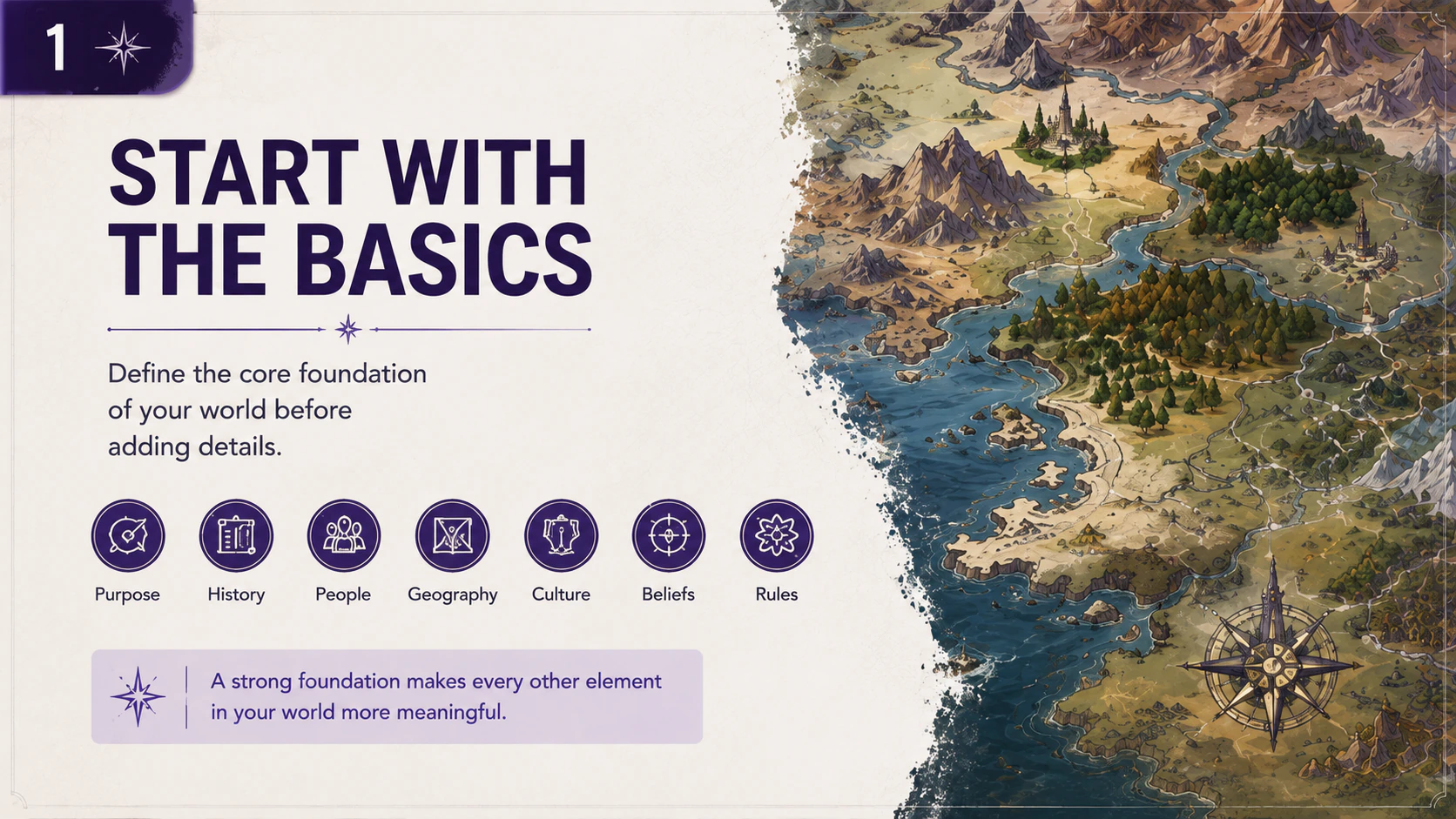
- What is your world called?
- Roughly how many people live in it?
- Can you describe it in one sentence?
- Is it Earth, an alternate Earth, or somewhere else entirely?
That last question matters more than it looks. It sets expectations for everything else. A world that is “Earth, but 200 years from now” plays by different rules than one that is an entirely separate planet with its own physics.
Write your one-sentence description first, actually. If you cannot summarize your world in a sentence yet, that is not a failure. It just means Part 1 is not done.
Part 2: Build the geography
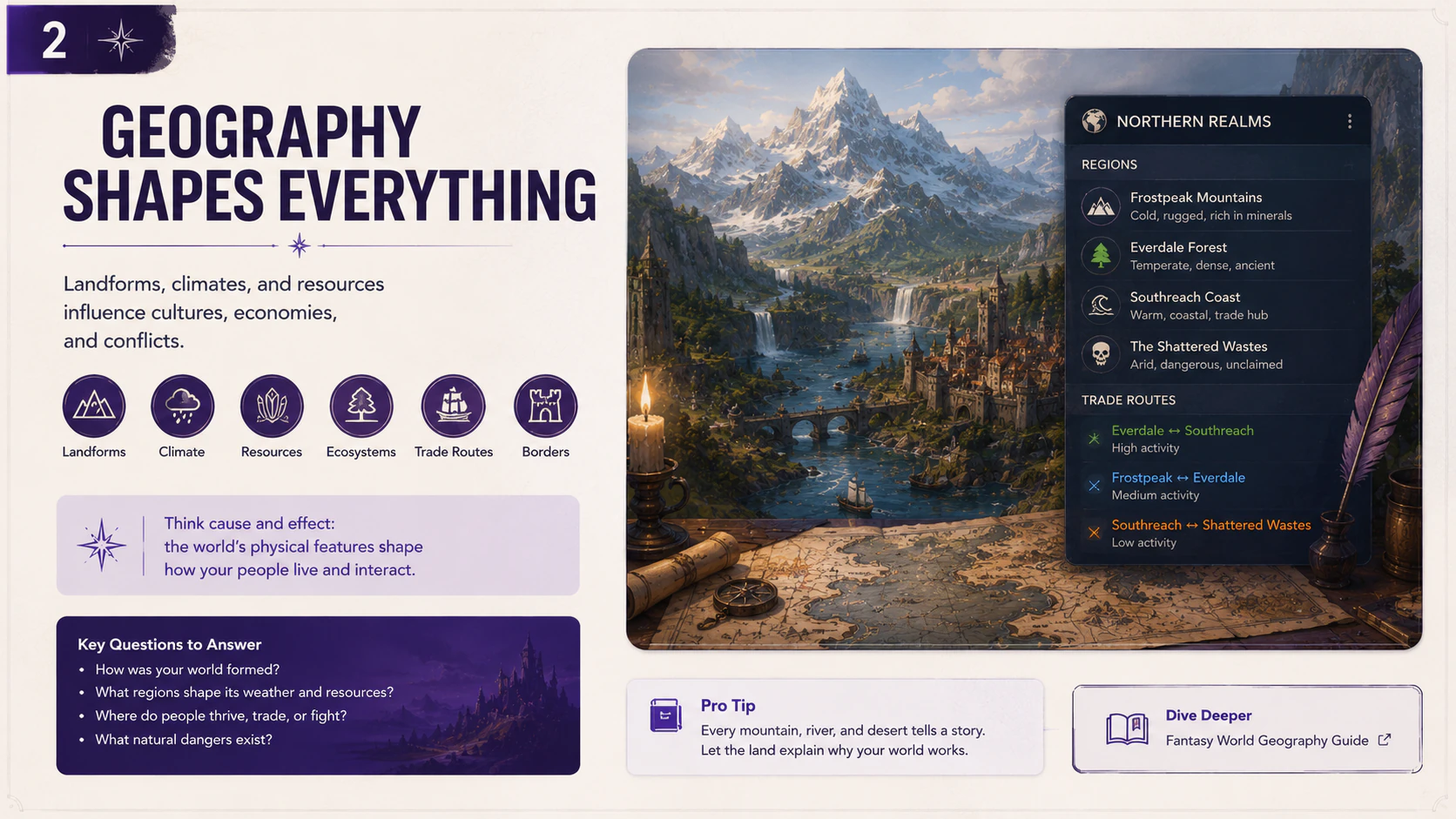
Geography shapes cultures, economies, trade, and conflict. Every physical feature should create a cause and an effect somewhere else in your setting.
The natural world
This is where your world's physical rules live: how it was made, how old it is, and whether the laws of physics even match ours. If you want to go deeper on the terrain itself, Fantasy World Geography: How Mountains, Rivers, and Kingdoms Shape Your World walks through how physical layout drives everything else in a setting.
Questions worth answering early:
- How did the world come to exist, and how long ago?
- How do plants and animals differ from region to region?
- Do any plants or creatures have properties that are not natural, and are any of them dangerous?
- Do mythical creatures exist? If so, how do they fit into the actual ecosystem instead of just showing up when convenient?
How to Create Fantasy Creatures That Fit Your World breaks down how to make that last decision hold up.
Diseases are an easy one to skip and an easy one to regret skipping. What has evolved naturally in your world, how does it spread, and has it shaped where people chose to settle or avoid?
Locations of significance
Every world needs a short list of places that matter: your capital city, your major ports, and the cities everyone has heard of even if they have never been there.
- What is the capital, and why is it the capital? Politics, geography, and history all give different answers.
- Is the world split in some meaningful way: rural versus urban, north versus south, or coastal versus inland?
- How does each city represent itself? A flag, a crest, or a signature color people associate with home?
If you want your capital to feel like more than a dot on the map, Fantasy City Design: How to Build Cities That Feel Alive in Your World is a good next stop.
Weather and climate
Weather shapes behavior more than most drafts account for.
Consider what drives weather and ocean patterns in your world. Are certain regions more exposed to storms, droughts, or floods than others? How many seasons exist, and do they match anything we would recognize?
A city that floods every spring should not look, function, or think like one built in a permanent desert. Worldbuilding Winter: How to Use Seasons, Weather, and Climate in Your Story goes further into how weather patterns can shape an entire narrative, not just a backdrop.
Part 3: People who live in your world
Races and species
Who actually lives in your world, and how did they get there? Elves, dwarves, or something you made up entirely—it does not matter, as long as you know how each group perceives the others and how they have learned, or failed, to coexist.
A world becomes believable when its inhabitants feel shaped by the place around them.
Physical build matters here too. What do people generally look like, and what does your world consider beautiful? That standard rarely looks the same from one region to the next, and the gap between regions can tell you a lot about a culture without a single line of exposition.
The important part is not simply listing the groups. It is understanding how they relate to one another.
Languages
Language carries history, class, identity, and power in your world building.
How many languages exist, and did any of them start from a shared root? Is there a universal trade language, or does everyone just muddle through?
Small details do a lot of work here:
- Common sayings, insults, or idioms that do not translate cleanly
- Accents that hint at where someone grew up, what class they belong to, or how educated they are
- Formal versus informal greetings, and who gets which one
You do not need to invent an entire functioning language—we are not all J.R.R. Tolkien, after all. A handful of consistent habits is often enough to make one feel real. If naming is where you tend to get stuck, Fantasy Names That Tell a Story: How to Use Naming to Build Cultures is built exactly for that problem.
Social frameworks
This is the underlying structure holding your society together—or occasionally not holding it together.
- Is there a class or caste system, and how visible is it? Can you tell someone's rank just by looking at them?
- What is the standard family structure, and is it patriarchal, matriarchal, or something else?
- How is marriage defined: civil, religious, arranged, or optional?
Class systems rarely stay static for long. If yours is starting to crack under its own pressure, How to Create Fantasy Factions and Power Struggles covers how those tensions actually take shape.
Part 4: Develop civilization and culture
History
History gives your world weight. What is the earliest recorded event? What wars actually changed something? Can your timeline be split into distinct eras the way we split ours into Georgian or Victorian?
You do not need a full 500-year timeline. Three or four events that people still argue about will do more work than a wall of dates nobody remembers.
Consider:
- What is the earliest recorded event?
- Which wars changed borders or governments?
- Have any civilizations disappeared?
- Can history be divided into distinct eras?
- Who records history?
- Which events are taught differently in different regions?
- What historical event still influences the present conflict?
The version written in a royal archive may look very different from the version remembered in a conquered village.
Culture
Culture is where worlds start to feel specific instead of generic. What is the local cuisine, and how does it shift with climate? Is there a real gap between what the wealthy eat and what everyone else eats? What is considered fashionable, and how does clothing signal status or profession?
Art matters too. Who are the celebrated artists in your world's history, and is any art form considered taboo?
Religion
How do people worship, and where? Who are the major gods, and what job do they actually do in daily life, not just in myth? Are there holy texts, and would an average person be able to recite any of them from memory?
Education and leisure
Formal education is not universal in most fantasy settings, so decide who gets access to it. If magic exists, is it taught in schools or passed down some other way? And when people are not working, what do they actually do for fun—sports, festivals, or something stranger?
Part 5: Technology, magic, and weapons
Magic systems
Magic needs rules, or it stops being interesting and starts being a way to solve any problem instantly.
- Who can use magic, and what does it cost them?
- Where does it come from, and is there a language or ritual required to call it?
- Is it regulated by anyone, or is it a free-for-all?
- How does society actually view magicians: trusted advisors, feared outsiders, or something in between?
Technology
How advanced is the technology in your world, and how does it interact with magic: rivalry, cooperation, or total separation? This single decision shapes transportation, medicine, and communication all at once.
Weaponry
What weapons dominate, and why those specifically? Are there signature weapons—the one-of-a-kind, Excalibur-style items? If so, how many exist, and who is allowed to wield them?
Part 6: Design the economy
Even the most mystical kingdom still needs food, labor, resources, and some way to pay for inconveniently expensive armor.
Economics and trade
What economic system runs your world: a market economy, feudalism, or something else? Is trade handled by independent merchants, formal guilds, or auction houses?
- What is the currency, and is it universal or regional?
- What are the major imports and exports, and has that changed over the world's history?
- What natural resources exist in each region, and how do they shape who trades with whom?
For a fuller pass at this whole system, How to Design a Fantasy Economy: Trade, Currency, Resources is worth reading alongside this section.
Transportation and business
Transportation controls how quickly news, armies, disease, trade, and rumors spread. That makes it a surprisingly powerful piece of worldbuilding.
How easy is it to get around, inside a city and between cities? What professions are considered elite, and how do people actually move up in their trade—apprenticeships, inheritance, or sheer luck?
Part 7: Politics and laws
Politics determines who has power, who wants it, and what everyone else has to do about it. How to Build Political Systems in Fantasy Worlds That Actually Drive Your Story is a good companion piece if this section is where your world keeps stalling.
Government
What form of government exists in your fantasy world: monarchy, republic, theocracy, or something stranger? How far does its authority actually reach—into religion, into magic, and into daily life?
Law
How is law enforced, and what happens when it is broken? Does magic sit above the law, below it, or somewhere murkier? And if war breaks out, is there a formal process for declaring it, or does it just happen?
Turning your worldbuilding template into an actual world
A fantasy world building template can become a lot to hold in your head at once. That is exactly why it helps to keep everything somewhere structured instead of scattered across notes, apps, Google Docs, and one notebook you last saw sometime in February.
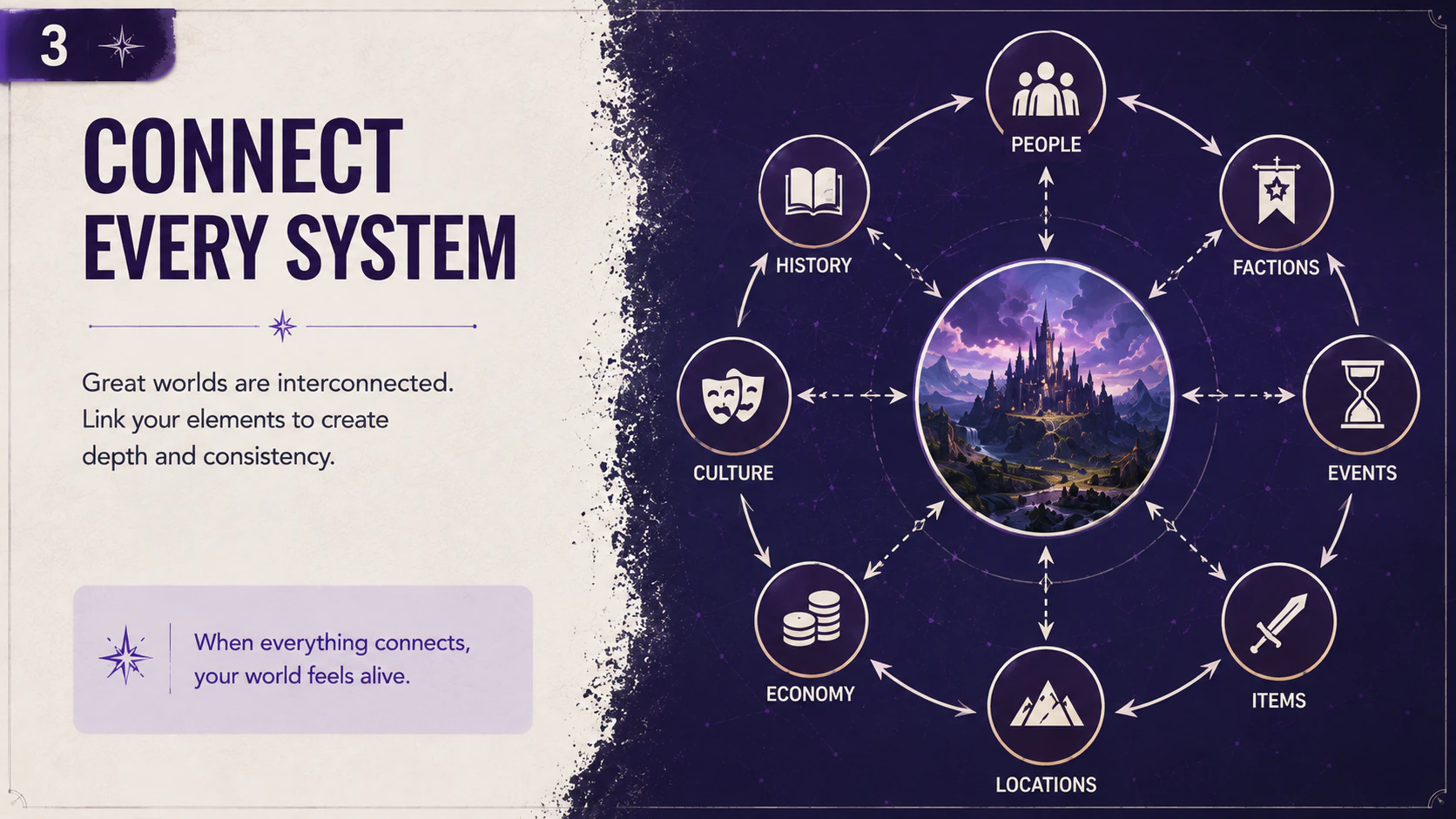
In Summon Worlds, the different parts of this template can become connected pieces of the same setting.
The connected worldbuilding software walkthrough follows that transition through one World, one Location, and one Character. Try the small project before moving a larger story bible or campaign reference into the app.
Your geography and important places can live as Locations inside your World. Your cultures, species, social systems, and magic can take shape through the Characters who experience them. Collections can help you organize related pieces, such as:
- Factions
- Religions
- Currencies
- Creatures
- Historical eras
- Magical traditions
- Weapons and artifacts
That way, a new Character does not exist in isolation. They can be connected to the city they grew up in, the faction they serve, the religion they follow, and the conflict they are about to make considerably worse.
You still do not need to complete all seven parts first.
Most worlds reveal themselves in the opposite order: you write one scene, realize someone needs to pay for dinner, invent a currency, and then discover that the currency has accidentally started a trade war.
The template is there to help you notice what needs an answer next.
Try this: Fill in one part tonight
Pick whichever part of the template is nagging at you most and answer just its top-level questions for one region of your world.
- If it is geography: Name your capital and explain, in two sentences, why it became the capital instead of somewhere else.
- If it is people: Pick two groups who share your world and describe how they greet each other differently depending on how well they know one another.
- If it is magic: Write down one real cost to using magic in your world—something a Character would think twice about before casting.
- If it is politics: Decide who currently holds power and who resents them for it.
One part, one region, tonight. The rest of the template fills in faster once you have a real foothold somewhere.
Frequently Asked Questions
What should a worldbuilding template include?
Typically, a worldbuilding template should include the setting's basic concept, geography, people, civilization, technology or magic, economy, and politics. These seven areas explain how the world functions physically, culturally, socially, and politically.
How do I start worldbuilding?
The fact that you are here means you have already started! You only need to begin with one clear idea and one manageable location. Define the world in a sentence, choose a city or region where the story begins, and answer only the questions that affect the Characters currently living there.
Is a worldbuilding template the same as a worldbuilding checklist?
Not exactly. A worldbuilding checklist is usually a quick way to identify missing details. A worldbuilding template provides a fuller structure that you can complete, reuse, connect, and expand as the setting develops.
Do I need to complete every part before I start writing?
Not at all. Most writers and game masters develop their worlds while writing stories, planning campaigns, or creating Characters. The template helps you identify gaps, but it does not need to be completed before the creative work begins.
What is the difference between a worldbuilding template and a worksheet?
A worldbuilding worksheet is usually a static set of questions completed once. A template is designed to grow with the world and can be updated as new Locations, Characters, factions, conflicts, and systems are created.
Build a world that stays connected
A good worldbuilding template does not remove spontaneity. It gives your spontaneous ideas somewhere to belong.
Start with the part you need today. Connect it to what you have already created. Then let the world grow one Location, Character, rule, and questionable political decision at a time.
When you are ready, put the seven parts into practice with our interactive worldbuilding template and checklist.