There is a quiet assumption baked into roleplaying: that you need a group.
A table. A schedule. Four friends who can all make Thursday work. And someone willing to run the whole thing.
If you have ever tried to organize that, you know the truth. The hardest boss fight in tabletop gaming is getting four adults to agree on Thursday.
A solo RPG skips all of it. You play a Character, make decisions, face consequences, and build a story alone, whenever you want, for as long as you want.
No scheduling. No waiting for your turn. No worrying that your dramatic Character moment is boring everyone else at the table.
If you have never done it before, here is how to actually start.
What is a solo RPG?
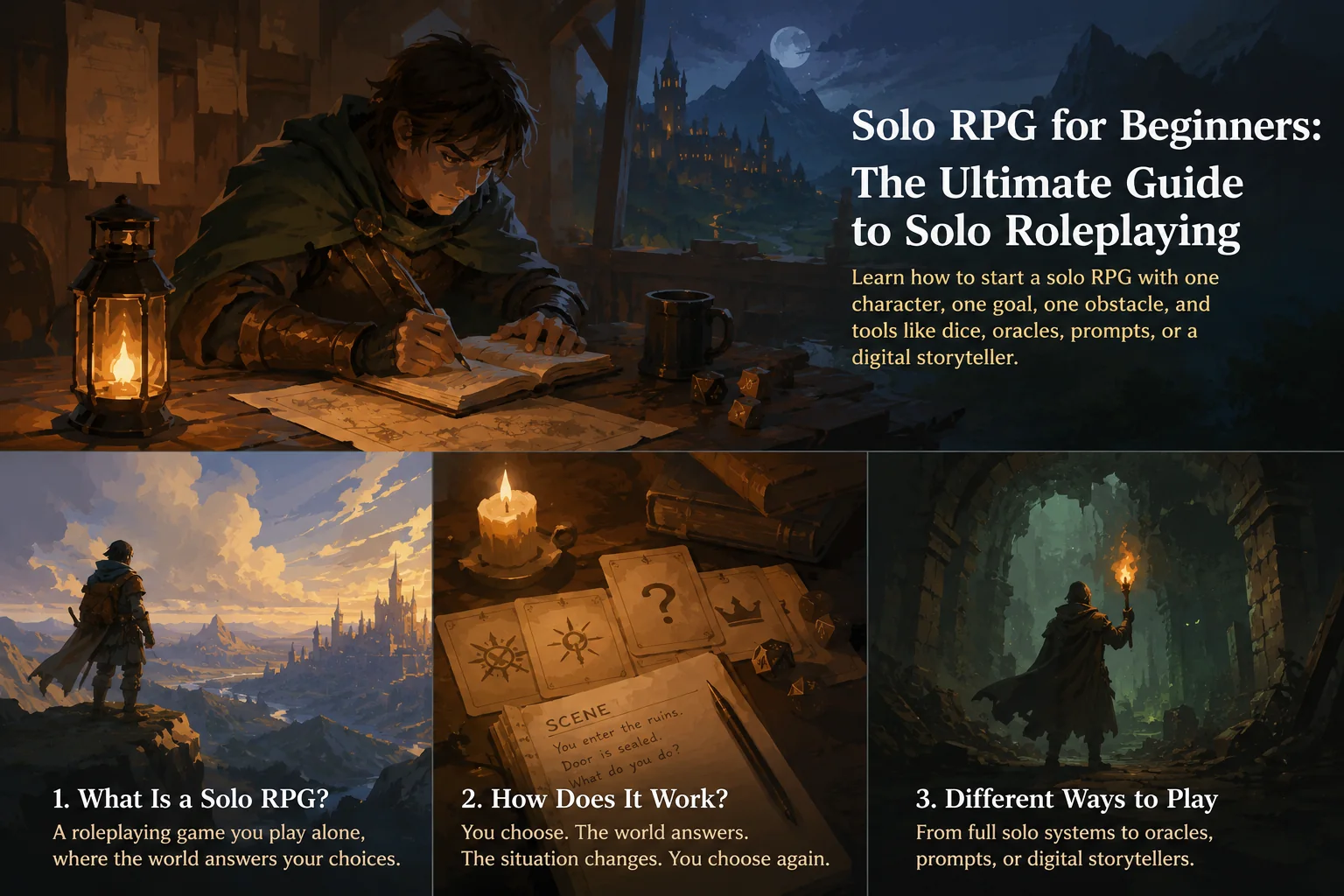
A solo RPG is a roleplaying game you play without a regular group or human game master. You decide what your Character attempts, then use rules, dice, cards, prompts, oracle tables, or a digital storyteller to find out how the World responds.
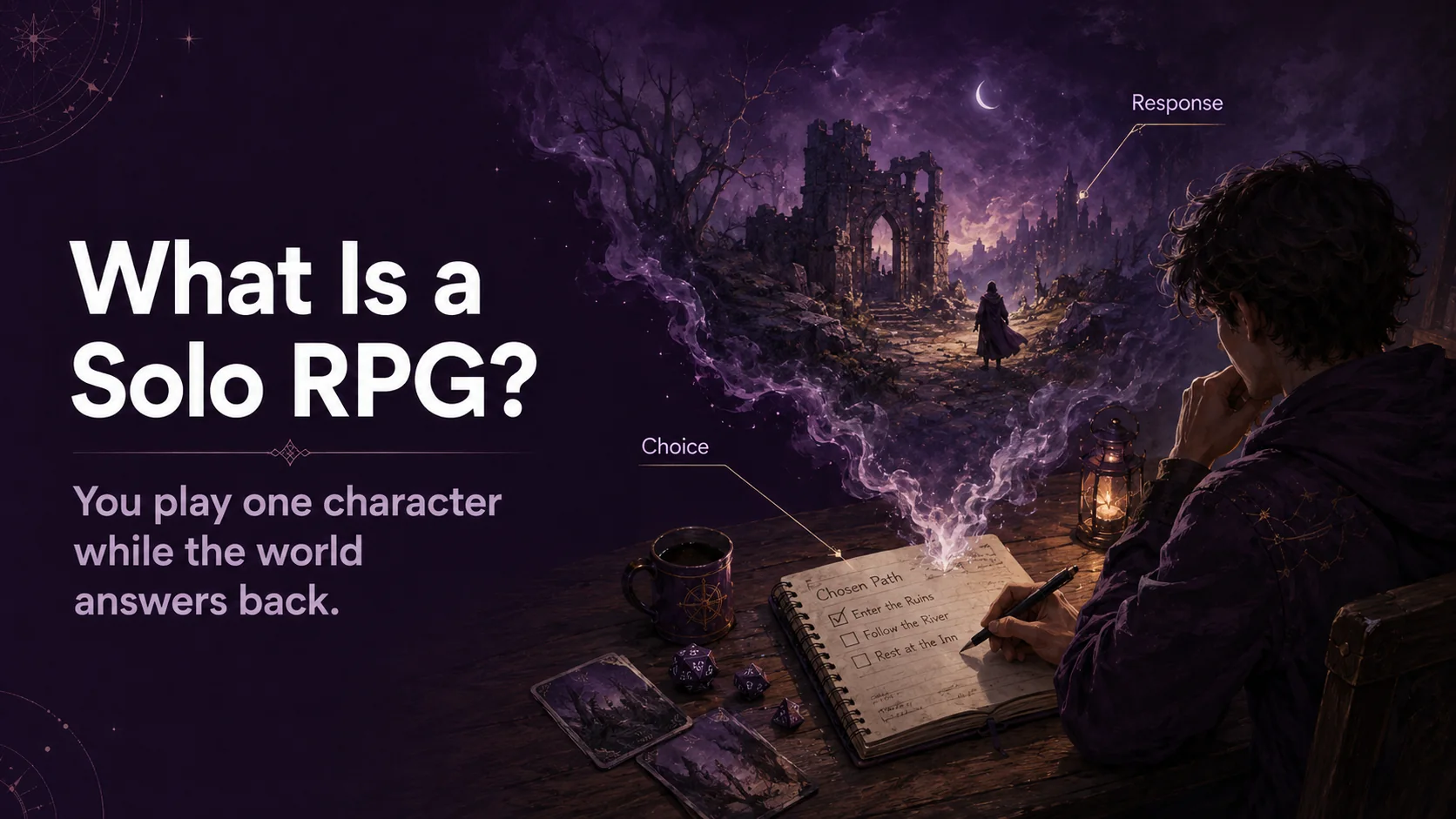
An oracle is simply a rule or table that answers a question you would normally ask a game master:
- Is the door guarded?
- Does the captain believe me?
- What complication arrives?
You are not deciding the whole story from above. You are inside it, making your Character's decisions and discovering the consequences.
That gap between what you choose and what comes back is where the fun lives. Our comparison of AI roleplay and traditional roleplay explains how that responsive exchange differs from writing a fixed story.
How does solo roleplaying work?
Solo roleplaying works through a simple loop:
You choose → The World answers → The situation changes → You choose again
You control your Character's intentions and decisions. A game system, oracle, deck of cards, set of prompts, or digital storyteller controls the uncertainty.
That separation matters.
You might decide that your Character tries to sneak through the city gates. You do not automatically decide whether they succeed. The rules or storyteller answer that part, giving you something new to react to.
That is what turns the experience from simply writing a story into playing one.
Solo RPGs are older than they look
Solo roleplaying is not a recent workaround invented because nobody could make Thursday work.
Buffalo Castle, a 32-page Tunnels & Trolls solo adventure published by Flying Buffalo in 1976, shows how far back the format reaches.
Solo RPGs have had fifty years to get weird.
And they have.
Different ways to play a solo RPG
There is no single correct way to play alone. You can use a complete game, add an oracle to a system you already know, or keep the rules small enough to fit on a few pages.
For a complete solo TTRPG system: Ironsworn offers a free digital edition designed for solo, co-op, and guided play.
For an oracle you can add to another RPG: Mythic Game Master Emulator uses yes-or-no questions, random events, scene structure, and meaning tables to generate unexpected details.
For something tiny: Alone Among the Stars needs only a six-sided die and a standard 52-card deck, and its listed average session lasts just a few minutes.
For Character-heavy journaling: Thousand Year Old Vampire uses prompts and resource tracking to follow one Character across centuries.
Different tools. Same engine.
You choose. The World answers. The story surprises you.
Why do people play solo RPGs?
Many people come to solo TTRPGs for a practical reason: no group, no time, or a campaign that quietly died when someone moved.
Fair enough.
But here is what keeps people playing solo even after they find a table again.
Alone, you can:
- Play a Character too strange, too quiet, or too unheroic for the current party
- Stay in one scene for an hour without anybody waiting on you
- Explore the parts of a story a group might rush past
- Fail interestingly without feeling like you let the team down
- Play at 1 a.m. in twenty-minute bursts because nobody else's schedule exists
Solo play can also become some of the best Character work you do. With no audience, you may stop performing your Character and start inhabiting them. If you want more help shaping that person first, the AI Character Creation guide covers backstories, traits, and common pitfalls.
There is nobody to impress.
There is only the next decision.
What do you need to start a solo RPG?
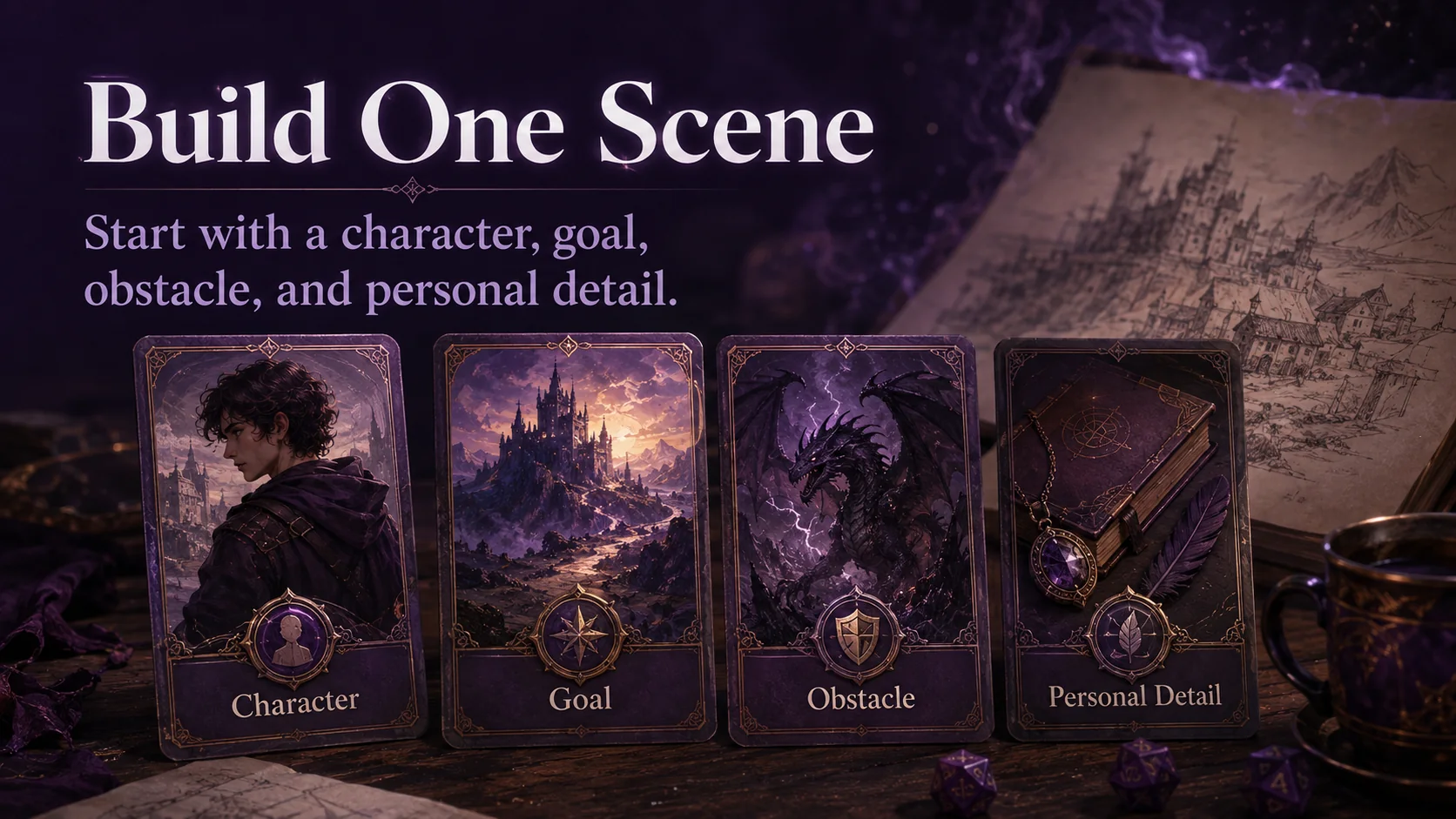
To start a solo RPG, choose one Character, one concrete goal, one obstacle, and one World detail that makes the problem personal. Then begin in the middle of a scene and let the World answer the Character's first decision.
Beginners often stall in the same place: they try to prepare an entire campaign before playing a single scene.
Skip that.
A reliable first solo session needs four things.
1. One Character you understand
Not your most elaborate creation.
The one you get.
You should be able to answer two questions without checking your notes:
- What does this person want?
- What are they afraid of?
That is enough.
Stats, a complete backstory, and a finished portrait are all optional for the first session.
2. One goal
Give them something concrete to want tonight.
Find the missing apprentice. Get out of the city before the gates close. Convince the captain to look the other way.
"Explore the World" is not a goal.
It is a mood.
Goals have finish lines.
3. One obstacle
Put something—or someone—between your Character and the goal.
A rival. A locked door. A debt. A lie that is about to surface.
The obstacle is what turns writing about a Character into playing one. Now there is friction.
And friction forces decisions.
4. One World detail that makes it personal
This is the ingredient many beginners skip, and it is the one that gives the scene weight.
Pick one detail from the World that turns the situation from generic to theirs.
The missing apprentice is not just missing. She is the daughter of the woman who once saved your Character's life.
The locked door does not lead to any archive. It leads to the archive your Character was banished from.
Now the scene matters before anything has even happened.
One Character. One goal. One obstacle. One personal detail.
That is enough for a complete session.
Everything else can show up when the story asks for it. If you want a little more foundation first, Your Complete Worldbuilding Template covers what is worth deciding early.
How to start your first solo RPG session
Your first solo RPG session only needs a scene, a decision, and a way for the World to answer. Start while something is already happening, decide what your Character attempts, resolve the uncertainty, and react to the result.
1. Open on a scene already in motion
Do not start with your Character waking up.
Start with the gates closing in an hour. Start with the rival walking into the tavern. Start with somebody pounding on the door.
Enter the scene late.
Something is already happening, and your Character has to respond.
2. Decide what your Character attempts
Say it aloud, write it down, or type it.
Be specific.
I follow her, keeping close to the market stalls.
That gives the World more to answer than:
I investigate.
Specific actions create specific consequences.
3. Let the World answer honestly
Use the rules, cards, oracle, or storyteller to determine what happens next.
If you do not have a system yet, use one six-sided die:
| Roll | Answer |
|---|---|
| 1 | No, and something gets worse. |
| 2–3 | No. |
| 4–5 | Yes. |
| 6 | Yes, and you gain an advantage. |
That gives you an even split between yes and no, with a one-in-three chance that the result changes the situation more dramatically.
Use it only when the answer is genuinely uncertain.
A result ends a beat.
A complication starts the next one.
4. React as the Character, not as the all-knowing author
You know the guard accepts bribes.
Does your Character?
You know the stranger is lying.
Would your Character notice?
The distance between what you know and what your Character knows is one of roleplaying's central skills.
Stay inside that distance.
5. Stop while something is unresolved
You do not need to finish the entire problem in one sitting.
Stop when the guard recognizes the stolen seal. Stop when the door opens from the other side. Stop when your missing apprentice finally answers—and calls you by the wrong name.
Ending mid-tension makes the next session start itself.
Solo RPG beginner traps worth knowing about
Most beginner problems come from removing uncertainty, preparing too much, or expecting the first session to feel completely natural. The solution is usually to make smaller decisions and let the game push back.
Deciding outcomes instead of attempts
If every outcome is already decided, nothing can push back.
Do not decide:
I defeat the guard.
Decide:
I try to knock the sword from the guard's hand.
You control the attempt.
Let the World decide what the attempt costs.
Over-preparing
The encyclopedia can wait.
Worlds built through play often become stranger—and more useful—because every new detail arrives under pressure. You invent the law when someone breaks it. You define the city gate when your Character needs to escape through it.
Making your Character too capable
A Character who solves everything effortlessly has fewer meaningful decisions to make.
Limits generate scenes.
Effortless competence closes them.
Give the Character something they misunderstand, something they cannot do, or something they refuse to sacrifice.
Quitting because it feels awkward
The first session may feel a little silly.
You are talking to yourself, writing imaginary decisions, and asking a table whether a fictional guard believes a fictional lie.
That is, technically, what is happening.
The awkwardness usually fades after the first decision surprises you.
How Adventure Mode fits into solo roleplaying
The classic challenge of solo roleplaying is that you are both the player and the World.
You have to surprise yourself, which is genuinely difficult. You know where the guard is posted because you posted him.
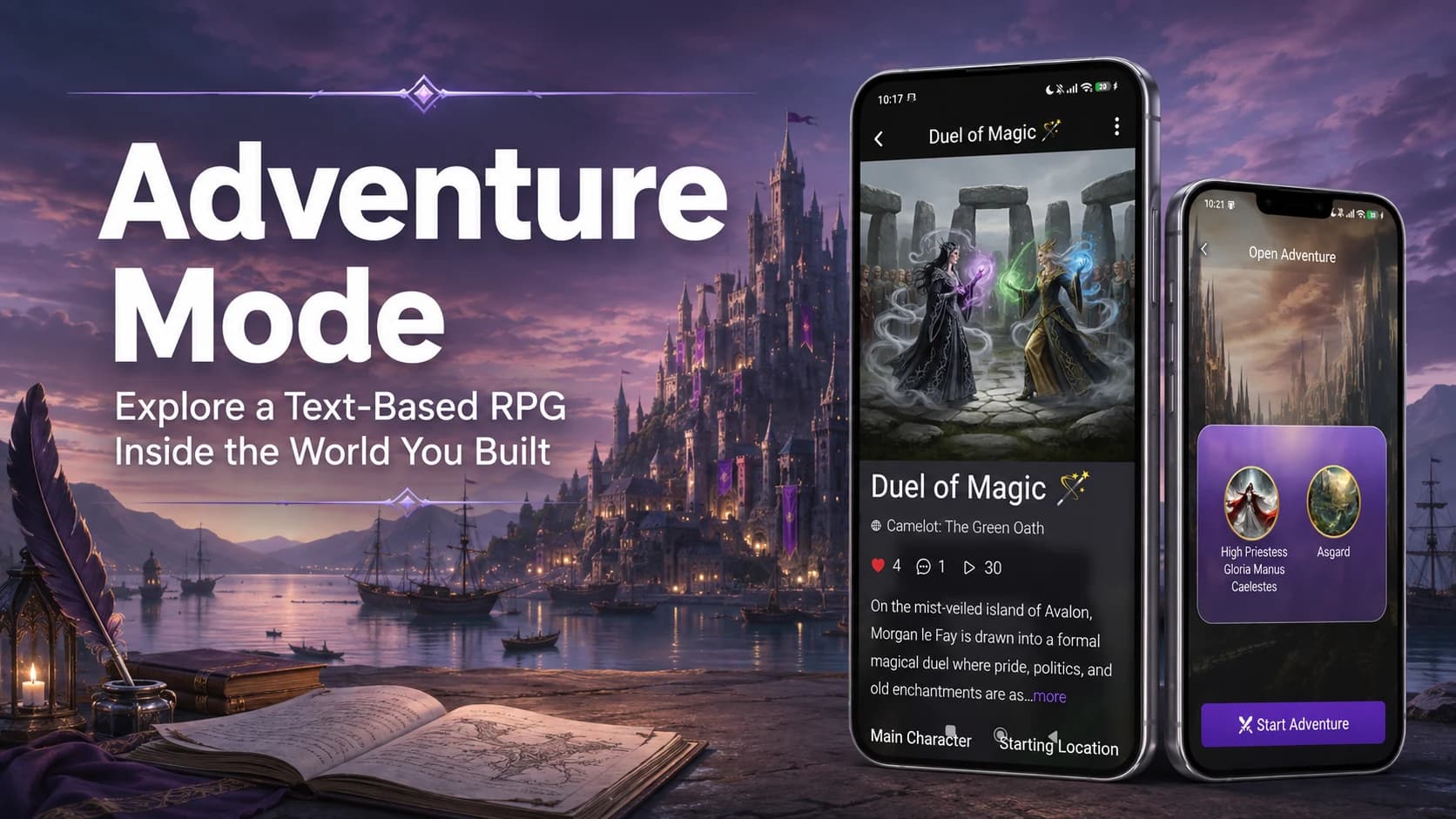
That is one problem Adventure Mode in Summon Worlds was built to solve.
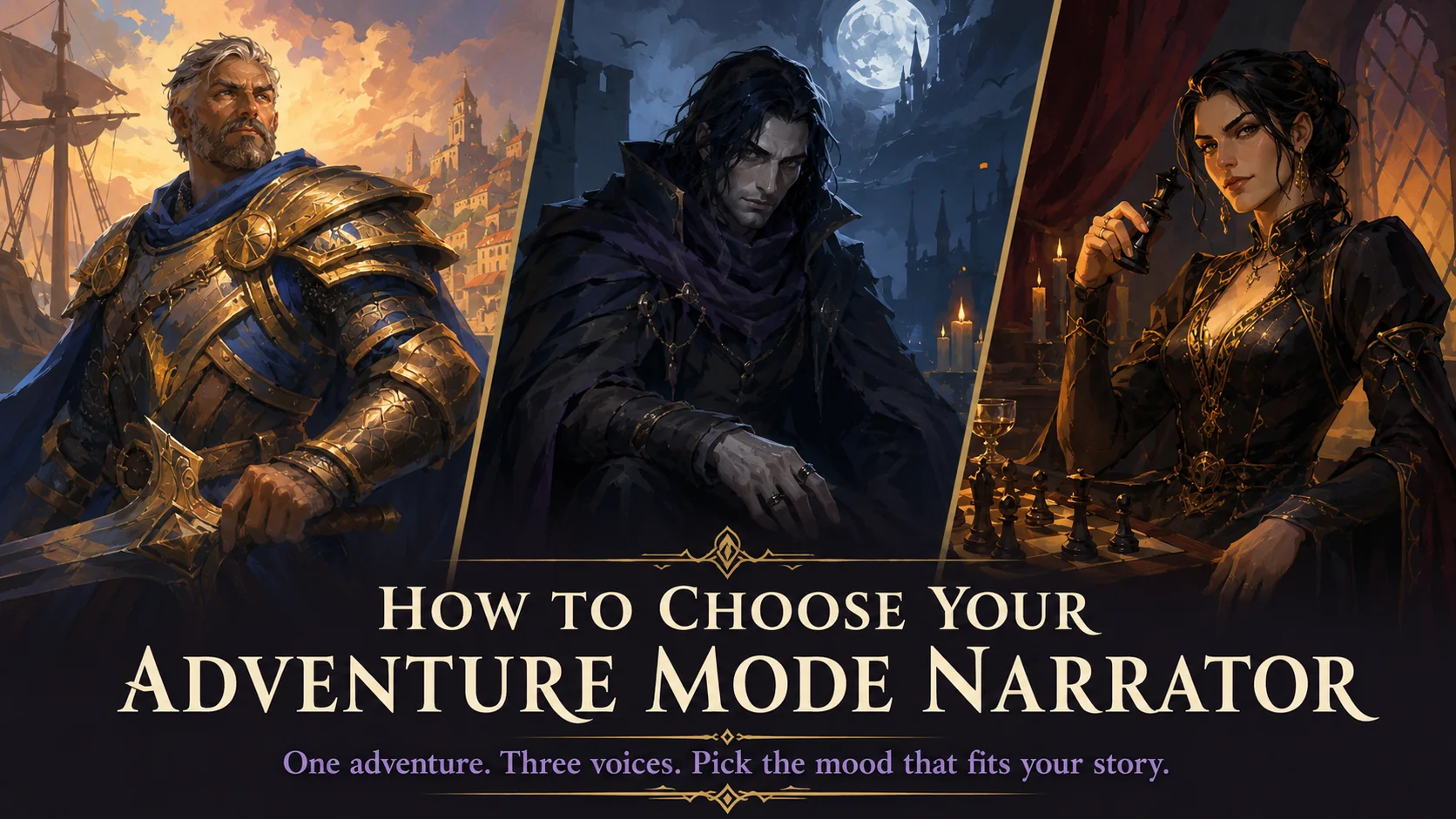
You bring in a World you created, select a Character, and choose an Adventure Mode Narrator. The Adventure can draw from the Characters, Locations, relationships, and lore already connected to that World while you make decisions turn by turn.
You stay on your Character's side of the table.
The Storyteller handles the World's.
Adventure Mode is a text-driven, turn-by-turn experience, with scene art supporting the story rather than replacing it. That makes it a natural fit for the same loop:
Scene → Decision → Response → Complication
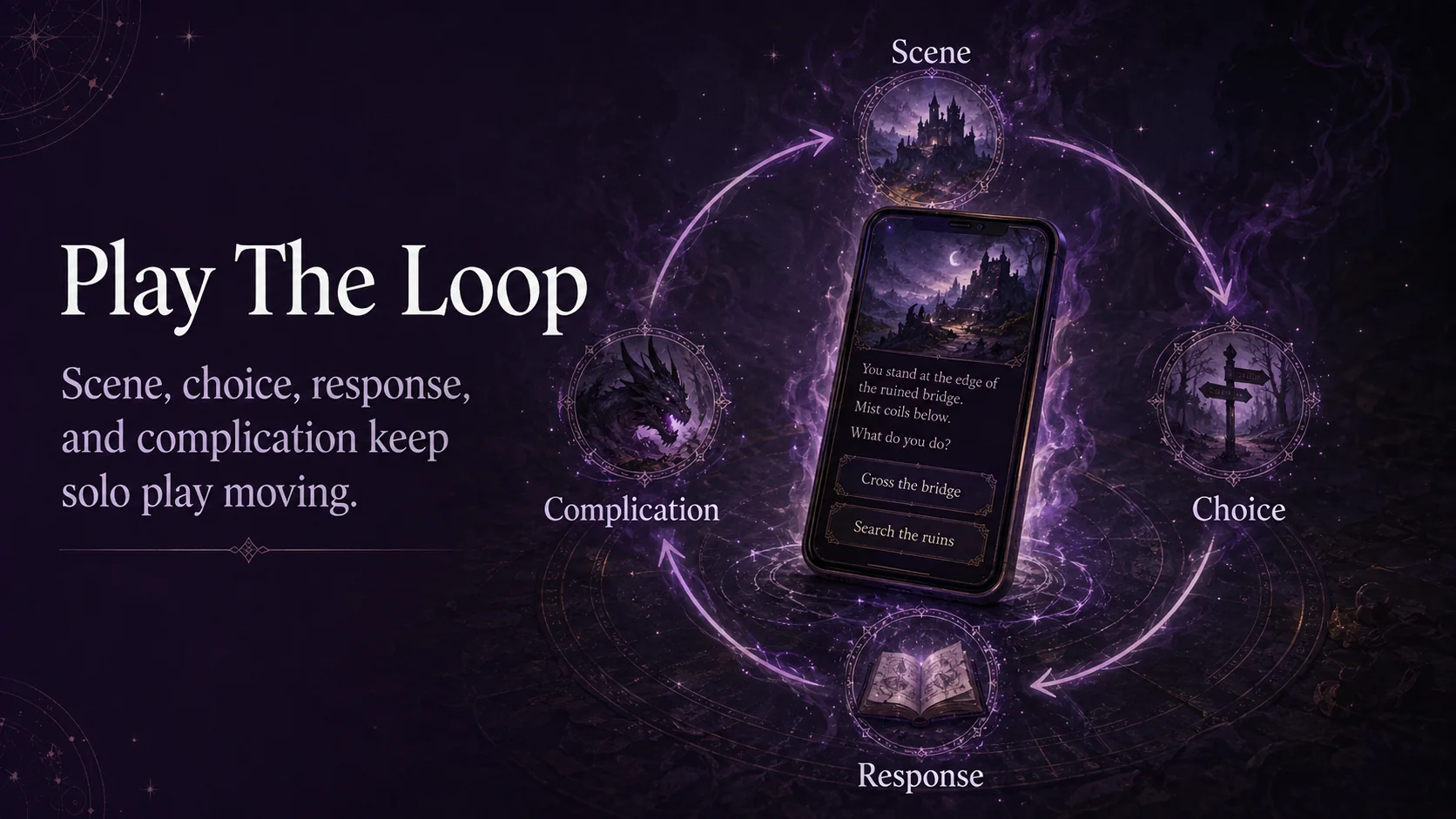
The Adventure Mode guide walks through the product workflow in more detail, while Fantasy City Design can help your starting Location carry more of the story's weight.
This framing matches the current product direction: choose a World, Character, and Storyteller, then let connected World and Character context shape a solo Adventure.
Try this solo RPG exercise tonight
Fill in these four blanks, then play one scene:
My Character is ______, and what they want tonight is ______. Standing in their way is ______. This matters to them personally because ______.
Open with the obstacle already in the room.
Make one decision.
See what comes back.
That is solo roleplaying.
Everything past that is just more nights like it.
Frequently asked questions
How do I start a solo RPG as a beginner?
To start solo roleplaying, choose one Character you understand, one concrete goal, one obstacle, and one World detail that makes the situation personally meaningful. Begin with a single scene, decide what the Character attempts, and use rules, dice, cards, an oracle, or a digital storyteller to determine what happens next.
Can you roleplay by yourself?
Yes. Solo roleplaying means playing a Character and making meaningful decisions without a regular group. You can use a complete solo RPG, a journaling game, oracle tables, cards, writing prompts, or a text-driven storyteller.
What do you need to play a solo RPG?
You need a Character, an immediate goal, an obstacle, and a way to introduce uncertainty. That uncertainty can come from dice, cards, prompts, game rules, an oracle table, or a digital storyteller.
Do I need a finished World to start solo roleplaying?
No. One Character, one Location, and one immediate problem are enough. You can add new places, rules, Characters, and history as the Adventure reveals what it needs.
What is the hardest part of solo roleplaying?
For many beginners, the hardest part is creating uncertainty while acting as both the player and the World. Dice, cards, oracle tables, game rules, and digital storytellers can take over part of the World's role so you can remain focused on your Character's decisions.